menu
Menu
account_box
Categories
Contact
email Send us a message

Contact us

phone By phone

+33 (0)1 42 25 12 79
Tue.-Sat., from 10am to 6pm
+33 (0)6 60 62 61 90
Everyday from 9am to 7pm.

email by Email

Adress: contact@marcmaison.com

share Let's get social

Languages
And also...
My selection
(7 Objects)
My selection (7 Objects)

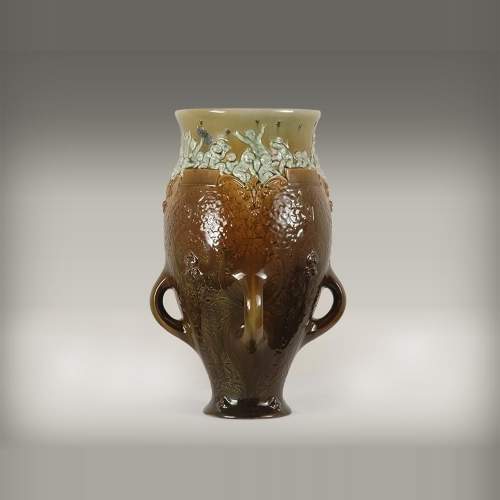
Louis-Robert CARRIER-BELLEUSE (1848 - 1913) and POTTERY FROM CHOISY LE ROI (1863 -1938),  "Children and Butterflies"

Ref.15230
Louis-Robert CARRIER-BELLEUSE (1848 - 1913) and POTTERY FROM CHOISY LE ROI (1863 -1938), "Children and Butterflies"

Stoneware model presented at the Exposition of the National Society of Fine-Arts in 1898, under the number 4060, with three other vases: Run for your lives! Hercules and Omphale and Music. Reproduced in Antique and Modern Decoration, 7th year, 1900, drawing 66. Enameled pottery.This vase has a slender form that contrasts the four handles. The body is completely decorated with floral or purely decorative elements while the characters are restricted to the neck level. A frieze of cherubs chasing butterflies develops along the neck, in a round frenzy. A brown tint covers the entire piece but fades in the upper part, thus becoming more yellow. This vase displays a decor that combines different techniques. The body of the vase is decorated with a floral decor which mixes elements in relief and engraved elements. The frieze of children is produced in clay on clay. This process, perfected at the Factory of Sevres around 1848 was frequently used by sculptors, which Louis Carrier-Belleuse was. It consists of applying generally white motifs on a colored background. However, the totality of the piece has been enameled which contributes to giving light green reflections to the bodies of the children. This original vase mixes two inspirations: the frieze of cherubs resembles the production of the Second Empire while the body of the vase displays plant elements indicating Art Nouveau.In the Exposition of the National Society of Fine-Arts in 1898, this vase appeared for the first time in stoneware, accompanied by three other vases: Hercules and Omphale, Run for your lives! and Music. These four vases are presented under the same number (no. 4060) and in the same display window. Three of the four vases, including Children and Butterflies, were reproduced, in 1900, in the review of Antique and Modern Decoration. Children and Butterflies was acquired in 2003 by Musee du Petit Palais, in Paris, and it is one of the rare examples of a vase by this artist conserved in a public French collection. The same year,  he exhibited a fifth vase under the number 4059, entitled Farming. The vase that we present, produced in stoneware, is not the one presented at the Exposition in 1898. However, its reproduction, by the pottery in Choisy-Le-Roi proves the popularity of this model and its creator.

Dimensions:
Width: 28 cm
Height: 45 cm

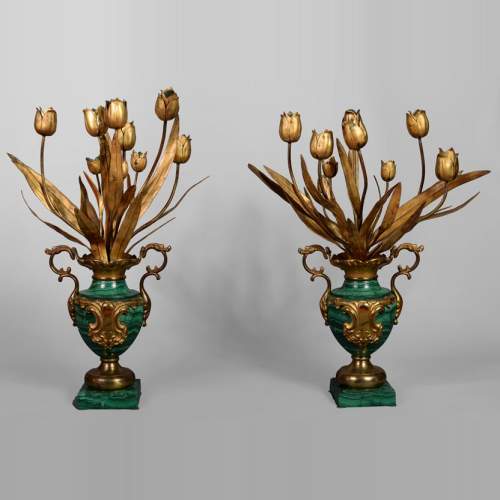
Pair of vases in malachite and gilt bronze, Russia, late 19th century

Ref.13299
Pair of vases in malachite and gilt bronze, Russia, late 19th century

This beautiful pair of vases was made of gilt bronze and malachite. It's very likely a Russian work from the end of the 19th century. The belly of our vases was made of malachite and welcomes a Rococo style decoration of gilt bronze. The whole decoration was made of gilt bronze, like the handles which are also reminding of the Louis XV style as they are shaped of thin acanthus leaves scrolls, or even the neck where are attached the handles and the foot. Finally, from the neck a beautiful gilt bronze tulips bouquet springs while the vase rests on a small malachite square base. The malachite, is an intense green stone because of its high copper composition, which makes it very appreciated in the 19th century. This stone mainly comes from Russia where important deposit are known since the 17th century, we can name the one called Nijni Taguil, discovered in 1835 and exploited by the Count Demidoff (1812 - 1870). Used in bloc to create small objects, the malachite can't be used for big pieces as the ones we can make in marble. That's why the technic called “Rusian mosaïc” was invented during the second half of the 19th century : malachite strips are inlaid to create the illusion of a block , allowing to put this extraordinary color on walls, columns or other interior elements like in the Malachite Room in the Winter Palace in Saint Petersburg. It's the Royal stone manufactory of Peterhof and Ekaterinbourg that develop this art which quickly seduces the aristocracy. This technic is discovered in France when Alexander I of Russia (1777 - 1825) gifted Napoléon Ier (1769 – 1821) a set of malachite element in 1808. Candelabras, big vases and basins are placed in the Emperor Room in Trianon, which became the “Malachite Room”. The new beauty of this sophisticated art creates an important enthusiasm which lasts during the entire 19th century.

Dimensions:
Width: 38 cm
Height: 61 cm
Depth: 23 cm

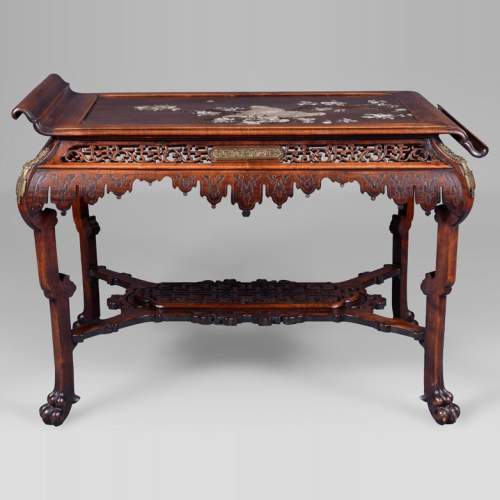
Gabriel Viardot (attributed to), Japanese table with bones birds marquetery, circa 1870-1880

Ref.11427
Gabriel Viardot (attributed to), Japanese table with bones birds marquetery, circa 1870-1880

This japanese table, made of tainted sycamore in the last decades of the 19th century, is attributed to the Parisian furniture maker Gabriel Viardot (1830-1906), specialized in the creation of Chinese and Japanese inspired furntiure. It's during the 1867 World Fair where he discovered the Japanese Art, the Gabriel Viardot decided to devote himself to “Chinese-Japanese style furniture”. It’s with this production that he was awarded a silver medal at the World's Fair of 1878. His furniture was produced thanks to lacquered and carved panels sent directly from China or Japan and decorated with mother of pearl inlays from Tonkin. He enlivened his furniture with bronze decorations, of which he made all the designs by hand. In 1885, he participated in the World Exhibition of Antwerp where he obtained a gold medal. At this time, the shop employed 90 – 100 workers, sculptors or cabinetmakers, a lot of who were educated directly by Gabriel Viardot. Following this exhibition, Gabriel Viardot was promoted to the rank of Knight in the Legion of Honor (December 29 1885). In 1889, he was at the World Exhibition that took place in Paris and awarded a gold medal. He obtained the same award at the World's Fair of 1900. The furniture maker is making here, a very beautiful table of which the shape and the decors are inspired by the Far East esthetic. The slab with enrolled edges is adorned on its central part with an important inlaid decoration of bones depicting birds on cherry tree branches. It rests on a very worked foot receiving a carved and open work decor as bronze pieces with high quality carving, typical of the furniture maker's work. The feet with sharp claws sculpted in the wood support on their middle an open work strut.

Dimensions:
Width: 72 cm
Height: 76 cm
Depth: 105 cm