menu
Menu
account_box
Categories
Contact
email Send us a message

Contact

phone By phone

+33 (0)1 42 25 12 79
Tue.-Sat., from 10am to 6pm
+33 (0)6 60 62 61 90
Everyday from 9am to 7pm.

email by Email

Adress: contact@marcmaison.com

share Let's get social

Languages
And also...
My selection
(14 Objects)

My selection (14 Objects)


Delphin MASSIER (1836-1907) - Important Orientalist style earthenware planter

Ref.10838
Delphin MASSIER (1836-1907) - Important Orientalist style earthenware planter

This important Orientalist earthenware planter was made around 1880 in the workshops of Delphin Massier, a member of the Massier family which was a dynasty of ceramists established since the 17th century in Vallauris. It consists of a large earthenware vase on a base with four columns adorned with muquarnas and covered with a floral and abstract Oriental ornamentation. The blue tones are both characteristic of the Massier production and of the Orientalism, especially in the field of ceramics. The pottery family tradition began with Pierre Massier (1707-1748) then with Jacques Massier (1806-1871) who gave to the workshop a new lease of life. Indeed, their factory, which was at first a simple workshop with an utilitarian vocation, stood out from the local production tanks to an innovative and artistic production. In Vallauris they introduced an art ceramic, notably thanks to the arrival of the Italian potter Gondolfi Gaetano in 1859, who initiated Delphin and his brother Clément (1844-1917) to numerous practices such as plaster molds and enamelled earthenware decoration techniques. The glory of the Massier family peaked at the turn of the century with Delphin and Clément and their cousin Jerome and son (1830-1916), son of Jerome (1820-1909). Both art ceramists and entrepreneurs, the Massiers had also made themselves known thanks to their elaborate sales catalogs which give us today a way to appreciate the diversity of their productions and to identify their models. The ceramicists family had built its reputation thanks to their ability to innovate (they developed several techniques) and because their productions were inspired by the important trends of the period. The Massiers, who played a certain role in the revival of the decorative arts, are very representative of the characteristic wealth of the 19th century. Thus, if their first realizations were inspired by historicism and eclecticism, Jerome and Delphin will devote themselves later to an Art Nouveau style production. Our planter is inspired by Orientalism, surely one of the greatest artistic movement of the 19th century which inspired the Massier for many creations as we can see in their catalogs where we can also find several similar planters to the one we present. Otherwise, one of the most prestigious realizations of Clément Massier is this planter constitued with a base, almost identical to ours, and a bowl. It is called Large Persian bowl with four columns base, whose one copy is preserved at the Vallauris Museum. Among Orientalism, Moorish Spain is one of the decorators lands of preference which gave them the turquoise blue for example. The Massiers, which developed an important taste for colors, will make green and red, but especially blue, and more precisely peacock blue, like the color of our planter, inspired by the Hispano-Moorish art, their favourite colors. The Massiers collaborated with great artists of their time such as Lévy-Dhurmer, Dominique Zumbo and their talent will be rewarded for example at the Paris World Fair in 1889 where Clement received a gold medal. They acquired an international reputation thanks to competitions and exhibitions in which they participated and had among their clients Victor Hugo or Emile Zola. This beautiful planter, with its exceptional large dimensions, its rich polychrome and its abstract and floral ornamentation, reflects both the taste for the Orient and the production of the Massier family, surely the most known dynasty of ceramists of the 19th century.

Dimensions:
Width: 50 cm
Height: 174 cm
Depth: 50 cm

Charles Hunsinger (attributed to), Beautiful presentation stand with a marquetry decor, circa 1870-1880

Ref.12653
Charles Hunsinger (attributed to), Beautiful presentation stand with a marquetry decor, circa 1870-1880

Even though it is not signed, this beautiful presentation stand is very likely a work made in the 1870's-1880's by the French funriture makers Charles Hunsinger and Charles Wagner because of the caracteristic marquetry decoration. Indeed, we find on our blackened wood stand a remarkable and very interesting decor of precious woods and ivory marquetry, drawing on a checked pattern, horns of plenty and flowers crowns. These elements frame an ivory medallion receiving the profil protraits of sovereigns. Small animals come also to animate the scene, such as a butterfly, a dragonfly or even snails. this stand is a very elegant and luxurious work. Charles Husinger was born in Dossenheim in 1823, it's only around 1859 that he starts to be named in the Almanachs du Commerce as a luxurious furniture maker. He specializes himself in the ebony furniture inlaid with ivory and marquetry furniture making. In 1872, he creates a business with Charles Adolphe Frédéric WAGNER, which lasted for about ten years. During his whole career, he participates to many World Fairs and especially the ones taking place in Paris (1865, 1867, 1878 et 1889), and exhibits also in the Havre. His work was rewarded by a gold medal in Brussels in 1881, a Progress and Merit medal in Vianna and another medal in London. The inventory after his death, in 1893, shows that he continued to work during the last years of his life, dropping furniture at some sellers shops, even though he had to legally close down his business in 1890, because of a long list of creditos among which we can name his old partner, Wagner. RELATED WORK : HUNSINGER, WAGNER Paris, Cabinet made of sculpted and blackened lime wood, marquetry of diverse variety of woods and engraved bones, 1879, Conserved at the Musée d’Orsay in Paris.

Dimensions:
Width: 57 cm
Height: 109 cm
Depth: 57 cm

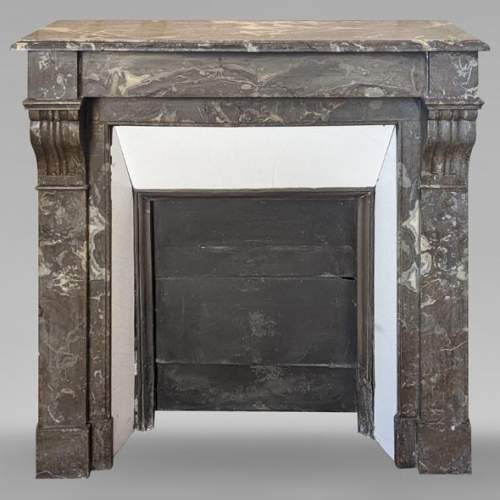
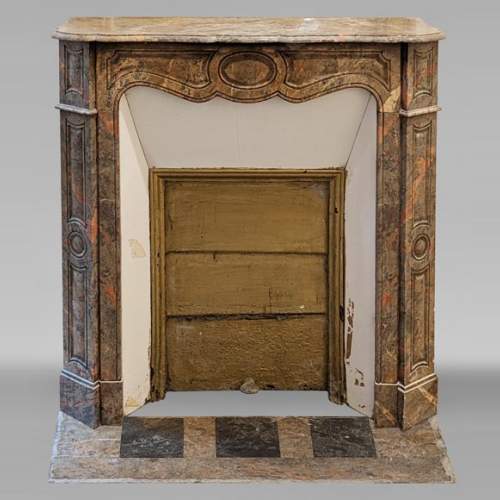
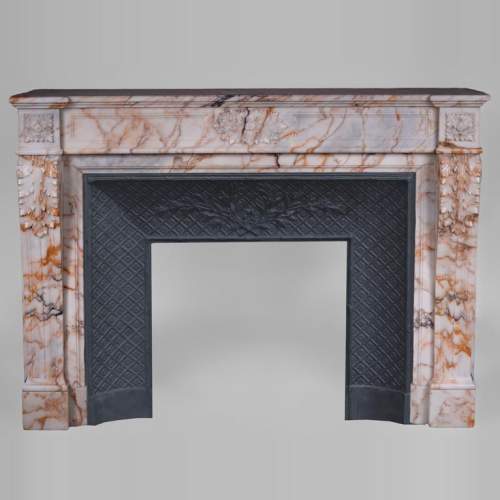
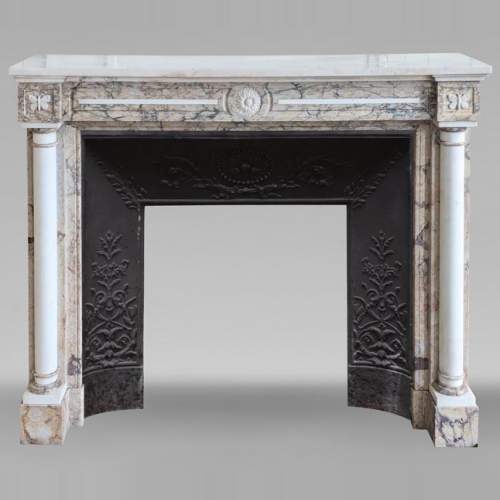
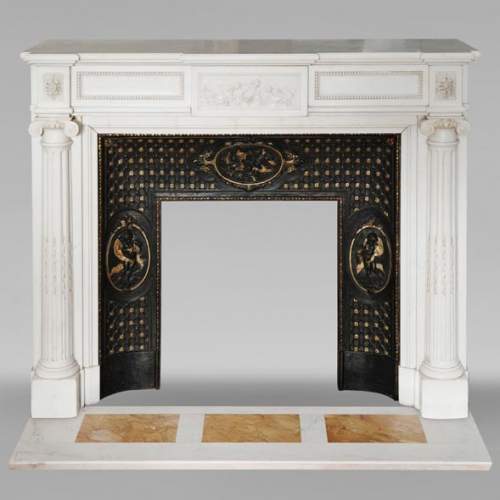
Louis XVI style mantel with acroterion in Rouge du Nord marble

Dimensions:
Width: 134 cm
Height: 120 cm
Depth: 34 cm
Inner width: 85 cm
Inner height: 92 cm

BACCARAT, Pair of vases with Japanese decoration of flowering trees and birds, circa 1880

Dimensions:
Width: 15 cm
Height: 38 cm
Depth: 15 cm

GILARDONI FILS & BRAULT tilery, Weepers, 1900 Paris Exposition

Ref.15020
GILARDONI FILS & BRAULT tilery, Weepers, 1900 Paris Exposition

These ceramic mourners were created around 1900 by the tile factory Gilardoni Fils & Brault. Founded in 1880 by Xavier Gilardoni, the son and nephew of the inventors of the revolutionary waterproof interlocking tile, and Alphonse Brault, the company was based in Choisy-le-Roi and produced decorative ceramic works. The iconography of mourners has existed in funerary art since the 13th century. These figures traditionally represent grieving men surrounding the deceased. In the 15th century, Claus Sluter revitalized this tradition with the prestigious commission for the tomb of Duke Philip the Bold of Burgundy. The project, initiated by Jean de Marville, was significantly reworked by Sluter, who individualized each mourner with unique postures, notably through the use of large drapery. The tomb of Philippe le Hardi is a masterpiece that revolutionized late 14th-century funerary sculpture, influencing subsequent works like the tomb of Jean sans Peur and Marguerite de Bavière, crafted by Jean de la Huerta and Antoine le Moiturier between 1443 and 1470. This latter tomb also features mourners inspired by those of Philippe le Hardi. Nearly five centuries later, the mourners from these ducal tombs still captivated artists. Gilardoni Fils & Brault produced several versions of these figures, separating them from their original context and rendering them as stand-alone works. The mourners here are notable for their expressiveness. The first figure, with its face hidden under a hood and arms crossed, leans slightly backward in a dignified expression of grief, resembling mourner No. 22 from Philippe le Hardi’s tomb by Sluter. The second figure, more humorous in nature, pinches its nose, perhaps due to the stench of death or to hold back tears. This figure echoes mourner No. 64 from Jean sans Peur’s tomb, which itself likely drew inspiration from the now-lost mourner No. 17 from Philippe le Hardi’s tomb. The mourners by Gilardoni Fils & Brault were exhibited at the 1900 Paris Exposition alongside other works by the manufacturer. An old photograph published in The Art Journal. The Paris Exhibition 1900 (volume 2, p. 351) shows a series of six mourners, including the two currently at the Marc Maison gallery. The No. 22 mourner from Philippe le Hardi’s tomb is displayed twice, at each end of the shelf, showcasing the uniform quality of the reproductions. The Marc Maison gallery mourners bear the numbers 3 and 6 under their bases. The photograph is accompanied by high praise for the manufacturer’s stand: “The works shown here were of a distinctly individual nature, and nothing finer of its kind than the little statuettes representing the “Monks of Dijon” was to be found in the Section” (The Art Journal. Paris Exhibition 1900, volume 2, p. 351). While inspired by significant works from the early 15th century, these mourners are firmly rooted in their time, reflected in the use of ceramics and their inherent reproducibility, which allowed for wider dissemination, though such works remain rare today.

Dimensions:
Width: 16 cm
Height: 43 cm
Depth: 13 cm