menu
Menu
account_box
Categories
Contact
email Send us a message

Contact us

phone By phone

+33 (0)1 42 25 12 79
Tue.-Sat., from 10am to 6pm
+33 (0)6 60 62 61 90
Everyday from 9am to 7pm.

email by Email

Adress: contact@marcmaison.com

share Let's get social

Languages
And also...
My selection
(30 Objects)

My selection (30 Objects)


Théodore DECK (ceramist) and Anthony Ludovic REGNIER (painter) - Ceramic dish glazed with tiger lily and butterfly on a blue background

Ref.11594
Théodore DECK (ceramist) and Anthony Ludovic REGNIER (painter) - Ceramic dish glazed with tiger lily and butterfly on a blue background

This glazed ceramic dish was made in the workshop of the ceramist Théodore Deck (1823-1891) and painted by Anthony Ludovic Régnier (1851-1930) in 1881. It is signed in the decor "A. L. REGNIER" and dated in "1881". In the back, it wears the mark "TH. Deck" ; it is entitled "LIS TIGRE" and bears the number "160". Théodore Deck initially trained as a stove maker. When he set up in Paris on his own account in 1858, he made stove linings and then, on the strength of his success, moved into ceramics. The studio produced many dishes in collaboration with well-known painters, including Anthony Ludovic Régnier. Deck gradually perfected his technique and enjoyed great success at the many World’s Fairs he took part in. In 1878, he was made an Officer of the Légion d'Honneur. He ran the Sèvres factory between 1887 and his death in 1891. Anthony Ludovic Régnier was a prolific artist from the workshop of Théodore Deck, specialising in flower paintings. He is otherwise little known. The painter's mastery is evident in his particularly precise and detailed depiction of the tiger lily, whose flowers are in various stages of bloom. A bindweed flower curls around its stem, adding complexity to the pattern. A butterfly flutters around the lily, as does a small yellow and black striped insect. This work is a fine example of the Japonism that swept through European art from the 1870s until the early years of the 20th century, and which particularly influenced Théodore Deck, a collector of Far Eastern art. The Musée des Arts décoratifs, de la Faïence et de la Mode in Marseille has a dish with daturas and nasturtiums by Deck, decorated by Régnier. The different flowers give the decoration great variety.

Fernand THESMAR, Ceramic gardener with applied enamel flowers decoration

Ref.11429
Fernand THESMAR, Ceramic gardener with applied enamel flowers decoration

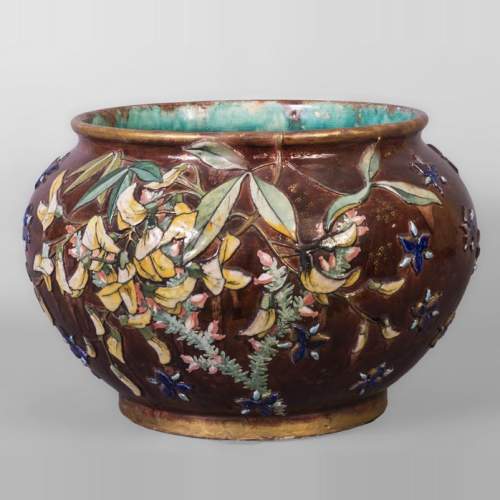
This important gardener bears the monogram of the enameler André-Fernand Thesmar (1843-1912), and was made in the beginning of his enemaler career when he discovers the enamel work and starts his first tries in the 1870's. Andre-Fernand Thesmar first devoted himself to oil painting and was known as a painter of flowers. He was educated in drawing in a factory for printed-fabric in Mulhouse where he had been placed at fourteen years old to learn the trade of a draftsman. His teacher was a painter of flowers: he “drew and dissected the plant with fury, requiring an anatomical analysis of shapes and a meticulous copy of nature.” He left this industrial environment to go to Paris in 1860 and engaged in various activities. It was probably for his talent as a painter that Thesmar was noticed in 1872 by Ferdinand Barbedienne. With Barbedienne, later Thesmar succeeded to the management of the production of enamels. The productions of Thesmar and Barbedienne reflected the interest that they had for the decorative techniques and compositions of Japanese enamel. It was as “co-operator of the Barbedienne company” that Thesmar exhibited at the Exhibition of Decorative Arts in 1874, A cock pheasant from China. At the exposition in 1875, Thesmar exhibited two large enamel compositions on copper. In 1891, Thesmar turned to the decoration of porcelain and introduced himself to Charles Lauth who, since 1879, led the Factory de Sèvres. Its at this time that the collaboration with the Barbedienne company ended. Afterwards, he would be especially known for having invented the “plique à jour” technique, which numerous pieces of are kept in public collections. He creates here a very beautiful gardener with a brown background on which is detaching a floral decoration, favorite theme of the artist, in light relief with applied enamel. His study of the botany allows him to create decor of which the flower speciment are easily recognizable. For instance, we can identify here on one face yellow bindweed as flowered rosemary. On the ohter side he depicts holly. Finally on the whole a rain of aquilegias put randomly on the surface.

Dimensions:
Height: 23 cm

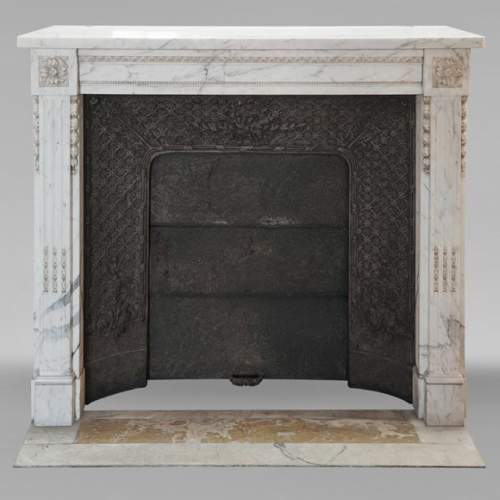
Louis XVI period fireplace, sculpted in Rouge Royal, decorated with a vitruvian frieze

Dimensions:
Width: 157 cm
Height: 107 cm
Depth: 36 cm
Inner width: 122 cm
Inner height: 88 cm

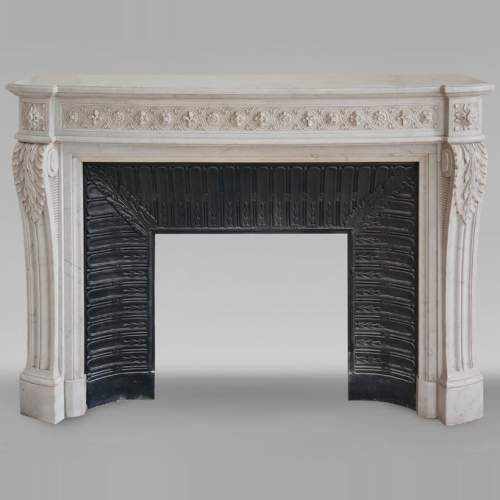
Louis XV style fireplace in Carrara marble richly carved with plant motifs

Ref.6122
Louis XV style fireplace in Carrara marble richly carved with plant motifs

This Louis XV–style fireplace was crafted in Carrara marble, a material prized for its soft whiteness. This light tone enhances the richness of the carving and the fluidity of the lines characteristic of the Rocaille style. The structure follows the typical movement of the Louis XV style, with a serpentine frieze in the shape of a basket handle and a sinuously profiled mantel shelf. The jambs, slightly curved, widen toward the base and rest on simple plinths. The overall effect is one of balanced elegance, where the rounded volumes contrast with the precision of the marble. The finely carved ornamentation is particularly refined. The centre of the entablature features a large acanthus leaf motif framed by volutes and foliage, from which flower bouquets emerge. On either side, branches adorned with flowers and fruits spread in relief across the full width of the frieze. The jambs echo this decorative vocabulary: each console is adorned with an upper scroll surmounting a cascade of flowers, leaves, and stylised acanthus, ending in a plinth carved with an upright vegetal motif. All these elements are executed with great finesse, highlighting the lightness characteristic of the Louis XV style. The cast iron interior is also decorated. It displays a large central shell motif surrounded by leafy scrolls, repeated on the sides with arabesques and floral ornaments in relief. These details recall the vegetal forms of the marble and create continuity between the sculpted frame and the hearth.

Dimensions:
Width: 153 cm
Height: 98 cm
Depth: 43 cm
Inner width: 105 cm
Inner height: 78 cm

Louis XV style fireplace in Carrara marble, decorated with a vase of flowers

Dimensions:
Width: 133 cm
Height: 106 cm
Depth: 38 cm
Inner width: 94 cm
Inner height: 90 cm