menu
Menu
account_box
Categories
Contact
email Send us a message

Contact us

phone By phone

+33 (0)1 42 25 12 79
Tue.-Sat., from 10am to 6pm
+33 (0)6 60 62 61 90
Everyday from 9am to 7pm.

email by Email

Adress: contact@marcmaison.com

share Let's get social

Languages
And also...
My selection
(5 Objects)
My selection (5 Objects)

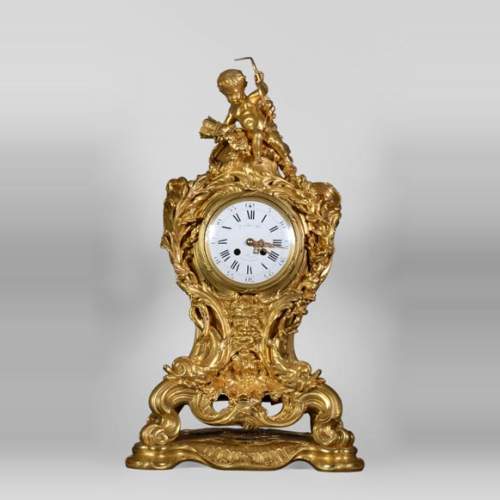
Léon MESSAGÉ (1842-1901) (att. to) - Antique Louis XV style clock

Ref.10867
Léon MESSAGÉ (1842-1901) (att. to) - Antique Louis XV style clock

This Louis XV style clock in gilt bronze was made around 1900. Identifiable by its rococo-inspired style made of curves and twists, this cmock is attributed to Léon Messagé who made of this original aesthetic his signature. The mechanism of the clock is modern and the dial is signed « S. Colin & Cie » then « Paris 17, rue des Tournelles ». The decoration of these elements is very rich and complex and the ornamental repertoire is characteristic of the Rococo style. The dial is adorned with acanthus and laurel leaves curled like a crown. The lower part is devoted to the marine theme with shells, including a large overturned in the center, and two dolphins on each side, a motif often used by Léon Messagé. Remember that the French term « Rocaille », from which comes from « rococo », originally refers to ornamentation imitating rocks, natural stones and shells. Typical large curves of this aesthetic, set back on either side of the dial, support the structure of the object that ends with four sinuous feet on a finely decorated tray. A bearded man mask similar to a faun merges in the center into the decor. A certain extravagance emanates from this clock with very tormented lines. This impression of movement, already present in the Rococo style, takes a certain scale at the end of the 19th century when Art Nouveau imposes a quasi-organic aesthetic that is not unrelated to the Rococo style. But Léon Messagé remains above all a historicist artist and great interpreter of the Louis XV style as confirm the motifs used: acanthus leaves, laurel branches, curves and a winged putto with bow and quiver enthroned at the top of the clock.

Dimensions:
Width: 34 cm
Height: 60 cm
Depth: 23 cm

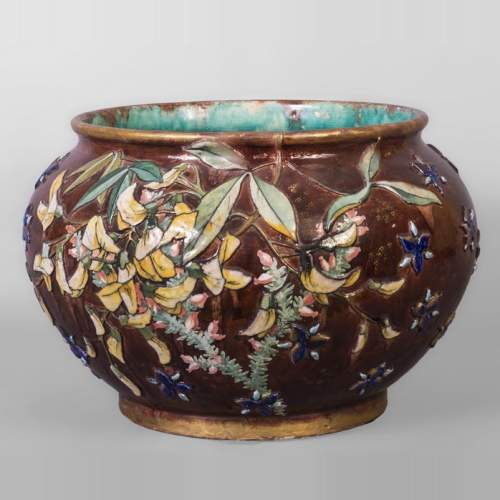
Fernand THESMAR, Ceramic gardener with applied enamel flowers decoration

Ref.11429
Fernand THESMAR, Ceramic gardener with applied enamel flowers decoration

This important gardener bears the monogram of the enameler André-Fernand Thesmar (1843-1912), and was made in the beginning of his enemaler career when he discovers the enamel work and starts his first tries in the 1870's. Andre-Fernand Thesmar first devoted himself to oil painting and was known as a painter of flowers. He was educated in drawing in a factory for printed-fabric in Mulhouse where he had been placed at fourteen years old to learn the trade of a draftsman. His teacher was a painter of flowers: he “drew and dissected the plant with fury, requiring an anatomical analysis of shapes and a meticulous copy of nature.” He left this industrial environment to go to Paris in 1860 and engaged in various activities. It was probably for his talent as a painter that Thesmar was noticed in 1872 by Ferdinand Barbedienne. With Barbedienne, later Thesmar succeeded to the management of the production of enamels. The productions of Thesmar and Barbedienne reflected the interest that they had for the decorative techniques and compositions of Japanese enamel. It was as “co-operator of the Barbedienne company” that Thesmar exhibited at the Exhibition of Decorative Arts in 1874, A cock pheasant from China. At the exposition in 1875, Thesmar exhibited two large enamel compositions on copper. In 1891, Thesmar turned to the decoration of porcelain and introduced himself to Charles Lauth who, since 1879, led the Factory de Sèvres. Its at this time that the collaboration with the Barbedienne company ended. Afterwards, he would be especially known for having invented the “plique à jour” technique, which numerous pieces of are kept in public collections. He creates here a very beautiful gardener with a brown background on which is detaching a floral decoration, favorite theme of the artist, in light relief with applied enamel. His study of the botany allows him to create decor of which the flower speciment are easily recognizable. For instance, we can identify here on one face yellow bindweed as flowered rosemary. On the ohter side he depicts holly. Finally on the whole a rain of aquilegias put randomly on the surface.

Dimensions:
Height: 23 cm

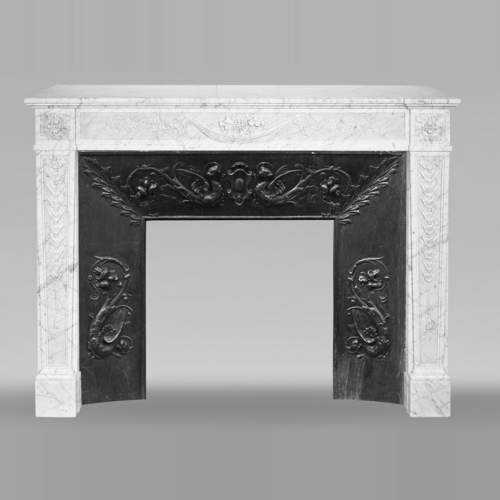
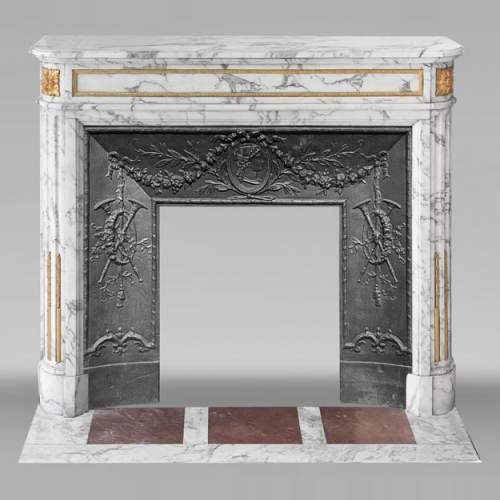
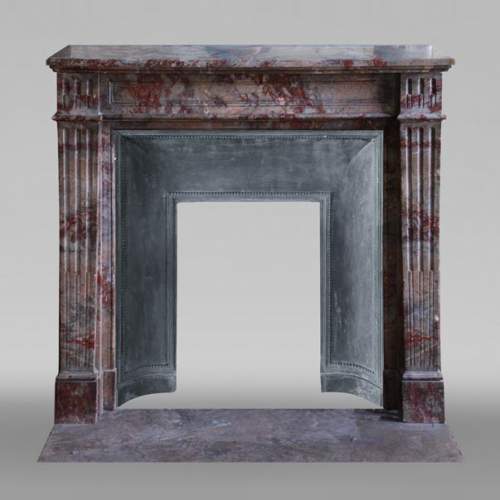
Louis XVI period fireplace with carved fruit decoration, in veined Carrara marble

Dimensions:
Width: 155 cm
Height: 114 cm
Depth: 40 cm
Inner width: 120 cm
Inner height: 96 cm