menu
Menu
account_box
Categories
Contact
email Send us a message

Contact

phone By phone

+33 (0)1 42 25 12 79
Tue.-Sat., from 10am to 6pm
+33 (0)6 60 62 61 90
Everyday from 9am to 7pm.

email by Email

Adress: contact@marcmaison.com

share Let's get social

Languages
And also...
My selection
(25 Objects)

My selection (25 Objects)


Jules LOEBNITZ (1836 – 1895), Ceramic panel “Child with a flower”

Ref.12841
Jules LOEBNITZ (1836 – 1895), Ceramic panel “Child with a flower”

This rectangular panel made of enameled ceramic made by Jules Loebnitz in the second half of the 19th century depicting a child holding a bow in one hand and a flower in the other one from a painting by Emile Lévy (1826 – 1890). The Pichenot-Loebnitz factory was founded by Mr Pichenot, grand parent of Jules Loebnitz, in 1833. From 1841, Mr Pichenot had started the fabrication of uncrackable earthenware panels for mantel's interiors, showed with success during the Exhibition of 1844. Breaking with the traditional fabrication of white heating system, the Pichenot-Loebnitz factory, was one of the first to start the production of architectural earthenware decorations. In 1857, Jules Loebnitz, artist as much as an industrial, succeeded to his grand father and became director of the factory. He helped renovating the old mantels tiles during the restoration of the Castle of Blois before collaborating with the most important architects of his time Eugène Viollet-le-Duc, Laval, Charles Garnier, Just Lisch et Paul Sédille. Between the architect Paul Sédille and Jules Loebnitz, a true friendship was born that leads them to collaborate very closely from 1867. The architectural polychromy theoretician had met the man that has brought important progresses to French ceramic, allowing the making of important uncrackable earthenware panels. Thus, during the Great Exhibition of 1878, Paul Sédille realized the door of the Palais des Beaux-arts, while Jules Loebnitz was in charge of the ceramic decoration of the facade, in order to advocate the renewed of architectural polychromy. For this purpose, he made a series of three panels taking as a model the paintings of Emile Lévy, kept today in the Musée de la céramique architecturale of Auneuil, depicting the Painting, the Sculpture and the Architecture, transposed to enamel by Lazar Meyer, a student of the painter. The Painting depicts a scene on which we can see a man painting three naked women in the characteristic position of the Three Graces. Cupid, asking for a flower held by one of the woman, has most likely been used too as a model for the one we can see on our panel, as they have the exact same body position. Indeed, the naked child with his red hair is standing by its profile on both panels, the left leg is out straight, the other is bend. He's holding in his left hand a bow and straight out his other hand to the sky, toward where he is looking. The difference is visible with the representation of the flower that the child is holding in our panel. On the contrary of the original painting, the background is abstract, the only décor is the flower behind the child. We also find on one of the plate from La brique et la terre cuite by Pierre Chabt – book that has contributed to the success of the manufactory after it was published in the 1880’s – a panel depicting the same subject with a different background. This model is today kept in the Musée des Arts et Métiers in Paris.

Dimensions:
Width: 39 cm
Height: 98 cm
Depth: 5 cm

Beautiful antique fireback with Albert de Luynes's coat of arms, 17th century

Dimensions:
Width: 80 cm
Height: 110 cm
Depth: 6 cm

CRISTALLERIE  DE BACCARAT, Neo-Greek, krater-shaped vase, made out of coated crystal, and etched through hydrofluoric acid, 1867 World’s Fair

Ref.13171
CRISTALLERIE DE BACCARAT, Neo-Greek, krater-shaped vase, made out of coated crystal, and etched through hydrofluoric acid, 1867 World’s Fair

This krater-shaped vase made out of coated crystal is a work from the Baccarat crystal-glass making factory, between 1862 and 1867, year when similar models were displayed at the Parisian World’s Fair. It is the Baccarat manufacture’s second entry, the first being at the first Parisian World’s Fair of 1855. Baccarat does win a gold medal, in particular for two vases made out of ruby red crystal, and a crystal fountain of seven meters high. Created under Louis XV’s reign, the crystal-glass making factory got its international fame through its participations, all along the 19th century, and until 1937, to the World’s Fairs.he works of the manufacture are scarcely signed between 1764 and 1860, year where the first labels did appear punctually. Fifteen years later, a seal with the name of the firm is placed on some blowing models and gilded bronze pieces. It is not until 1936 that the « BACCARAT » brand, with a carafe and two glasses, started appearing systematically on every production. During the 1867 World’s Fair, Baccarat inspired itself from the Bacchus cult for most of its production. We can see in our vase the influence of ancient ceramics through the shape of a krater – a piece of ceramics used by Greeks to dilute wine with water – as well as in the composition and the decoration’s subject. The latest is engraved thanks to hydrofluoric acid, a technical mastered by the German chemist Louis Kessler in 1855, who did improve the chemical formula of the bath to make it less aggressive and thus, less dangerous. Baccarat bought the patent in 1864, allowing the manufacture to diverse its production and to reach a new level of virtuosity. Detaching themselves from an opaque, white background, pink colored figures are represented in the spirit of ancient decorations on ceramics. We can see on one face a maenad wearing a spinning drapery, holding a drinking cup in one hand and a thyrsus in the other – a stick similar to a scepter and crowned with a pine cone, Dionysus’s attribute. On the other side, two figures are placed face to face, a masculine and a feminine one. They might represent the divine couple of Dionysus and Ariadne : she is sat on an ancient seat, richly dressed, and addressing the half-naked young man that is also carrying a thyrsus. In order for this decoration to be perfect, the two figurative scenes are framed with different patterns : palm motif, interlacing, Greek key frieze and laurel leaves.The handles have been realized after : they were shaped in clear crystal, and then adorned with gold painting applied with a brush. Even if, until today, our vase is the only one known showing this krater shape and the color rose, other similar models, with similar decorations, does exist – in particular in blue and yellow. Moreover, this bacchanal scene on an opaque white background have been applied on other pieces produced by the firm, that can be seen in museums’ collections, such as the Corning Museum of Glass, the Chrysler Museum of Norfolk, the Musée d’Orsay or at the Petit Palais.

Dimensions:
Width: 31 cm
Height: 25 cm
Depth: 25 cm

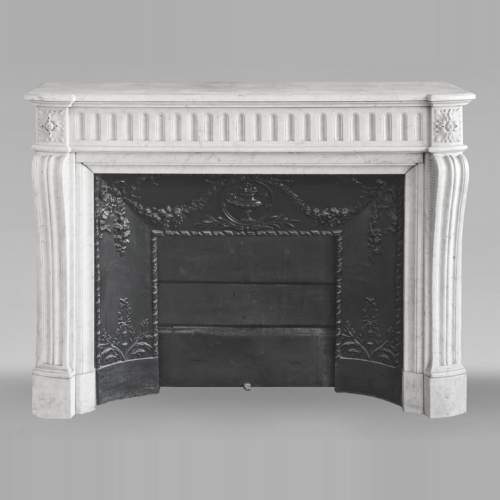
Louis XVI style molded Arabescato marble mantel

Dimensions:
Width: 124 cm
Height: 104 cm
Depth: 34 cm
Inner width: 92 cm
Inner height: 89 cm

BOCH Frères, Art Nouveau Vase in Iridescent Faience Decorated with a Toad and Mushrooms, late 19th century

Ref.14914
BOCH Frères, Art Nouveau Vase in Iridescent Faience Decorated with a Toad and Mushrooms, late 19th century

This iridescent faience vase with a toad and mushroom motif was created by the Boch Frères manufactory in the late 19th century. In 1841, Eugène and Victor Boch founded a fine faience manufactory called Kéramis in La Louvière, Belgium. The faience factory quickly flourished and diversified its production, adapting to the stylistic and technical evolutions of the time. This particular vase is emblematic of the Art Nouveau movement, as evidenced by its asymmetrical design directly inspired by nature: the body of the vase takes the form of a tree stump. Wider and rounded at the base due to roots seemingly ready to plunge into the earth, it rises to a certain height before ending with an irregular rim. Several mushrooms, among which an agaric, grow on it, and a toad climbs at the base of the stump. The vase features an iridescent glaze transitioning from pink to violet, lightening to white on the mushrooms and darkening to brown on the toad. This glazing demonstrates the high level of mastery achieved by certain artists and the most important manufactories at the end of the 19th century. The mark under the base indicates that the manufactory had a subsidiary in Thiais, in the Seine department. A vase of the same shape but with a slightly different glaze – where pink blends with yellow-orange, green, and blue (and the toad appears black) – was noted by expert Alain Cical.

Dimensions:
Width: 20 cm
Height: 34 cm
Depth: 13 cm

Cheminée de style Napoléon III en marbre noir moucheté

Dimensions:
Width: 105 cm
Height: 102 cm
Depth: 30 cm
Inner width: 78 cm
Inner height: 87 cm

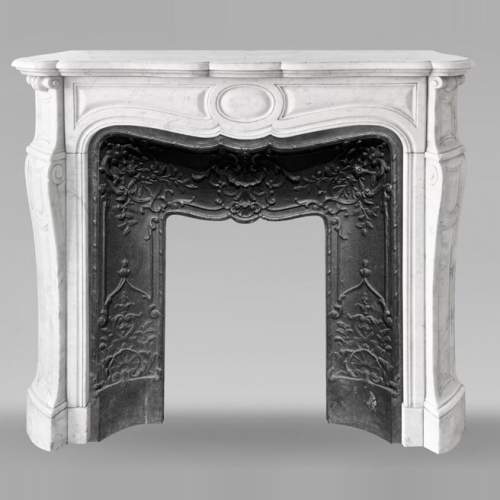
Small Louis XV mantel in Carrara marble

Dimensions:
Width: 111 cm
Height: 107 cm
Depth: 37 cm
Inner width: 72 cm
Inner height: 83 cm

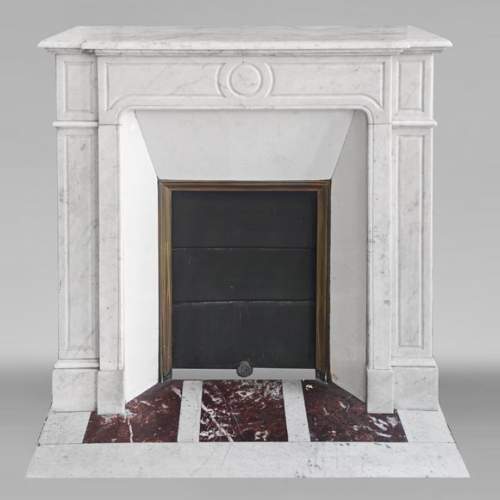
Louis XVI style mantel with sunflower blossom in Carrara marble

Dimensions:
Width: 145 cm
Height: 110 cm
Depth: 42 cm
Inner width: 104 cm
Inner height: 82 cm

Louis XVI period fireplace, sculpted in Rouge Royal, decorated with a vitruvian frieze

Dimensions:
Width: 157 cm
Height: 107 cm
Depth: 36 cm
Inner width: 122 cm
Inner height: 88 cm

Louis XV style fireplace, Pompadour model, in light blue turquoise marble

Dimensions:
Width: 121 cm
Height: 103 cm
Depth: 36 cm
Inner width: 81 cm
Inner height: 88 cm

 Louis XVI style fireplace with a central sunflower, in Carrara marble

Dimensions:
Width: 146 cm
Height: 109 cm
Depth: 42 cm
Inner width: 103 cm
Inner height: 83 cm

Louis XVI style fireplace in blue turquoise marble

Dimensions:
Width: 114 cm
Height: 106 cm
Depth: 36 cm
Inner width: 86 cm
Inner height: 92 cm

 Louis XVI period fireplace in red northern marble, slightly curved

Dimensions:
Width: 163 cm
Height: 103 cm
Depth: 64 cm
Inner width: 128 cm
Inner height: 84 cm

Louis XVI style fireplace in Arabescato marble

Dimensions:
Width: 126 cm
Height: 105 cm
Depth: 34 cm
Inner width: 88 cm
Inner height: 85 cm