menu
Menu
account_box
Categories
Contact
email Send us a message

Contact

phone By phone

+33 (0)1 42 25 12 79
Tue.-Sat., from 10am to 6pm
+33 (0)6 60 62 61 90
Everyday from 9am to 7pm.

email by Email

Adress: contact@marcmaison.com

share Let's get social

Languages
And also...
My selection
(17 Objects)

My selection (17 Objects)


Victor GEOFFROY-DECHAUME, Pair of incense burners made out of silvered bronze, adorned with dogs, circa 1840

Ref.12389
Victor GEOFFROY-DECHAUME, Pair of incense burners made out of silvered bronze, adorned with dogs, circa 1840

This pair of incense burners made out of silvered bronze and adorned with dogs is a work by the goldsmith and sculptor Victor Geoffroy-Dechaume (1816-1892), as indicated by the chiselled signature on the covert’s backs. This pair of incense burners is a testimony of the taste, combining references to the arabic and medieval arts, that develops itself during the 1840 decade, in every field of the decorative arts and in particular in the work of Victor Geoffroy-Dechaume, a prolific designer for civil and religious goldsmithing models. He entered the Beaux-Arts school of Paris in 1831, where he was the student of David d’Agners and James Pradier. His taste pushed him into dedicating himself to decorative arts, and in particular to model designs for goldsmithing, until 1848, when he discovered the medieval sculpture. He gave numerous designs for other artists to use as models, for example the bronzemaker Auguste-Maximilien Delafontaine (1813-1892) or the goldsmith François-Désiré Froment-Meurice (1801-1855). Then, circa 1850, he went for the study of monumental statuary and more accurately of medieval statuary. He became one of Viollet-le-Duc’s principal collaborators and participated thus at some of the biggest restoration sites, like the Chartres cathedral, Notre-Dame of Paris or the Sainte-Chapelle. A multiple and fecund artist, he was at the same time a restorator of religious buildings, a sculptor of monumental pieces, commemorative statues, a goldsmith for the princes and a prolific moulder. In 1855, Geoffroy-Dechaume is appointed director at the Museum for Comparative sculpture (actual Cité de l’Architecture et du Patrimoine). Our pair of incense burners is thus realised according to the main works of the first part of Geoffroy-Dechaume’s career. At this time he dedicated himself to decorative arts and to goldsmithing by producing models and works which ornamental references find their sources into arabic and medieval arts. We recognize these inspirations thanks to the polylobed and animated shapes of our incense burners. Made out of silvered bronze, they present on the top two small sculptures depicting dogs. Their bodies have been pounded with small, abstract patterns bringing them some texture and reminding of the oriental inspiration. The two scenes are different, since on the first one, we can see the dogs fighting, sitted, one biting the other’s neck, while on the other burner, a sitting female is nourishing her babies. These canine figures are set on a ring adorned with oriental patterns and pierced with holes in order for the incense to spread. On the four-feeted base, the sinuous lines and the decoration does form an hybridisation between oriental art and grotesque or even monstruous forms from gothic art, for example with the stylished paw-feet or the scale motif. Bibliography : Catalogue of the exhibition « De plâtre et d’or. Geoffroy-Dechaume sculpteur romantique de Viollet-le-Duc. » Musée d’art et d’Histoire Louis Senlecq, L’Isle-Adam, 1998.

Dimensions:
Width: 24 cm
Height: 37 cm
Depth: 24 cm

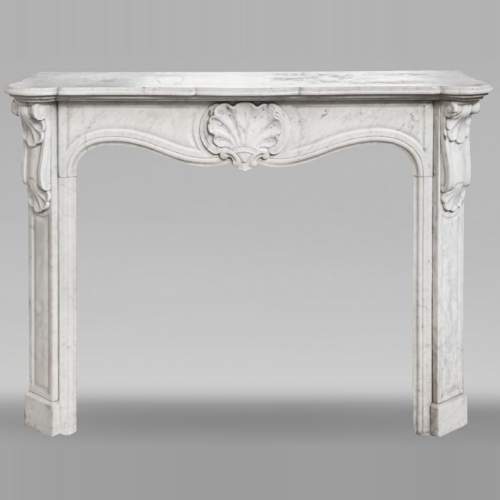
Louis XV style mantel with rich décor of shells and volutes in Griotte marble

Dimensions:
Width: 150 cm
Height: 107 cm
Depth: 46 cm
Inner width: 110 cm
Inner height: 81 cm

Sarreguemines Pottery Works for Vermont Brothers, Dinnerware set with "Views of Paris", circa 1890

Ref.15271
Sarreguemines Pottery Works for Vermont Brothers, Dinnerware set with "Views of Paris", circa 1890

This cream-colored earthenware set decorated with the arms and monuments of Paris was made by the Sarreguemines Pottery Works around 1890 and distributed by the Vermont Brother store in Paris. The stamp on the base of each piece in the set indicates that it was a Parisian company, located near the Opera. It also indicates that this set is made of “ironstone”, a term for fine earthenware mixed with feldspar and kaolin to make it whiter and more durable; thus, it is very close to porcelain. The pieces in the set are marked with numbers and letters to individualize them on the reverse side. The set includes thirteen large dinner plates, fourteen small plates, six soup plates, three serving dishes, and three compotes. In total, the set features sixteen different designs, as some motifs are repeated on different pieces. It includes representations of the Pantheon, the Carrousel Arc de Triomphe, the Church of the Trinity, the Opera, the Madeleine, the Eiffel Tower, Notre Dame Cathedral, the Étoile Arc de Triomphe, the Medici Fountain in the Luxembourg Gardens, Saint Augustin’s Church, Saint Lazare’s Station, the Louvre Palace, Saint Michel’s Fountain, the Palace of Justice, and Saint-Jacques’ Tower. It also depicts the Palace of Industry, which was demolished in 1896 and replaced by the Grand Palais, indicating that the set likely dates from before its demolition. The monuments are painted like watercolors on a blue sky with pastel colors. The top of the pieces is adorned with the coat of arms of the city of Paris standing out on a laurel branch, while the decorations are underlined by a chestnut branch at the bottom, intertwined with scrolls bearing the name of the depicted monument. Two other sets of the same model, sold at Drouot in 2012 and at Thierry de Maigret in 2023, provide additional representations of the monuments initially depicted in this set: the Central Halls (now demolished), the Pont Neuf, Longchamps, Saint Sulpice’s Church, the Buttes Chaumont Park, the Bastille (although already destroyed when the set was made, it remains a strong symbol of Paris), the Luxembourg Palace, the Longchamps Hippodrome, etc. This set gives a beautiful overview of the most beautiful monuments of the capital. These are represented in a state contemporary to its creation, thus evoking the Parisian landscape at the very end of the 19th century while allowing the viewer to recognize buildings that are still famous today.

Dimensions:
Width: 33 cm
Height: 4 cm
Depth: 33 cm

Regence style mantel in veined red marble

Dimensions:
Width: 169 cm
Height: 121 cm
Depth: 35 cm
Inner width: 118 cm
Inner height: 96 cm

Statuary marble mantel with lion paws

Dimensions:
Width: 150 cm
Height: 102 cm
Depth: 40 cm
Inner width: 100 cm
Inner height: 72 cm

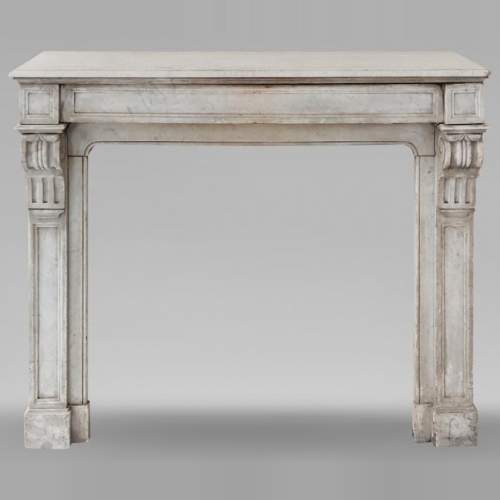
Regence style mantel in Campan marble

Dimensions:
Width: 145 cm
Height: 106 cm
Depth: 31 cm
Inner width: 112 cm
Inner height: 90 cm

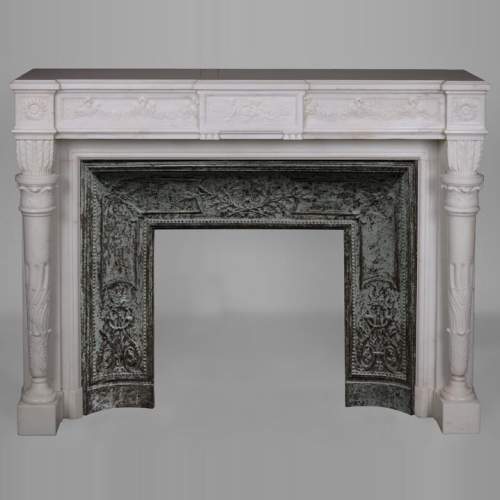
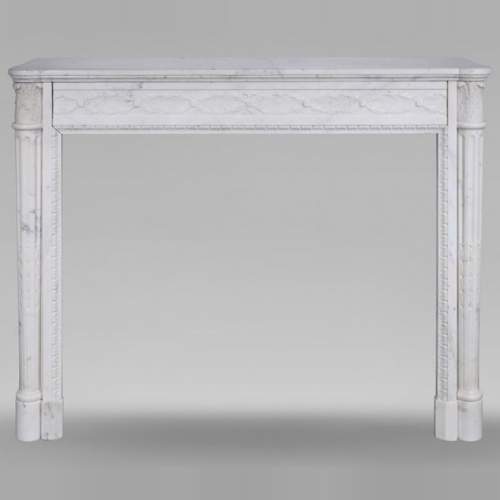
Louis XVI style mantel carved in Carrara marble

Dimensions:
Width: 145 cm
Height: 107 cm
Depth: 39 cm
Inner width: 115 cm
Inner height: 89 cm

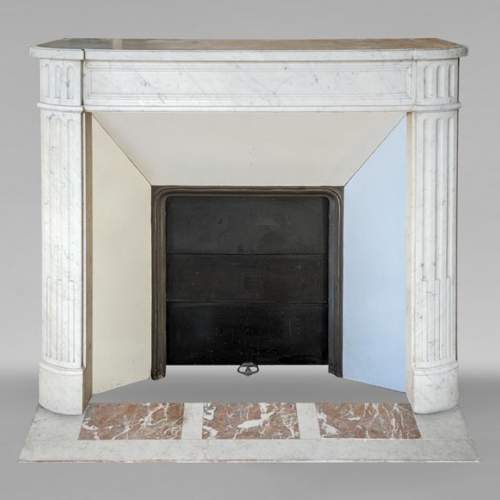
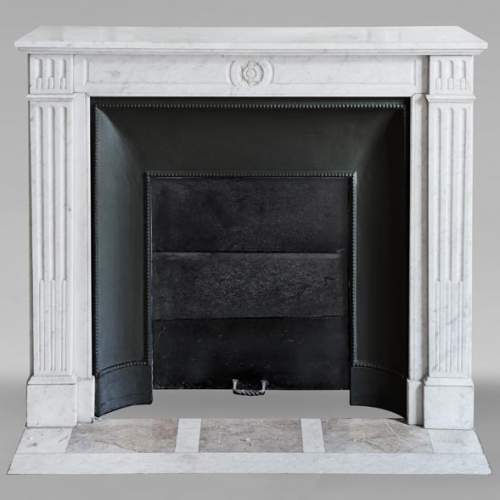
Curved Louis XVI style fireplace in Arabescato marble, decorated with a laurel wreath

Dimensions:
Width: 129 cm
Height: 110 cm
Inner width: 87 cm
Inner height: 83 cm

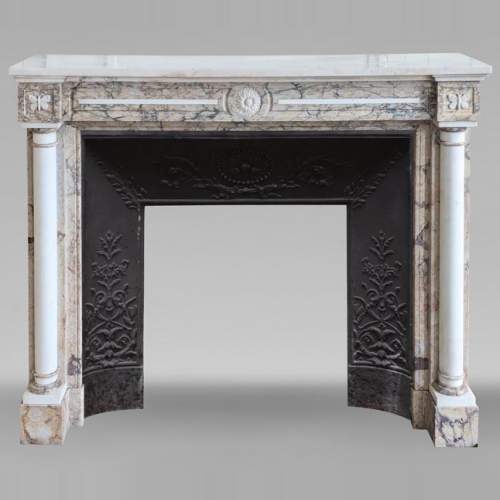
Louis XVI style fireplace in Médous breccia

Dimensions:
Width: 156 cm
Height: 113 cm
Inner width: 112 cm
Inner height: 86 cm

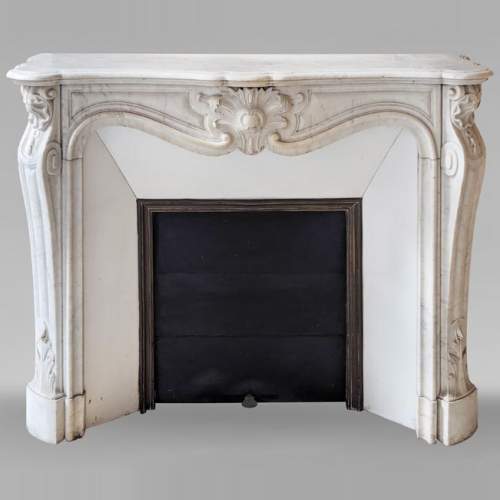
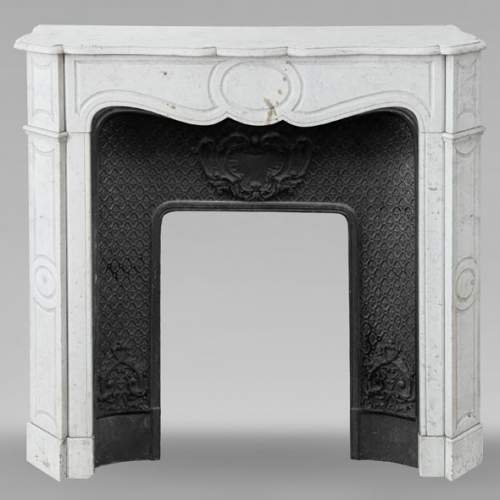
 Louis XV style fireplace, Pompadour model, in red Campan marble

Dimensions:
Width: 103 cm
Height: 100 cm
Depth: 35 cm
Inner width: 68 cm
Inner height: 86 cm