menu
Menu
account_box
Categories
Contact
email Send us a message

Contact

phone By phone

+33 (0)1 42 25 12 79
Tue.-Sat., from 10am to 6pm
+33 (0)6 60 62 61 90
Everyday from 9am to 7pm.

email by Email

Adress: contact@marcmaison.com

share Let's get social

Languages
And also...
My selection
(7 Objects)

My selection (7 Objects)


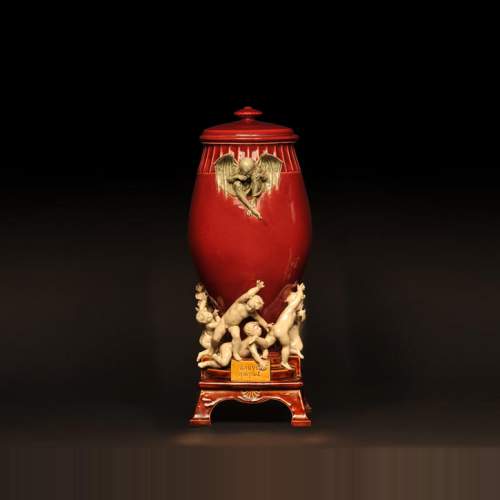
Louis-Robert CARRIER-BELLEUSE (1848 - 1913) and POTTERY FROM CHOISY LE ROI (1863 -1938),  "Children and Butterflies"

Ref.15230
Louis-Robert CARRIER-BELLEUSE (1848 - 1913) and POTTERY FROM CHOISY LE ROI (1863 -1938), "Children and Butterflies"

Stoneware model presented at the Exposition of the National Society of Fine-Arts in 1898, under the number 4060, with three other vases: Run for your lives! Hercules and Omphale and Music. Reproduced in Antique and Modern Decoration, 7th year, 1900, drawing 66. Enameled pottery.This vase has a slender form that contrasts the four handles. The body is completely decorated with floral or purely decorative elements while the characters are restricted to the neck level. A frieze of cherubs chasing butterflies develops along the neck, in a round frenzy. A brown tint covers the entire piece but fades in the upper part, thus becoming more yellow. This vase displays a decor that combines different techniques. The body of the vase is decorated with a floral decor which mixes elements in relief and engraved elements. The frieze of children is produced in clay on clay. This process, perfected at the Factory of Sevres around 1848 was frequently used by sculptors, which Louis Carrier-Belleuse was. It consists of applying generally white motifs on a colored background. However, the totality of the piece has been enameled which contributes to giving light green reflections to the bodies of the children. This original vase mixes two inspirations: the frieze of cherubs resembles the production of the Second Empire while the body of the vase displays plant elements indicating Art Nouveau.In the Exposition of the National Society of Fine-Arts in 1898, this vase appeared for the first time in stoneware, accompanied by three other vases: Hercules and Omphale, Run for your lives! and Music. These four vases are presented under the same number (no. 4060) and in the same display window. Three of the four vases, including Children and Butterflies, were reproduced, in 1900, in the review of Antique and Modern Decoration. Children and Butterflies was acquired in 2003 by Musee du Petit Palais, in Paris, and it is one of the rare examples of a vase by this artist conserved in a public French collection. The same year,  he exhibited a fifth vase under the number 4059, entitled Farming. The vase that we present, produced in stoneware, is not the one presented at the Exposition in 1898. However, its reproduction, by the pottery in Choisy-Le-Roi proves the popularity of this model and its creator.

Dimensions:
Width: 28 cm
Height: 45 cm

Joseph Chéret (1838 - 1894) for the Manufactory of Sèvres "Putto with greek masks" Coin tray made in faience with a blue glaze

Ref.15462
Joseph Chéret (1838 - 1894) for the Manufactory of Sèvres "Putto with greek masks" Coin tray made in faience with a blue glaze

This coin tray was made in blue glazed faience in the 19th century by the manufacture of Sèvres, after an artwork of Joseph Gustave Cheret (1838-1894). This sculpture represents a putto with two Greek comedy masks. The first one, sitting at its foot, is a woman's mask of a courtesan called 'pseudokoré'. The putto is holding the other one in his arms, it is the mask of a bearded man called 'pornoboskos'. The putto is partially covered with a drape. At his feet are severals musical instruments : a flute, some bells and a tambourine, with the signature 'Joseph Cheret Saw'. Another mark 'CH FICQUENET. - Sevres' is on the side. Cheret is an important sculptor of the 19th century. He was trained by the famous Carrier-Belleuse. This very gifted student eventually married one of the daughters of his mentor in 1868. From 1863 he regularly presented works in different Fairs and Exhibitions. We owe him the first salamander design, which he realized in collaboration with the Chaboche Company. This object is inspired by sculptures depicting putti or young satyrs having fun with Greek comedy masks. Very popular in the imperial Rome period, these images are experiencing a revival during the Renaissance and then in the 19th century during eclecticism. It is particularly representative of the 19th century taste, especially by its material: a blue glazed faience. At that time, ceramic techniques were very popular. This blue can be compared to 'Deck blue', used by Théodore Deck at the same time.

Dimensions:
Width: 25 cm
Height: 63 cm
Depth: 27 cm

Albert-Ernest CARRIER-BELLEUSE, CHOISY-LE-ROI Manufacture, Bust of an Oriental Woman in glazed earthenware

Ref.14966
Albert-Ernest CARRIER-BELLEUSE, CHOISY-LE-ROI Manufacture, Bust of an Oriental Woman in glazed earthenware

This bust was created by Albert-Ernest Carrier-Belleuse for the Choisy-le-Roi faience factory in the second half of the 19th century. Albert-Ernest Carrier de Belleuse, known as Carrier-Belleuse (1824-1887), was the most prolific sculptor of the Second Empire. He was quickly influenced by the importance of decorative arts and worked with Ferdinand Barbedienne on the creation of decorative objects. He achieved great success at exhibitions and received numerous official commissions. He produced many busts of beautiful and elegant young women, including a Bust of a Woman Wearing a Diadem held at the Orsay Museum. He also provided bust models for the Choisy-le-Roi Faience Factory, where his son later became the artistic director. This bust of an oriental woman, created from an original sculpture signed by Carrier-Belleuse, was made for this manufactory. Titled The Bust of an Algerian Woman, it was auctioned at Sotheby’s in 2017. It is one of his rare orientalist works. The desire to depict a woman in oriental costume aligns with the idealization evident throughout the sculptor's work. The smiling woman shows her teeth. Her long, loose hair, adorned with multiple sequins along the edges, rests on her shoulder and is topped with a hat featuring orientalist motifs. Her bare chest, partially covered by a crumpled fabric and accentuated by the two rows of her necklace, exudes great sensuality. The colorful costume draping her shoulders is highlighted by the vivid colors and brilliance of the faience. At the base of the bust, a gilded belt emphasizes the richness of the costume. The bust is signed on the back and bears the mark of the Choisy-le-Roi manufactory.

Dimensions:
Width: 22 cm
Height: 76 cm
Depth: 22 cm

Gabriel VIARDOT, Japanese-Style Shelf Cabinet, late 19th Century

Ref.15090
Gabriel VIARDOT, Japanese-Style Shelf Cabinet, late 19th Century

This shelf cabinet was crafted by Gabriel Viardot in the late 19th century. A talented wood sculptor, Gabriel Viardot opened a furniture workshop and store in Paris in 1853. In the 1870s, he decided to focus on “Chinese-Japanese style furniture”. He received prestigious awards at the Universal Exhibitions in Paris in 1878, 1889, and 1900, as well as a gold medal at the International Exhibition in Antwerp in 1884. This piece, serving as both a cabinet and a display stand, belongs to Viardot’s Sino-Japanese style production. Its four legs, shaped as stylized scrolls, support an asymmetrical structure. The lower left section features shelves inspired by Japanese “cha’dansu” (tea cabinets). It is adorned with a dragon seemingly weaving through a panel at the bottom, a recurring motif in Viardot’s work. At the top, the last shelf is supported by a delicate sculpture of a crane perched on a turtle. The right section consists of a cabinet on a stand, decorated with a panel showcasing rich low-relief carvings. Stylized flames and smoke swirls intertwine with highly realistic flowers. A Japanese panel from the Meiji era (1868-1912), depicting a basket of flowers, was included after a delicate cutting process. The small left side is adorned with Japanese maple leaves, while the right side features a flower. Gabriel Viardot’s signature can be found just below, on the lower crosspiece. A very similar version of this cabinet is depicted in an old sketchbook by the artist. Notably, the crane supporting the shelf and the tiered supports above the dragon on the left are present, although their orientation is reversed.

Dimensions:
Width: 102 cm
Height: 180 cm
Depth: 41 cm