menu
Menu
account_box
Categories
Contact
email Send us a message

Contact

phone By phone

+33 (0)1 42 25 12 79
Tue.-Sat., from 10am to 6pm
+33 (0)6 60 62 61 90
Everyday from 9am to 7pm.

email by Email

Adress: contact@marcmaison.com

share Let's get social

Languages
And also...
My selection
(15 Objects)

My selection (15 Objects)


André-Fernand Thesmar, Enameled ceramic gardener

Ref.13644
André-Fernand Thesmar, Enameled ceramic gardener

This important gardener bears the monogram of the enameler André-Fernand Thesmar (1843-1912), and was made in the beginning of his enemaler career when he discovers the enamel work and starts his first tries in the 1870's. Andre-Fernand Thesmar first devoted himself to oil painting and was known as a painter of flowers. He was educated in drawing in a factory for printed-fabric in Mulhouse where he had been placed at fourteen years old to learn the trade of a draftsman. His teacher was a painter of flowers: he “drew and dissected the plant with fury, requiring an anatomical analysis of shapes and a meticulous copy of nature.” He left this industrial environment to go to Paris in 1860 and engaged in various activities. It was probably for his talent as a painter that Thesmar was noticed in 1872 by Ferdinand Barbedienne. With Barbedienne, later Thesmar succeeded to the management of the production of enamels. The productions of Thesmar and Barbedienne reflected the interest that they had for the decorative techniques and compositions of Japanese enamel. It was as “co-operator of the Barbedienne company” that Thesmar exhibited at the Exhibition of Decorative Arts in 1874, A cock pheasant from China. At the exposition in 1875, Thesmar exhibited two large enamel compositions on copper. In 1891, Thesmar turned to the decoration of porcelain and introduced himself to Charles Lauth who, since 1879, led the Factory de Sèvres. Its at this time that the collaboration with the Barbedienne company ended. Afterwards, he would be especially known for having invented the “plique à jour” technique, which numerous pieces of are kept in public collections. He creates here a very beautiful gardener with a brown and orange background on which is detaching on slight relief a flower decoration, favorite theme of the artist. He alternates a decor of wide flowers in a light pink shade with strips on a beige background with a motif composed of leaves and flowers scrolls.

Dimensions:
Height: 32 cm

Robert LALLEMANT, "High Jump" Vase, 1930

Ref.15278
Robert LALLEMANT, "High Jump" Vase, 1930

This vase was made in 1930 by Robert Lallemant on the occasion of the Grand Prix of the Stade Français. The ceramicist and decorator Robert Lallemant (Pau, 1902-Davos, 1954) attended the École des Beaux-Arts in Dijon before becoming interested in ceramics between 1921 and 1923. In 1926, his father, Théophile Lallemant, bought him a small ceramics factory in Paris; he managed the business until his death in 1928, which explains the presence of his initial in the signature on our vase, under its base: “T. R. Lallemant”. Robert Lallemant quickly invented a modern and original ceramic style, which he produced in small series. His work was well-received by critics at the Salons des Artistes Décorateurs and the Salons d’Automne in 1926, 1927, and 1928. He was among the founders of the Union des Artistes Modernes (UAM) in 1929. A few years later, he gradually lost interest in ceramics to produce furniture, and then got involved in his father-in-law’s public works business. In 1939, he joined the French Navy, and in 1945 and 1946, he went to Indochina, where he showcased his talents as a photographer. Among other popular themes in the 1920s and 1930s, Lallemant particularly focused on sports, producing several vases on this subject; he was a sportsman himself. Our vase reflects the influence of Art Deco on his work, notably with the stepped shoulders that frame it and its geometric shapes. At the center, an athlete is dynamically depicted in a high jump event. The decoration is characterized by a certain simplification of shapes and colors, aligning with contemporary painting trends. The glaze is brilliant and of high quality. The inscription at the base of the decoration indicates that this vase was commissioned to serve as a trophy for the winner of the high jump event at the 1930 Grand Prix of the Stade Français. Other vases of the same model, without this inscription, were also created by the same artist; the decoration of one of them represents a pole vault event in a style very similar to that of our “High Jump” vase. A photograph from the artist’s archives shows the importance of the sports theme in his work; it depicts a vase of the same shape as ours, decorated with cross-country runners. This photograph also shows that the same decoration could be adapted to different vase shapes.

Dimensions:
Width: 20 cm
Height: 22 cm
Depth: 8 cm

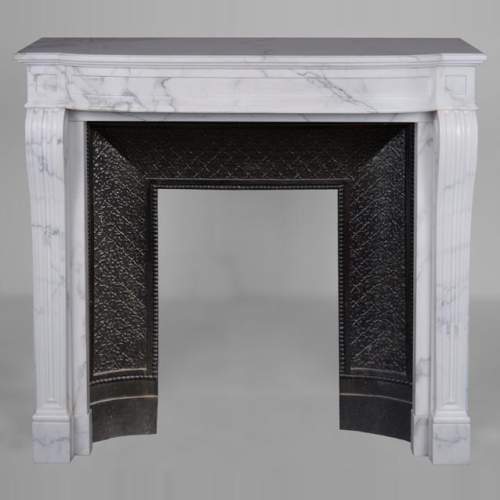
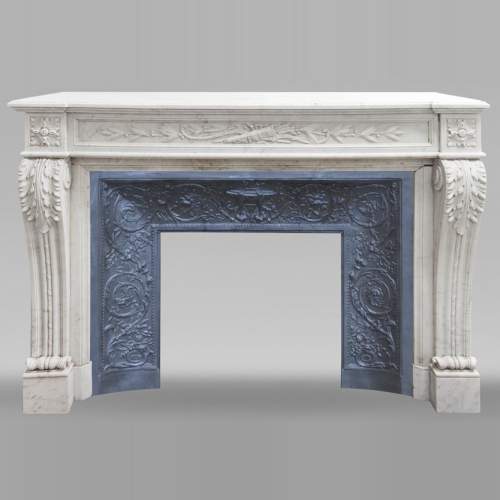
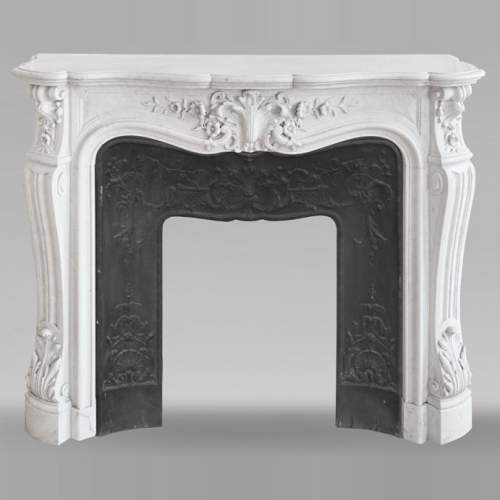
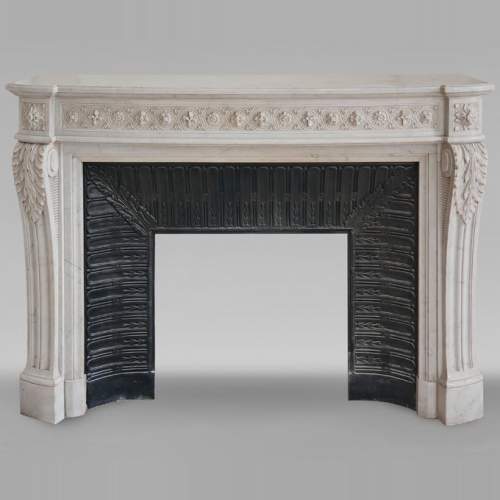
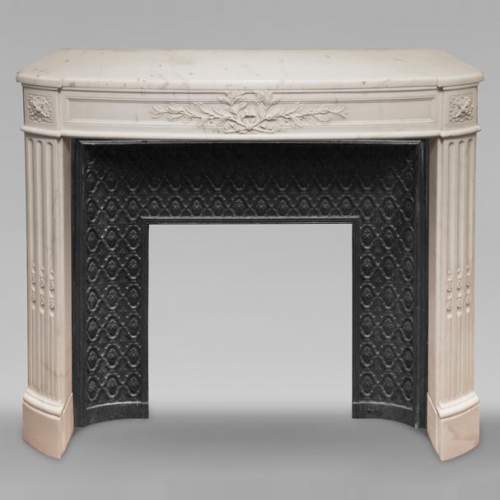
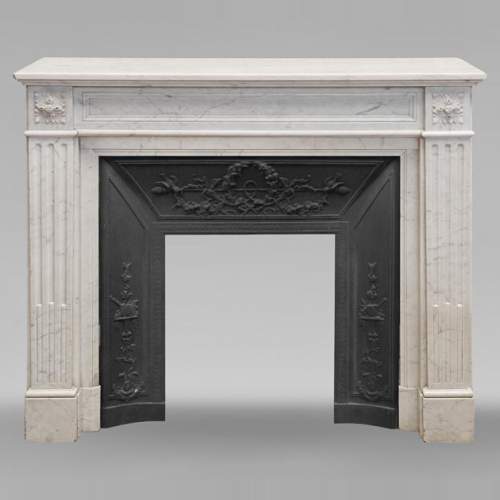
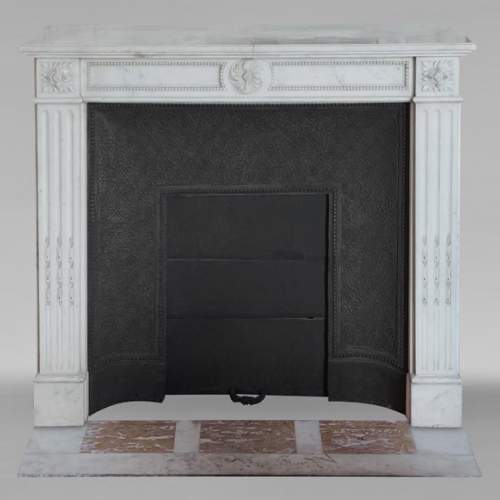
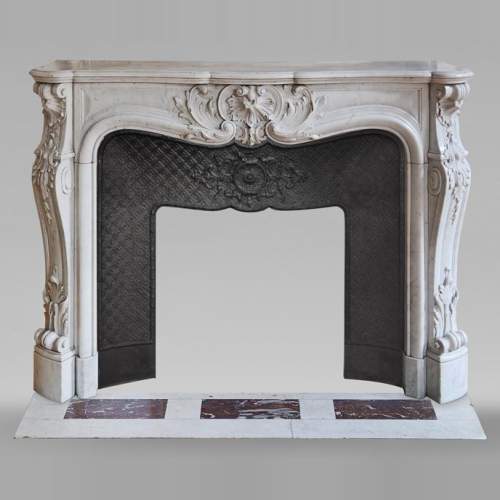
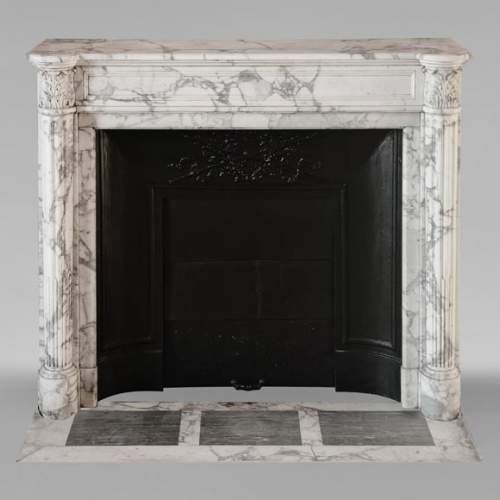
Louis XV style fireplace in Carrara marble with plant decoration

Dimensions:
Width: 155 cm
Height: 105 cm
Inner width: 119 cm
Inner height: 89 cm