menu
Menu
account_box
Categories
Contact
email Send us a message

Contact

phone By phone

+33 (0)1 42 25 12 79
Tue.-Sat., from 10am to 6pm
+33 (0)6 60 62 61 90
Everyday from 9am to 7pm.

email by Email

Adress: contact@marcmaison.com

share Let's get social

Languages
And also...
My selection
(8 Objects)
My selection (8 Objects)

Jules LOEBNITZ (1836 – 1895), Ceramic panel “Child with a flower”

Ref.12841
Jules LOEBNITZ (1836 – 1895), Ceramic panel “Child with a flower”

This rectangular panel made of enameled ceramic made by Jules Loebnitz in the second half of the 19th century depicting a child holding a bow in one hand and a flower in the other one from a painting by Emile Lévy (1826 – 1890). The Pichenot-Loebnitz factory was founded by Mr Pichenot, grand parent of Jules Loebnitz, in 1833. From 1841, Mr Pichenot had started the fabrication of uncrackable earthenware panels for mantel's interiors, showed with success during the Exhibition of 1844. Breaking with the traditional fabrication of white heating system, the Pichenot-Loebnitz factory, was one of the first to start the production of architectural earthenware decorations. In 1857, Jules Loebnitz, artist as much as an industrial, succeeded to his grand father and became director of the factory. He helped renovating the old mantels tiles during the restoration of the Castle of Blois before collaborating with the most important architects of his time Eugène Viollet-le-Duc, Laval, Charles Garnier, Just Lisch et Paul Sédille. Between the architect Paul Sédille and Jules Loebnitz, a true friendship was born that leads them to collaborate very closely from 1867. The architectural polychromy theoretician had met the man that has brought important progresses to French ceramic, allowing the making of important uncrackable earthenware panels. Thus, during the Great Exhibition of 1878, Paul Sédille realized the door of the Palais des Beaux-arts, while Jules Loebnitz was in charge of the ceramic decoration of the facade, in order to advocate the renewed of architectural polychromy. For this purpose, he made a series of three panels taking as a model the paintings of Emile Lévy, kept today in the Musée de la céramique architecturale of Auneuil, depicting the Painting, the Sculpture and the Architecture, transposed to enamel by Lazar Meyer, a student of the painter. The Painting depicts a scene on which we can see a man painting three naked women in the characteristic position of the Three Graces. Cupid, asking for a flower held by one of the woman, has most likely been used too as a model for the one we can see on our panel, as they have the exact same body position. Indeed, the naked child with his red hair is standing by its profile on both panels, the left leg is out straight, the other is bend. He's holding in his left hand a bow and straight out his other hand to the sky, toward where he is looking. The difference is visible with the representation of the flower that the child is holding in our panel. On the contrary of the original painting, the background is abstract, the only décor is the flower behind the child. We also find on one of the plate from La brique et la terre cuite by Pierre Chabt – book that has contributed to the success of the manufactory after it was published in the 1880’s – a panel depicting the same subject with a different background. This model is today kept in the Musée des Arts et Métiers in Paris.

Dimensions:
Width: 39 cm
Height: 98 cm
Depth: 5 cm

Large pink and green earthenware planter with plant decoration

Ref.12204
Large pink and green earthenware planter with plant decoration

This large pink and green earthenware planter is decorated in the centre with a medallion surrounded by scrolls and acanthus leaves, with two horizontal bands surrounded by a plant decoration of large leaves and flowers. Two bands of gadroons on three sides of the piece frame the central decoration, and are embellished with beehives in their corners. The piece is made up of different separable parts, as earthenware pieces, which need to be fired at high temperatures in a kiln, must have volumes adapted to the kiln in which they are fired. Each part was made separately from the others and then, once all the parts had been fired, they were all assembled to obtain the final work. Each part is signed by the artist, Pierre Perret, and by the place where the planter was produced, Mont Boron in Nice. The intertwining of plant motifs in the decoration, giving an effect of movement, and the imposing size of this planter are a perfect example of Napoleon III's reinterpretation of the Baroque style, however, the colours seem more markedly Art Nouveau, particularly the green that appears in the ceramics under the direction of the Massier family. A former notary of the town of Vallauris, located on the French Riviera, Pierre Perret worked from 1895 with the Massier family, owners of a ceramic factory. This family of ceramists innovated in the artistic field through their research into old techniques, such as glazed earthenware, or metallic lustre, but also showed great originality, characteristic of the works of the factory, with the search for harmony between green and purple with a floral and plant vocabulary of the art nouveau. In 1898, Pierre Perret bought the Mont Boron and Vallauris potteries from Jérôme Massier Fils (Jean-Baptiste). He sold them in 1901, but after going bankrupt in 1908, took over his property, finally selling it to Jean-Baptiste Massier in 1909.

Dimensions:
Width: 211 cm
Height: 52 cm
Depth: 40 cm

Mathurin Moreau for the Val d’Osne foundry, The Flower Fairy, late 19th century

Ref.14982
Mathurin Moreau for the Val d’Osne foundry, The Flower Fairy, late 19th century

This cast-iron sculpture was created by Mathurin Moreau for the Val d'Osne foundry, with which he collaborated, at the end of the 19th century. It depicts a winged young girl being led by a cherub. The composition of the sculpture is complex: the woman is seated in the form of an Amazon; her naked body forms a circular arc, her arm raised above her intertwining with long garlands of flowers. These link her to the cherub, who seems to be dragging the fairy through them, setting the whole composition in motion. The sculptor paid great attention to detail: the simple headband on the woman's head, the modest drape over her thigh and falling over the base, and the cherub's hair pulled back by the wind give the composition its liveliness. The sculpture's imposing pedestal is in harmony with it. It is divided into several compartments, the inside of which is decorated with floral motifs and various symbolic objects: two recorders forming an aulos (ancient wind instrument) accompanied by small birds, embodying harmonious music; a panpipes associated with grapes evoking the world of Dionysus; a sheaf of wheat and tools symbolising agriculture; a theatrical mask and a fool's hat with a tambourine and a curtain representing the performing arts. The sculpture of the Flower Fairy is shown in the catalogue of the Val d'Osne foundry (on plate 583), as is its pedestal, independently (on plate 570 bis). The combination of the two works was therefore the result of a desire on the part of the patron, who imposed his own taste on the commission. The Museum of Fine Arts in Houston owns a copy of the Flower Fairy identical to our own. Mathurin Moreau also created another Flower Fairy, a statuette. This one is a young woman in a dancing posture, whose nudity is emphasised rather than concealed by a wet drape around her body. This very delicate figurine echoes the larger but no less elegant bronze sculpture.

Dimensions:
Height: 265 cm

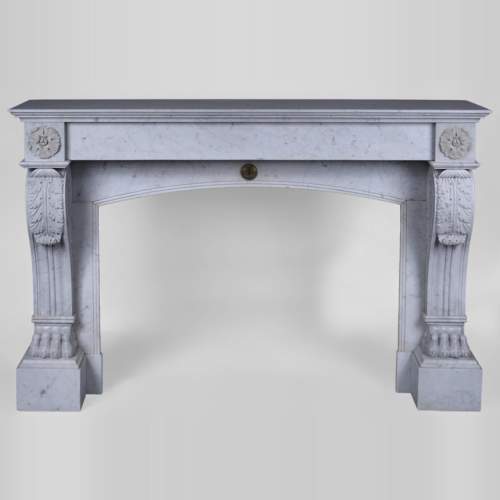
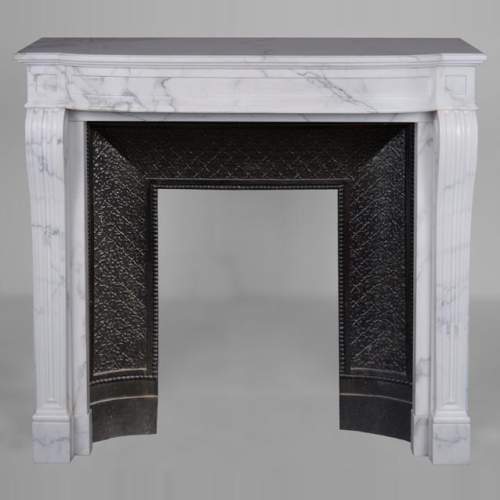
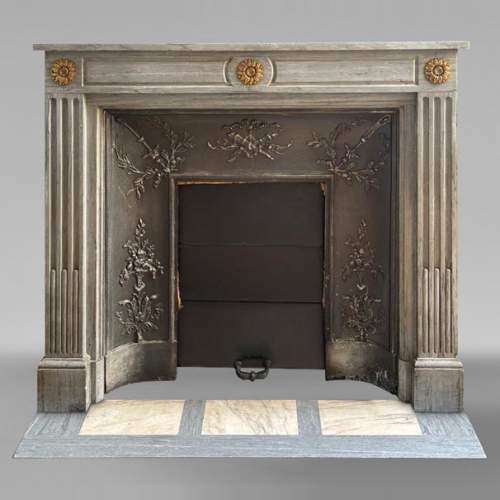
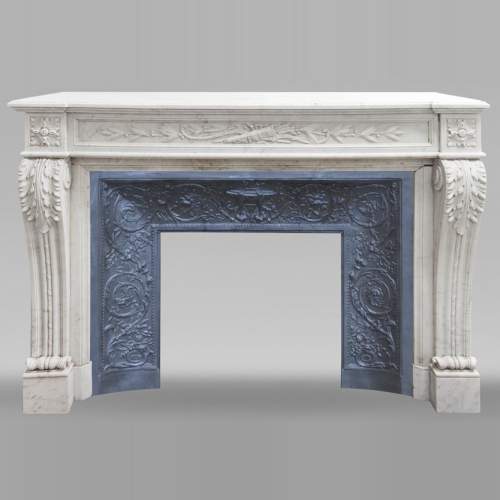
Louis XVI style Arabescato marble mantel with curved entablature decorated with a laurel wreath

Dimensions:
Width: 146 cm
Height: 108 cm
Depth: 38 cm
Inner width: 100 cm
Inner height: 84 cm