menu
Menu
account_box
Categories
Contact
email Send us a message

Contact

phone By phone

+33 (0)1 42 25 12 79
Tue.-Sat., from 10am to 6pm
+33 (0)6 60 62 61 90
Everyday from 9am to 7pm.

email by Email

Adress: contact@marcmaison.com

share Let's get social

Languages
And also...
My selection
(21 Objects)

My selection (21 Objects)


Antique Troubadour style 5 pieces clock set, cast iron and Paris porcelain

Ref.10634
Antique Troubadour style 5 pieces clock set, cast iron and Paris porcelain

This important Troubadour style fireplace garniture was realized in the 19th century. It includes a clock, two candelabras with six branches and two candlesticks, the set being made out of cast iron decorated with Paris porcelain. A knight in armor leaning on an ax, his cuirass and shield on the ground, is accompanied by his young squire. He sets foot on an enemy flag. The group is mounted on a pedestal evoking medieval architecture by arches and a pediment in Neo-Gothic style . Three sides are decorated with painted porcelain plates, with grisaille decorations on a beautiful starry blue background. The deep blue is highlighted by golden paint and pink and water-green ornaments, evoking the art of illuminations. The dial is decorated with medieval grisaille arms on a star-blue background. Two hands, chiselled with interlacings, indicate the hours painted in gold. Under the central panel an oval medallion depicts a medieval king, framed by crawling dragons. On each side, the arc-shaped porcelain plates represent knights in picturesque armor, in an ark decorated with chimeras, and in front of which cast iron war trophies are placed. The two large six-branched candelabra, and the two small candlesticks, are also decorated with medallions depicting weapons and kings' faces, and their shape recalls a legendary Middle Ages. The long hair of the characters, with large mustaches and winged helmets, indicate fantastic Gaulish warriors, perhaps Vercingetorix, whose memory had been popularized by Napoleon III.

Dimensions:
Width: 43 cm
Height: 70 cm
Depth: 23 cm

Maison GIROUX and Ferdinand DUVINAGE - Exceptional and rare cup with waders with iridescent glass and electroplated decor, circa 1870-1880

Ref.13630
Maison GIROUX and Ferdinand DUVINAGE - Exceptional and rare cup with waders with iridescent glass and electroplated decor, circa 1870-1880

This cup made in the 1870-1880’s by the maison Giroux, as indicates the signature on the mount, is a piece extremely rare because of the material used. Indeed, few models with iridescent glass are known today. The Japanese inspiration of the decor and the model of our cup indicate that it is a creation of Ferdinand Duvinage who takes the direction of the maison Giroux between 1867 and 1876, then taken by his widow when he dies. This store which was originally selling all kind of supplies and small objects such as paints, varnishes, albums, writing-papers, fans, toys, boxes and souvenirs, but also lithographs, drawings and watercolors, considerably developed in the first decades of the 19th century. First, because they count among the clients, important persons such as the Duchesse de Berry, Louis XVIII or even Charles X, then by the drive given by Alphonse Giroux’s sons who joined the firm in 1833. Thus, Alphonse-Gustave Giroux, the eldest son, had the idea to sell small furniture. Even though he was an artist himself, he worked like furniture dealers of the 18th century, with artists who did not have the right to put their signature and exerted a hold over the design of the creation that he chose. He also decided to move the store in the new Opera district on the corner of the 43 boulevard des Capucines and the 24 rue Neuve des Capucines in 1855. On this same year, the company which had already won medals for the quality of its production during previous events, sells during the World Fair, to the Impress Eugénie, a bonheur du jour, conserved today in the château de Compiègne. In 1867, the store direction is given to Ferdinand Duvinage, Harinkouck and Brune. Little things are known about Harinkouck and Brune who seem to have been associated for a short period of time as Duvinage remains the only one in 1874. Ferdinand Duvinage (1813-1876) who seems to be cousin with Alphonse-Gustave Giroux, joins the company during a few years before taking its direction, without changing the name. He files in 1874, 1876 and 1877 patents for a marquetry technique of mosaic with metallic partitioning for furniture and art objects. His method is really original because it involves the combined union of ivory as a base, wood for the designs or ornaments, and copper or other metal to partitioning the ivory fragments. The firm continues to participate to World Fairs where they win many medals, even though they are not that much mentioned by the critics, we know that the productions with the Japanese vocabulary created under the direction of Duvinage were also very appreciated and were a real commercial success. As said above, our cup takes the form of a very known Duvinage model, of which the decor was made with the cloisonne ivory marquetry, invented in 1874. Here, the silvered mount, taking the shape o three waders, supports the iridescent glass cup covered with a decor made according to the electroplated method, famous thanks to Christofle. The motif of which the vivid colors are suggested by many shades created by the proceed and the painting, is composed of a wader in a very luxurious natural decor where are coexisting insects, lizard and different Japanese plants. The scene is made particularly naturalist thanks to the precision given to the many details, which are not only on the visible side of the cup but also under it. Indeed, when we turn over the cup, we can admire the splendid mount taking the shape of blooming cherry tree branches, of which the colors are again given by the electroplated proceed, joining the feet by a medallion on the center where we can read the signature.

Dimensions:
Height: 11 cm

Mirror with polychrome enamel decoration of Nasrid inspiration signed and dated 1886

Ref.14042
Mirror with polychrome enamel decoration of Nasrid inspiration signed and dated 1886

.noticeclient.container { display:flex; flex-direction:column; gap:0px; width: 100%; } .noticeclient img { border-radius: 5px; box-shadow: 0px 0px 5px grey; } .noticeclient-section { display: flex; flex-direction: row; gap: 0px } .noticeclient figcaption { text-align: center; } .noticeclient figure { width: none; text-align: center; } @media screen and (max-width: 640px) { /* .noticeclient figure { width: none; text-align: center; } */ .noticeclient img { width: none;} .noticeclient-section { flex-direction: column; } } This superb mirror with polychrome enamel decoration is an exceptional piece inspired by Nasrid art, representative of the architectural and decorative forms of the Alhambra Palace. Mr. Philippe Imberton is, at the present time, the king of enamel; he sows it on the glass, with a prodigal and brilliant hand, early by large plates, sometimes by light veins, but in such a way as to always produce the happiest decorative effects. Article by Louis Enault in La Presse, published on September 25th, 1884. The geometric and vegetal patterns are a real innovative achievement in the glass enameling industry. Arranged on a rectangular mirror, the enamels are elegantly composed and colored to form a Nasrid-inspired decoration, representative of a Mudejar architecture, and manifesting the cultural and artistic exchanges in the Iberian Peninsula in the 12th and 16th centuries. The outline of enamels in the form of a horseshoe arch is a typical element of Arabic-Andalusian architecture, visible from early Christian churches to converted mosques. Polylobed arche Aljaferia Palace in Saragossa Muqarnas seilings in the Alhambra Palace in Granada The horseshoe arch is supported by very thin columns with a concave base and molded rings, a unique type of column that appears only in the Alhambra Palace and indicates the passage to a sacred or royal place. The capital is divided into two bodies, the first of which is cylindrical and has a voluptuous floral decoration. Above, a prism decorated with a plant frieze with a rounded base delicately curves the whole mirror. I have rarely seen more power combined with greater skill. Article by Louis Enault in La Presse, published on December 17th, 1880. The talent of the enameler is rendered by the richness of the polychrome ornamentation of the vegetal patterns, notably by the arabesques of the polylobed arch, that is to say small contiguous arches, each ending in a pointed arch, also polylobed. These arches also evoke the muqarnas vault, one of the most impressive decorative elements among the ornamentation used in the Alhambra. The alfiz, the frame that surrounds the outside of the arch, is decorated with intricate bands of red and yellow floral filigree. The entire portico is framed by regular and harmonious friezes, decorated with vegetal motifs and structured by lines of small white flowers. Six wild pomegranate flowers, also known as balaustes, are framed on a white enamel background by the eight-pointed star, a recurring figure throughout Islamic art. The flowers are slightly open and accompanied by small pomegranate seeds, a connotation of fertility and the literal symbol of the city of Granada, where the Alhambra is located. The decoration is also characterized by four mirrored fleur-de-lis, as if to express the meeting of the two monotheistic influences in Granada. We can see the extent of refinement in the detail of the rhinestone fixtures that attach the glass mirror to a wooden support. While the representation of human figures in Muslim art is prohibited, the reflections of faces in the mirror naturally thwart the ban. One can read in an article of the Arts Industriels, published in La Presse on September 25, 1884, some lines notifying a mirror preceding ours: It will not displease the women either to find themselves beautiful by reflecting their fresh faces in this pretty oriental mirror, whose marvellous framing joins the charm of the motive to the splendour of the colorings. The dynamic ornamentation finely worked highlights the Arabo-Andalusian influences of a lush vegetation, stylized with flowers and polychrome arabesques. The structured yet dreamlike appearance of the decoration gives this mirror a solemn and majestic look, adding depth to the silver-covered glass piece. The lines of the polylobed arch are characteristic of Ottoman architecture, as well as the use of vegetal motifs decorated with interlacing, geometric or floral networks. The complexity of the cloisonné enamels, a real innovation for the time, confirms the mastery the glassmaker. Alhambra Palace, in Granada in Spain Philippe Imberton affirmed his audacity and originality when he exhibited a remarkable oriental kiosk in the center of the great nave of the Palais de l'Industrie in 1880. He brought together all his savoir-faire, all his applications of enamel on different objects and supports. His stand presented numerous novelties such as stained glass enamel and enameled porcelain, a very successful attempt and "to which we believe a great future". JACQUES-PHILIPPE IMBERTON Originally from Portugal, Jacques-Philippe Imberton was a glassmaker, enameler and inlayer of first rank, recognized for his tireless research in the production of enamels on glass. He participated in the revival of the polychrome enameled glass industry in the 19th century, in which he was the inventor of a new enamelling process on glass that took his name. After a period of oblivion linked to the decline of the seventeenth century, the multitude of enamelled glass pieces exhibited in 1878 at the Paris World Fair, including notable pieces by Philippe Imberton, contributed to the rediscovery of enamel on glass, as well as the Ottoman motifs which became a source of inspiration for Western ceramists. He worked in 1882 at Bucan and Duponthieu and realized some projects for the Appert brothers in Clichy. Between 1878 and 1891 he set up his workshops at 21 rue Rochechouart in the north of Paris, as well as a store at 38 boulevard des Italiens. He quickly developed an original style of his own, notably by the persistent use of turquoise blue and by his mixture of enamels, cloisonné with gold or vitrifiable colors, favored by a special composition that he applied by hand. The pieces are then blown and heated until the enamel is completely fused to the glass. His technique of enameling glass makes his pieces true works of art "with a sparkling and fragile substance", as much by the purity of the forms, the delicacy of the ornaments as by the richness of tone. Pair of enamelled glass stained glass windows decorated with a vase of flowers At the head of modern enameling, P. Imberton is distinguished by the rare and precious quality of his solid enamel and is thus closer to the great oriental artists. Indeed, the energetic sharpness of his colored enamels recalls the wonders found in the mosques of Cairo, Damascus or Constantinople, of which he will undertake some reconstructions of Arab masterpieces. Sometimes in the taste of the Renaissance, or in the Byzantine or Persian taste, he develops a new process of application of enamel on stained glass windows of the most original, where the enamel forms on the glass of brilliant laces, of an original design and an incomparable brightness. Some of his pieces are true specimens of luxury glassware, some of which are kept at the Corning Museum of Glass and the Museum of the Conservatoire National des Arts et Métiers. In 1884, he donated to the Conservatoire National des Arts et Métiers a collection of samples showing the successive stages of his technique of applying enamels to glass. His innovations, as well as his curiosity, earned him notable success at the Universal Exhibitions in which he participated, including those of 1878 in Paris, 1884 in Amsterdam, and 1888 in Barcelona, where he was awarded gold medals.

Dimensions:
Width: 48 cm
Height: 80 cm
Depth: 3 cm

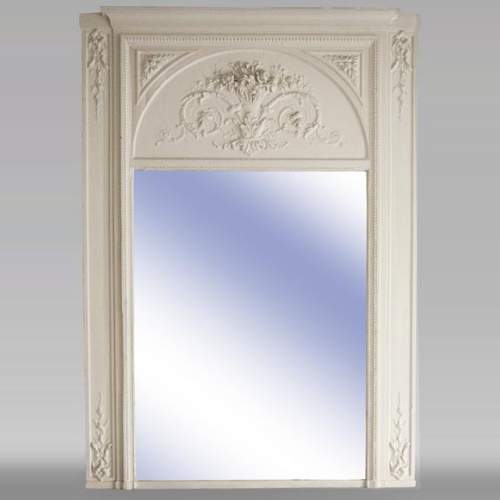
Louis XVI style mantel with curved flutes and carved capitals in highly veined Arabescato marble

Dimensions:
Width: 145 cm
Height: 111 cm
Depth: 40 cm
Inner width: 94 cm
Inner height: 86 cm

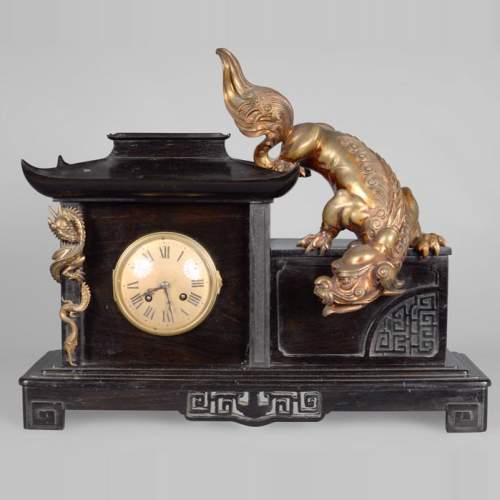
L'ESCALIER DE CRISTAL, Vase Clock with Dragon Mount, after 1885

Ref.11159
L'ESCALIER DE CRISTAL, Vase Clock with Dragon Mount, after 1885

This highly original bronze vase clock was created for Escalier de Cristal at the end of the 19th century. The clock movement is signed “Japy Brothers & Co”. Founded around 1808 by Widow Désarnaud, this famous house was taken over by brothers Georges and Henri Pannier at the end of the 19th century. They actively contributed to the spread of the Japonism trend, of which this work is a fine example, while maintaining the high quality that made the store renowned. The decoration of the piece, of great craftsmanship, is inspired by Japanese iconography and revolves around the theme of the dragon. The clock adopts the form of a vase resting on a gilt bronze mount shaped like a threatening dragon at the front, and clouds of smoke at the back. The body is adorned with low-relief motifs reminiscent of Japanese Meiji-era panels. An Asian warrior is depicted preparing to battle a dragon. At the top, a polylobed dial set against a matching motif displays numbers inscribed in Japanese calligraphy, along with two hands forming a dragon whose shape constantly evolves with the hours. The piece is crowned with a Foo dog stretching on its front paws. The quality of execution and the chiseling of the base demonstrate the mastery of the bronzesmith who created the object. The vase clock is listed in one of Henry Pannier’s notebooks under the designation “Crystal vase with dragon mount forming clock”. The sketch shows an undeniable resemblance to our piece. The notebook also indicates that only two vase clocks were sold: one in crystal and the other in bronze.

Dimensions:
Width: 31 cm
Height: 56 cm
Depth: 26 cm