menu
Menu
account_box
Categories
Contact
email Send us a message

Contact

phone By phone

+33 (0)1 42 25 12 79
Tue.-Sat., from 10am to 6pm
+33 (0)6 60 62 61 90
Everyday from 9am to 7pm.

email by Email

Adress: contact@marcmaison.com

share Let's get social

Languages
And also...
My selection
(47 Objects)

My selection (47 Objects)


Rare pair of cast iron andirons shaped as a laying dog, Wallonia, 16th century

Ref.12745
Rare pair of cast iron andirons shaped as a laying dog, Wallonia, 16th century

Product of the popular figurative art of Wallonia, this pair of andirons made in the 16th century in cast iron shows a naive beauty but is also a testimony of some kind of aesthetic concerns. Made in a zoomorphic shape, the Musée Gaumais, where a similar pair is preserved, describes them as a representation of laying dogs. However, our andirons shows distinctly the representation of hair all around the neck suggesting a mane. Furthermore the representation of the head can also lets us think that a lion is represented instead of a dog. The author of those andirons didn't only give a shape to their visible parts. Indeed the back shows as much precised details with the add of a relief scroll on each side, in which we can see a stylization of the back legs. Also, a small ornamental bolection was added on the andiron's body. It's a very certain inventive spirit, a dexterity but also a sensitivity that the popular art in Wallonia expresses through this pair of andirons. The Wallonia is a French speaking region of the Belgium's south. It is famous for its medieval cities and its Renaissance architecture. Nevertheless, we can't find a real stylistic unity in the region because of the neighbors variety and sometimes the different influences from the outside, without saying the individualism. In olden days, we could count simultaneously and on a very small area, subjects of the Liège Prince-Archbishop, Limbourg or Luxembourg Duke, Prince-Abbot of Stavelot-Malmedy, Namur or Hainaut Count, either independent or under the Burgundian, Spanish, Austrian or French tutelage. This historic past that has divided the actual Wallonia into divided political territories, sometimes rivals, can also explains this dispersal.

Dimensions:
Width: 8 cm
Height: 18 cm
Depth: 43 cm

Antique Neo-gothic style wood and cardboard fireplace

Dimensions:
Width: 242 cm
Height: 180 cm
Depth: 86 cm
Inner width: 135 cm
Inner height: 119 cm

Beautiful Louis XV period mantel in grey Sainte Anne marble

Dimensions:
Width: 188 cm
Height: 125 cm
Depth: 35 cm
Inner width: 143 cm
Inner height: 100 cm

Émile BRACQUEMOND, Octave GUILLONNET, Winner's vase, 1924

Ref.13009
Émile BRACQUEMOND, Octave GUILLONNET, Winner's vase, 1924

This vase was created by the painter Octave Guillonnet and the ceramicist Émile Bracquemond for the Sèvres Manufacture on the occasion of the Paris Olympic Games in 1924. Octave Guillonnet (Paris, 1872-Montgeron, 1967) was an Orientalist painter who could also be considered a sports painter: he notably exhibited a monumental “rugby match” at the 1899 salon. He was also a member of the Society of Sport Painters and Sculptors from its foundation in 1922. The career of Émile Bracquemond (Paris, 1889-Clichy, 1970) is less well-known. However, it seems that besides his collaboration with the Sèvres Manufacture, he was particularly recognized for his feline sculptures. The order for commemorative vases to be awarded to the winners of sporting events was placed by the city of Paris in anticipation of the 1924 Olympic Games to promote the production of the Sèvres Manufacture. Although Pierre de Coubertin was opposed to awarding trophies to winners, the project, once launched, was completed for this edition only. Subsequently, the rules were changed, and winners were awarded only medals. The shape of this vase is very simple: the body flares out in an almost straight line from the base to two-thirds of its height before tapering towards the neck. The neck is adorned with a gray band bordered by a gold stripe, decorated with silhouettes of biplanes left in reserve. The body of the vase, with its subtly shaded blue glaze, features four pâte-sur-pâte scenes, each honoring a different sport. In the case of our vase, polo, Basque pelota (the athlete holds a chistera), and gymnastics apparatus are represented. The sports are depicted very precisely, with each discipline represented by a characteristic gesture. The slight relief of these decorations gives them greater depth and liveliness. While the winner’s vases were usually covered with a gold and brown decoration representing laurel branches, ours has a plain blue background that distinguishes it from the others. Not all the disciplines represented on our vase were Olympic sports in 1924. Indeed, Basque pelota was only presented as a demonstration sport at this edition of the competition. Moreover, polo, which was an Olympic sport in 1924, is no longer part of the Games today. There are four models in total for these commemorative vases, each depicting four different sports. The Sports Museum has a copy of each model, providing a complete overview. The sports represented on the other vases are as follows: rugby, rowing, diving, and football; javelin, wrestling, shot put, and boxing; tennis, cycling, sailing, and shooting. This winner’s vase is therefore both a historical and artistic testament to the 1924 Olympic Games, which will resonate on the centenary of this event and the Paris Olympic Games in 2024, particularly within the framework of the edition by the manufacture of trophy vases created by six artists from the Beaux-Arts de Paris, intended to be awarded to the French gold medalists at the Paris 2024 Games.

Dimensions:
Height: 33 cm

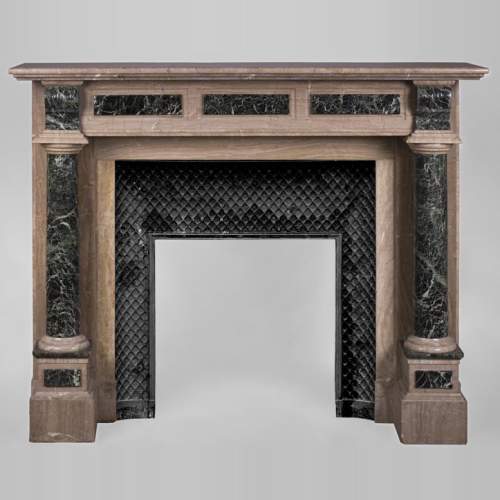
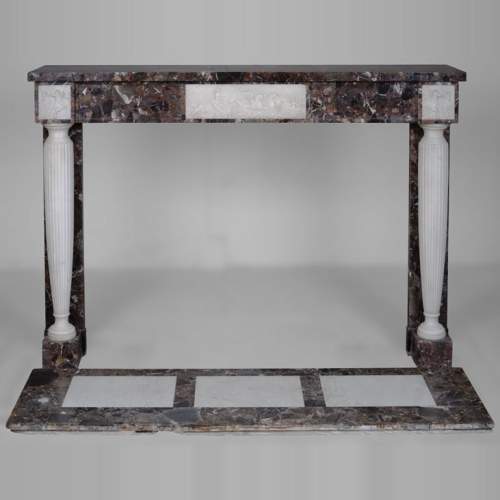
Louis XIV style mantel with acroterion in Rouge du Nord marble

Dimensions:
Width: 145 cm
Height: 126 cm
Inner width: 111 cm
Inner height: 94 cm

Persian-style double-sided clock and garnitures, Charles Stanislas MATIFAT, dated 1851

Ref.15732
Persian-style double-sided clock and garnitures, Charles Stanislas MATIFAT, dated 1851

Charles Stanislas Matifat is the creator of this ensemble consisting of a double-sided enameled bronze clock and a matching pair of large garnitures. Dated 1851 and bearing his signature, the clock was designed for both European tastes and the Ottoman-Persian market. This model was presented in the French section of the 1851 Great Exhibition in London. The MATIFAT display was located at the heart of the Crystal Palace, showcasing Parisian decorative arts of the mid-19th century. The clock features two white enamel dials: one with Roman numerals for European time (Paris or London), and the other on the reverse with Turkish numerals. This dual display made the piece suitable for different cultural time systems. Around this time, MATIFAT developed a vitreous enamel process on bronze, enabling highly refined decoration. The gilded bronze case is richly adorned with polychrome enamel motifs inspired by Persian decorative arts: scrollwork, stylized foliage, rosettes, and interlacing patterns. The openwork base includes enameled escutcheons. The two side garnitures echo the same cloisonné enamel decoration, in tones of green, blue, white, and gold. Their complex architectural shapes and scroll-like handles reflect the orientalist aesthetic popular in the decorative arts of the period. Recognized as one of the most important Parisian art founders of his time, MATIFAT also created decorative objects such as chandeliers, fountains, and vases. He collaborated with major sculptors like Carpeaux and Frémiet, and his work was appreciated by Charles Garnier.

Dimensions:
Width: 31 cm
Height: 66 cm
Depth: 25 cm

STEINER, Hermann, The Lost Soul

Ref.10540
STEINER, Hermann, The Lost Soul

This small sculpture in carved walnut, a work of fabulous inventiveness, is by the Tyrolean artist Hermann Steiner (Merano, 1878-1963). Son of the sculptor Sebastian Steiner and husband of the painter Adele Perlemutter, he created works of rare intensity, combining sacred and secular themes. Furniture, ornamental masks, virtuoso sculptures—Steiner's art conjures mysterious figures from the depths of the wood. According to the Thieme-Becker and Benezit biographical dictionaries of artists, Hermann Steiner was awarded a gold medal at the 1904 St. Louis World's Fair. A few of his pieces are exhibited in museum collections: the Vatican Museums hold a carved rosary by the artist. Representing Austria, Steiner participated in the Deutsche Luftkriegsbeute Ausstellung exhibition in Munich in 1918, exhibited at the Milan International Fair in 1952, and at the Bari International Fair in 1955. Our sculpture depicts a swarm of faces from which a bust-length man stands out, representing the human soul, his arms folded in an attitude of both protest and protection. A group of four distorted faces comes to life in a whirlwind of malevolent spirits seeking to drive the soul to its doom. In this chaos, the human soul seems to have found salvation: the exchange of glances with the angelic face is the only reciprocal interaction between the figures in the sculpted group. Seeking the soul with his gaze, a final demon, positioned between the human figure and the cherub, makes one last attempt to lure it toward vice. This virtuoso work, imbued with a palpable sense of inner life, reflects the temptations and choices that torment and trouble the human soul. Signed "H. Steiner," our piece rests on a separate wooden base.

Dimensions:
Width: 32 cm
Height: 16 cm
Depth: 17 cm

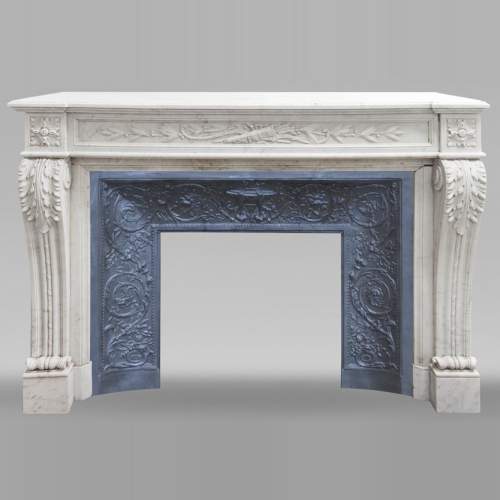
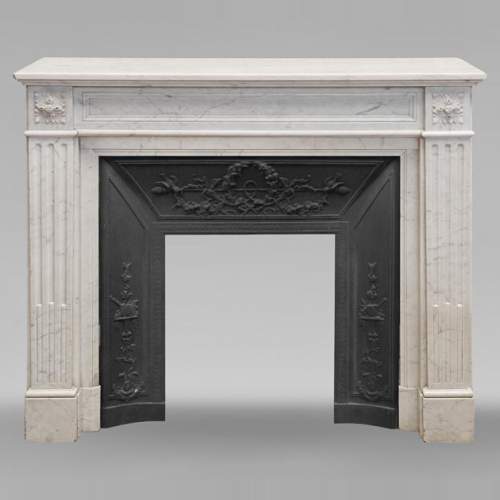
Louis XVI style fireplace with acanthus leaves and beading, in Carrara marble

Dimensions:
Width: 145 cm
Height: 110 cm
Depth: 42 cm
Inner width: 103 cm
Inner height: 84 cm

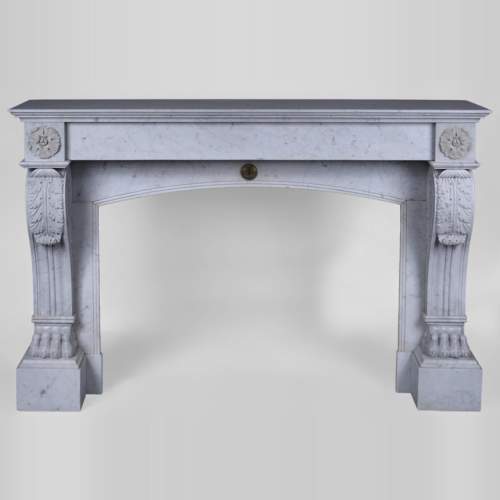
Napoleon III period fireplace with lion's paw feet, in Carrara marble

Dimensions:
Width: 158 cm
Height: 110 cm
Depth: 50 cm
Inner width: 116 cm
Inner height: 81 cm