Ref.16867
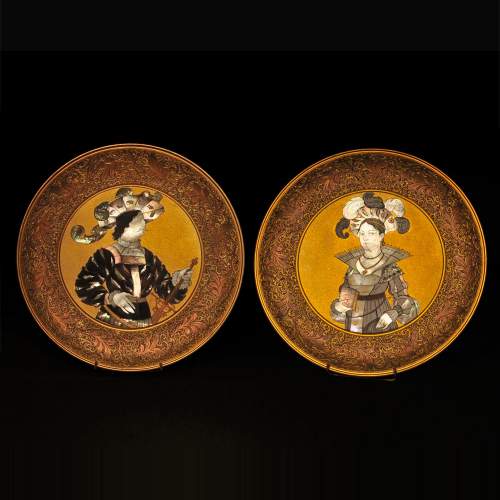
Maison KAYSER SOHN, Renaissance Personalities, Pair of plates decorated in corviniello
Copper, mother-of-pearl, tortoiseshell Signed “J. P. Kayser Sohn, Crefeld”; on the reverse “Corviniello Patent 82” (female figure) Signed “J. P. Kayser Sohn, Crefeld”; on the reverse “Corviniello Patent 83” (male figure) The house of Kayser Sohn, founded in 1862, in the area of Dusseldorf, originally specialized in the manufacture of metal objects. The company made a name for itself mainly in the production of Art Nouveau pewter ware that was manufactured in Krefeld based on highly finished models designed in their Cologne workshop. The Kayser Shon brothers reached the height of their careers between 1889 and 1902 and participated in various exhibitions at the beginning of the 20th century, notably in Paris, in 1900, where they won a gold medal, at the Exhibition of Decorative Arts in Turin, in 1902 (again winning a gold metal), and at the International Exhibition that took place in Saint Louis, in 1904. The company was equally well known at the beginning of the 20th century for the very original inlay technique that used mother-of-pearl and tortoiseshell, a process that also involved electroplating, known as corviniello. This is a perfect example of the union of art and industrial technique, and this process was used to create the ornamentation in the central part of this plate. One of the plates represents a young, elegant woman attired in a shimmering costume and wearing a feathered hat. The figure is finely engraved, giving an extremely realistic effect. The pendant plate represents a man with a belligerent look whose hand rests on the hilt of his sword. The artist has used the various materials to their best advantage in portraying his doublet. The close similarity in the treatment of the hands and the eyes allows us to attribute the design of the two personages to the same draughtsman. Executed mainly in mother-of-pearl and tortoiseshell, the two figures wear the Renaissance style costumes that were so fashionable at the end of the 19th century. Perfected by Otto von Corvin, this technique required extreme precision in its execution and demanded both great concentration and expert knowledge of the materials used. The artisan first had to cut out the mother-of-pearl and tortoiseshell elements in the most meticulous manner and then temporarily glue the pieces onto a die mould. The die mould was then varnished with an insulating coating while the pieces that were to be inlaid were covered with a conducting substance. The deposit of the metallic layer was done by electrolysis and it covered the bottom of the die mould, surrounding the glued elements. The die mould was then detached, exposing a smooth surface where the joints are extremely precise, with metallic filaments filling in the cracks. Certain parts of the figures have been left blank and were not inlaid, such as the rings or the edge of the book the woman carries, thus leaving the metal background of the plate exposed and demonstrating the technical virtuosity of the casting. The border, made entirely of metal, emphasizes the contrast between the polished gilt copper and the delicate scrolls interspersed with foliage. The finely engraved decoration is identical to those produced on other plates made by the Kayser Sohn company, which indicates that such plates with the same border were likely produced in quantity, differing only in the decoration used for the center. The difference of the dating of the two pieces (1882 for the female figure and 1883 for the man) further supports this supposition. Neo-Renaissance style.