menu
Menu
account_box
Categories
Contact
email Send us a message

Contact us

phone By phone

+33 (0)1 42 25 12 79
Tue.-Sat., from 10am to 6pm
+33 (0)6 60 62 61 90
Everyday from 9am to 7pm.

email by Email

Adress: contact@marcmaison.com

share Let's get social

Languages
And also...
My selection
(5 Objects)

My selection (5 Objects)


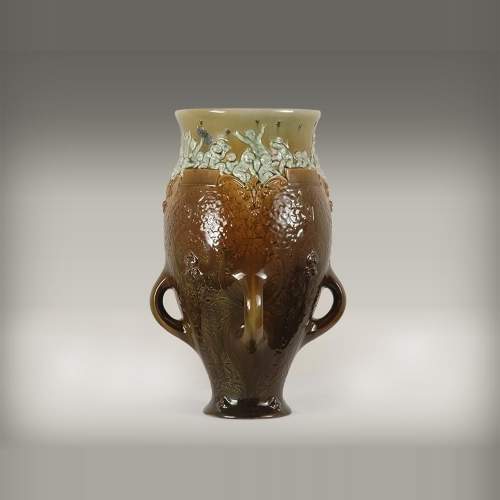
Louis-Robert CARRIER-BELLEUSE (1848 - 1913) and POTTERY FROM CHOISY LE ROI (1863 -1938),  "Children and Butterflies"

Ref.15230
Louis-Robert CARRIER-BELLEUSE (1848 - 1913) and POTTERY FROM CHOISY LE ROI (1863 -1938), "Children and Butterflies"

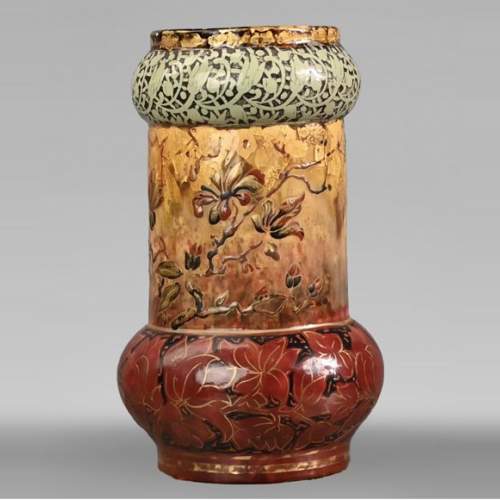
Stoneware model presented at the Exposition of the National Society of Fine-Arts in 1898, under the number 4060, with three other vases: Run for your lives! Hercules and Omphale and Music. Reproduced in Antique and Modern Decoration, 7th year, 1900, drawing 66. Enameled pottery.This vase has a slender form that contrasts the four handles. The body is completely decorated with floral or purely decorative elements while the characters are restricted to the neck level. A frieze of cherubs chasing butterflies develops along the neck, in a round frenzy. A brown tint covers the entire piece but fades in the upper part, thus becoming more yellow. This vase displays a decor that combines different techniques. The body of the vase is decorated with a floral decor which mixes elements in relief and engraved elements. The frieze of children is produced in clay on clay. This process, perfected at the Factory of Sevres around 1848 was frequently used by sculptors, which Louis Carrier-Belleuse was. It consists of applying generally white motifs on a colored background. However, the totality of the piece has been enameled which contributes to giving light green reflections to the bodies of the children. This original vase mixes two inspirations: the frieze of cherubs resembles the production of the Second Empire while the body of the vase displays plant elements indicating Art Nouveau.In the Exposition of the National Society of Fine-Arts in 1898, this vase appeared for the first time in stoneware, accompanied by three other vases: Hercules and Omphale, Run for your lives! and Music. These four vases are presented under the same number (no. 4060) and in the same display window. Three of the four vases, including Children and Butterflies, were reproduced, in 1900, in the review of Antique and Modern Decoration. Children and Butterflies was acquired in 2003 by Musee du Petit Palais, in Paris, and it is one of the rare examples of a vase by this artist conserved in a public French collection. The same year,  he exhibited a fifth vase under the number 4059, entitled Farming. The vase that we present, produced in stoneware, is not the one presented at the Exposition in 1898. However, its reproduction, by the pottery in Choisy-Le-Roi proves the popularity of this model and its creator.

Dimensions:
Width: 28 cm
Height: 45 cm

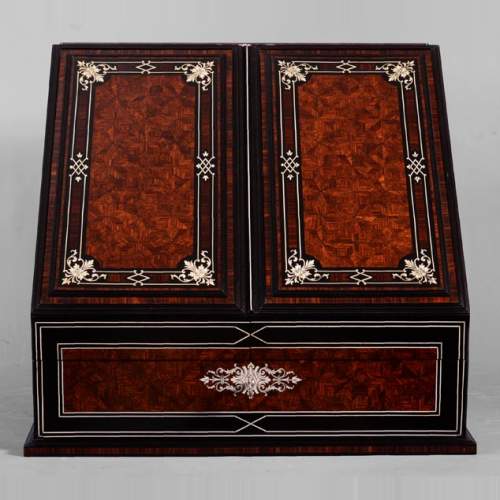
Maison SORMANI, Luxurious writing set in mahogany, ebony and ivory marquetry

Ref.11536
Maison SORMANI, Luxurious writing set in mahogany, ebony and ivory marquetry

This luxurious writing set was made by the great Maison Sormani around 1875, as indicated by the calendar and the signature « Veuve P. Sormani & Fils, 10 r.Charlot PARIS ». Indeed, this signature is used between 1866, the year Paul Sormani died, and 1886, the year Paul-Charles Sormani took over the company on his own. The Maison Sormani is considered one of the greatest luxury manufacture during the Second Empire and until the beginnings of the 20th century. One of the reasons to their success is that the Impress, Eugénie, used to decorate her palaces with the creations of the house. The lattest was founded by Paul Sormani (1817-1866), who was born in Italy, but settled his shop in Paris as soon as 1847. He initially concentrated himself on small, fancy pieces, exploiting the techniques of marquetry and leatherwork, before specialising himself in the reproduction of ancient furniture often due to the greatest cabinetmakers of the 18th century, which could be found in particuler in the royal furniture store. Paul Sormani entered all the World’s Fairs that punctuated the second half of the 19th century, wining twice a silver medal in 1855 and 1867, and once a bronze one in 1862. After his death in 1866,his wife and his son Paul-Charles (1848-1926) took over his activity under the corporate name « Sormani Veuve Paul et Fils » (meaning, « Sormani widow Paul and sons ») until 1886, when Paul-Charles became the only director. The workshops of the 10, rue Charlot used to employ about a hundred of workers, amongst them leather craftsmen, goldsmiths, cabinetmakers, etc. and collaborated with famous artists, like the designer and cabinetmaker Edouard Lièvre (1828-1886) for some pieces of furniture. The house’s success remains constant as testified by the participation to the World’s Fairs of 1878, 1883 and 1889, where it was awarded respectively a gold medal, the Diplôme d’honneur and the Grand Prix. In 1914, Paul-Charles Sormani associated himself with Thiebault Frères, creating the Thiebault-Sormani firm settled at the 134, Boulevard Haussmann, and which production was characterised by high quality pieces in the Louis XV and Louis XVI styles. The firm closed in 1934. Our writing set is characteristic of the luxuous production of marquetry of the Maison Sormani. With a sumptuous mahogany and ebony marquetry adorned with refined ivory patterns, the angled chest opens itself through two frontal doors, discovering plenty of small compartments with serrated edges where one was supposed to put the letters, paper and ink pot. The left door leaf is lined with electric blue velvet, and thought in order to welcome all the small tools with their ivory handles necessary to write a correspondence, such as a seal or a dip pen. Meanwhile, the right door leaf retains a calendar dating back from 1875, and a piece of paper on which some inscriptions are still legible. Underneath is a drawer locked with a key, allowing to keep the correspondences safe.

Dimensions:
Width: 41 cm
Height: 37 cm
Depth: 31 cm

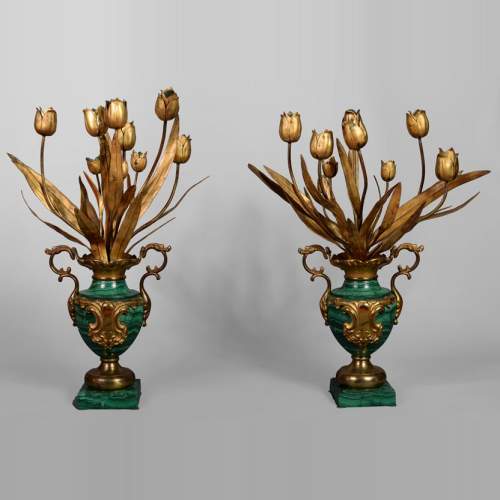
Pair of vases in malachite and gilt bronze, Russia, late 19th century

Ref.13299
Pair of vases in malachite and gilt bronze, Russia, late 19th century

This beautiful pair of vases was made of gilt bronze and malachite. It's very likely a Russian work from the end of the 19th century. The belly of our vases was made of malachite and welcomes a Rococo style decoration of gilt bronze. The whole decoration was made of gilt bronze, like the handles which are also reminding of the Louis XV style as they are shaped of thin acanthus leaves scrolls, or even the neck where are attached the handles and the foot. Finally, from the neck a beautiful gilt bronze tulips bouquet springs while the vase rests on a small malachite square base. The malachite, is an intense green stone because of its high copper composition, which makes it very appreciated in the 19th century. This stone mainly comes from Russia where important deposit are known since the 17th century, we can name the one called Nijni Taguil, discovered in 1835 and exploited by the Count Demidoff (1812 - 1870). Used in bloc to create small objects, the malachite can't be used for big pieces as the ones we can make in marble. That's why the technic called “Rusian mosaïc” was invented during the second half of the 19th century : malachite strips are inlaid to create the illusion of a block , allowing to put this extraordinary color on walls, columns or other interior elements like in the Malachite Room in the Winter Palace in Saint Petersburg. It's the Royal stone manufactory of Peterhof and Ekaterinbourg that develop this art which quickly seduces the aristocracy. This technic is discovered in France when Alexander I of Russia (1777 - 1825) gifted Napoléon Ier (1769 – 1821) a set of malachite element in 1808. Candelabras, big vases and basins are placed in the Emperor Room in Trianon, which became the “Malachite Room”. The new beauty of this sophisticated art creates an important enthusiasm which lasts during the entire 19th century.

Dimensions:
Width: 38 cm
Height: 61 cm
Depth: 23 cm

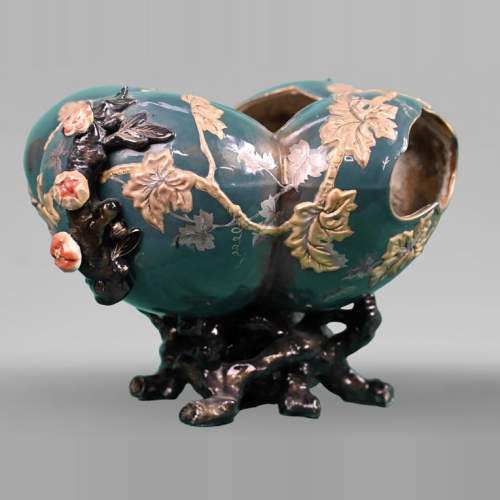
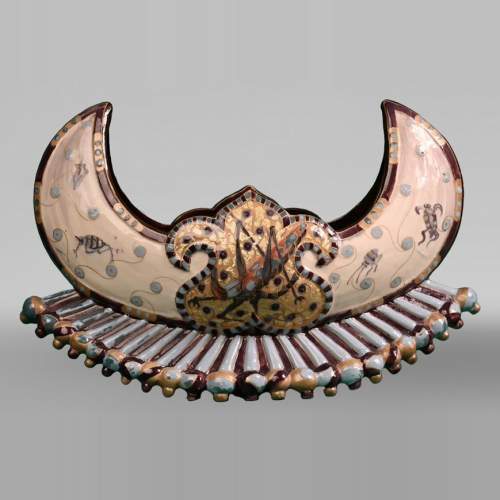
Émile GALLÉ, Jardiniere with a design inspired by the nature of Pharaonic Egypt, circa 1879-1890

Dimensions:
Width: 26 cm
Height: 17 cm
Depth: 15 cm