Ref.10515
After Jean-Auguste BARRE (1811-1896) - Set clock with Marie de Bourgogne going falcon hunting
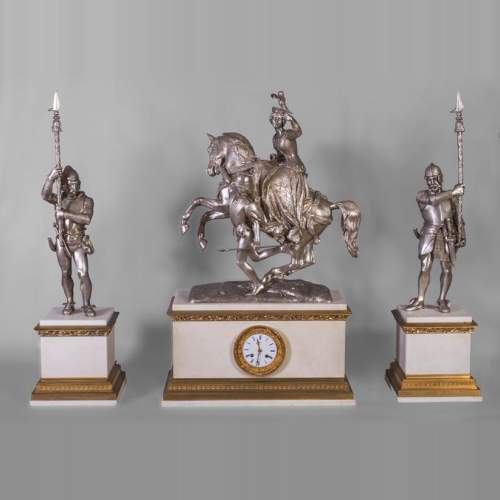
This important silvered bronze, gilded bronze and white Statuary marble clock set was probably made around 1840-1844. The central group is depicting Mary of Burgundy on a falcon hunt, silvered bronze group after the model by Jean-Auguste Barre, placed on a pedestal.
The only daughter of Charles the Bold, Duke of Burgundy, wife of Maximilian, Archduke of Austria and future Emperor, Mary of Burgundy was born in 1457. She became Duchess of Burgundy at the age of twenty, after the death of his father during the siege of Nancy. She is here represented practicing her favorite hobby, the hawk hunt. The moment chosen by the sculptor is crucial: Mary seems carefree while she will deadly fall in only a few minutes. She does not notice the nervousness of the rearing horse, which is barely restrained by the page. A lively movement animates the sculpted group, counterbalanced by the apparent serenity of the duchess. The fatal outcome is even more tragic: she falls from her horse in the Wijnendaal forest and dies a few days later, at the age of 25.
Her destiny fascinates the romantic generation of which Jean-Auguste Barre belongs, in addition to awakening the taste for medieval subjects which is perfectly illustrated in this Troubadour style group. Indeed, the sculptor accurately represents the costumes: Mary wears a sumptuous damask dress and a surcot bordered with ermine and wears a typical small cap of linen under his crown with fleur-de-lys ; the page wears a doublet with broad armholes, breeches, poulaines and a feathered hat. The horse’s harness is meticulously depicted, inlaid with pearls and cabochons. The saddle carpet bears the wedding coat of arms of Burgundy and Habsburg.
The Louvre Museum and the Art Institute of Chicago preserve in their collections a bronze group of the same model.
After a first apprenticeship as a medalist with his father, Jean-Auguste Barre improved his training with David d'Angers and Achille Devéria. He had a long and successful career, receiving important commissions for the state or the imperial family. Favorite portraitist of Napoleon III, Jean-Auguste Barre executed no less than 26 busts of the Emperor and several others of Empress Eugenie. He also made the funerary monument of Queen Hortense de Beauharnais for the church of Rueil-Malmaison in 1858. For the city of Paris, he sculpts a group of four children in bronze symbolizing the seasons (for the Circus fountain at the Champs- Élysées, 1840), La Prudence (for the Saint-Michel fountain, 1860), Saint Luc (for the Saint-Vincent-de-Paul church), and the monumental bronze statue of Pierre-Antoine Berryer for the city of Marseille. He exhibited at the Salon from 1831 to 1886, winning a second class medal in 1834, a first class medal in 1840 and was appointed knight of the Legion of Honour in 1852.
He was also one of the sculptors behind the creation of small female portrait statuettes in the 1830s, giving birth to sculpted groups of small dimensions characteristic of Louis-Philippe's reign and of romantic sculpture.
The group of Mary of Burgundy is then a perfect example of the small romantic sculpture of the mid-nineteenth century. The small sizes are now more adapted to the bourgeois interiors and each model knows many casts, allowing a more constant income to the sculptors. Mary of Burgundy appears on the catalogs of the Susse foundry from 1844.
The clock set we present here is also composed of two halberdiers in armor and helmets, as perfect example of the Troubadour style.