menu
Menu
account_box
Categories
Contact
email Send us a message

Contact us

phone By phone

+33 (0)1 42 25 12 79
Tue.-Sat., from 10am to 6pm
+33 (0)6 60 62 61 90
Everyday from 9am to 7pm.

email by Email

Adress: contact@marcmaison.com

share Let's get social

Languages
And also...
My selection
(11 Objects)

My selection (11 Objects)


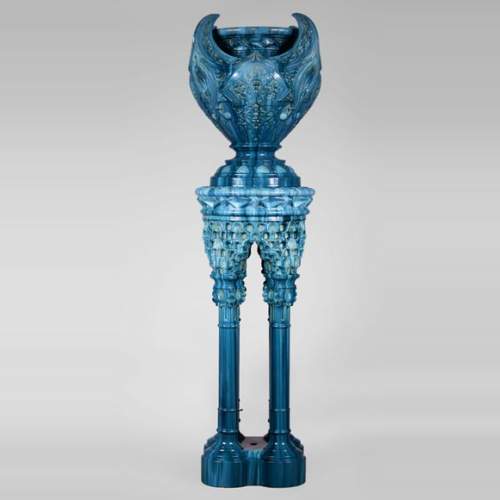
Delphin MASSIER (1836-1907) - Important Orientalist style earthenware planter

Ref.10838
Delphin MASSIER (1836-1907) - Important Orientalist style earthenware planter

This important Orientalist earthenware planter was made around 1880 in the workshops of Delphin Massier, a member of the Massier family which was a dynasty of ceramists established since the 17th century in Vallauris. It consists of a large earthenware vase on a base with four columns adorned with muquarnas and covered with a floral and abstract Oriental ornamentation. The blue tones are both characteristic of the Massier production and of the Orientalism, especially in the field of ceramics. The pottery family tradition began with Pierre Massier (1707-1748) then with Jacques Massier (1806-1871) who gave to the workshop a new lease of life. Indeed, their factory, which was at first a simple workshop with an utilitarian vocation, stood out from the local production tanks to an innovative and artistic production. In Vallauris they introduced an art ceramic, notably thanks to the arrival of the Italian potter Gondolfi Gaetano in 1859, who initiated Delphin and his brother Clément (1844-1917) to numerous practices such as plaster molds and enamelled earthenware decoration techniques. The glory of the Massier family peaked at the turn of the century with Delphin and Clément and their cousin Jerome and son (1830-1916), son of Jerome (1820-1909). Both art ceramists and entrepreneurs, the Massiers had also made themselves known thanks to their elaborate sales catalogs which give us today a way to appreciate the diversity of their productions and to identify their models. The ceramicists family had built its reputation thanks to their ability to innovate (they developed several techniques) and because their productions were inspired by the important trends of the period. The Massiers, who played a certain role in the revival of the decorative arts, are very representative of the characteristic wealth of the 19th century. Thus, if their first realizations were inspired by historicism and eclecticism, Jerome and Delphin will devote themselves later to an Art Nouveau style production. Our planter is inspired by Orientalism, surely one of the greatest artistic movement of the 19th century which inspired the Massier for many creations as we can see in their catalogs where we can also find several similar planters to the one we present. Otherwise, one of the most prestigious realizations of Clément Massier is this planter constitued with a base, almost identical to ours, and a bowl. It is called Large Persian bowl with four columns base, whose one copy is preserved at the Vallauris Museum. Among Orientalism, Moorish Spain is one of the decorators lands of preference which gave them the turquoise blue for example. The Massiers, which developed an important taste for colors, will make green and red, but especially blue, and more precisely peacock blue, like the color of our planter, inspired by the Hispano-Moorish art, their favourite colors. The Massiers collaborated with great artists of their time such as Lévy-Dhurmer, Dominique Zumbo and their talent will be rewarded for example at the Paris World Fair in 1889 where Clement received a gold medal. They acquired an international reputation thanks to competitions and exhibitions in which they participated and had among their clients Victor Hugo or Emile Zola. This beautiful planter, with its exceptional large dimensions, its rich polychrome and its abstract and floral ornamentation, reflects both the taste for the Orient and the production of the Massier family, surely the most known dynasty of ceramists of the 19th century.

Dimensions:
Width: 50 cm
Height: 174 cm
Depth: 50 cm

Léon MESSAGÉ (1842-1901) (att. to) -  Clock with Cupidon

Ref.15705
Léon MESSAGÉ (1842-1901) (att. to) - Clock with Cupidon

Gilded bronze, enameled face.  This exceptional Louis XV style clock is attributed to the sculptor and decorator, Leon Message, active in the last quarter of the nineteenth century. Made of gilded bronze, this piece adopts the forms of the eighteenth century. Indeed, the arabesques, and decorative vocabulary, are characteristic of the rococo style and of a Juste-Aurele Meissonier, leader of this movement. The clock stands on four winding feet, that suppor themselves on a shelf, in the style of Louis XV decorative clocks. The decorative motifs consist of an inverted shell, foliage and coils, are also specific to the rococo style through their asymmetric treatment, the abundance and decorative character somewhat extravagant. Moreover, the term 'rococo' means, originally, artificial caves, which contained imitations of shells. The abundance of curved lines and the relatively pronounced fantasy of the ensemble are from the eighteenth century. Similarly, the rockery used a lot of grotesques, which is well illustrated here by the presence of a mask of a bearded man crowned with laurel, beneath the clock face. From both sides of this grotesque are dolphins, a motif which one often finds in the works of Léon Messagé. The clock face is surrounded by garlands of leaves lined with flowers, which bloom in the upper part of the clock, giving birth to a small horn on which sits a Cupid, holding his bow in his left hand and wearing his quiver on his back. LÉON MESSAGÉ(March 8, 1842 - May 16, 1901?)Léon Messagé was born March 8, 1842 in Sens, Yonne. At 20 years old, he lived in Paris at 23 rue de Rivoli and was then referred to as 'stone carver.' Around 1885, he began collaborating with François Linke, important cabinetmaker of the Belle Epoque,  providing him models for furniture and ornamental bronzes. They collaborated until the death of Messagé, who lived until the age of 58 and died May, 16 1901. It is through this collaboration with François Linke, that Messagé would be successful during the last decades of the nineteenth century. In fact, Messagé was awarded a gold medal at the 1889 World Fair and it was he who designed all the important furniture for the stand of François Linke for the Universal Exhibition in 1900. Even though he worked hard for Linke, Messagé still remained an independent craftsman, working on his own account. In his studio at 40 rue Sedaine, in the 11th arrondissement of Paris, he was the designer and creator of its models. The fundamental principle of the designs by Messagé is a light rococo, a characteristic asymmetry of rock that Parisian artisans developed in the 1720s. This clock is a good testimony of this lively design and the unique style of Leon Messagé.Although this clock is not signed by him, there is no doubt that it was made by his hand. Indeed, in his notebook drawings and sketches Style Louis XV, published in 1890, there are two drawings of pendulums, very similar to the one presented here. ? ?Moreover, in a book on Francois Linke, a clock very similar to it is illustrated (Christopher Payne, Francois Linke 1855-1946. The Belle Epoque of French Furniture, p. 93). We find the same decorative vocabulary, the same overall composition crowned by a cherub and a similar work of sculpture. On the dial is the signature of Emile Colin et Co, art foundry located at 29 rue Sevigne in Paris, starting in 1843. The latter has participated in numerous expositions, notably that of Chicago in 1893 where she presented a bronze clock mounted on a column of white marble. Everything was completed by a female figure made of bronze according to a work by Piat et Steiner. Like the clock, Emile Colin worked regularly for many renowned artists, such as Carrier-Belleuse Feuchère, Charpentier or Mathurin Moreau. Around 1900, we know that she was making parts based on the models of Léon Messagé, which leads us to date this clock to that time. Colin's company was also present at the Exposition Universelle in Paris in 1900. 

Dimensions:
Width: 34 cm
Height: 60 cm
Depth: 23 cm

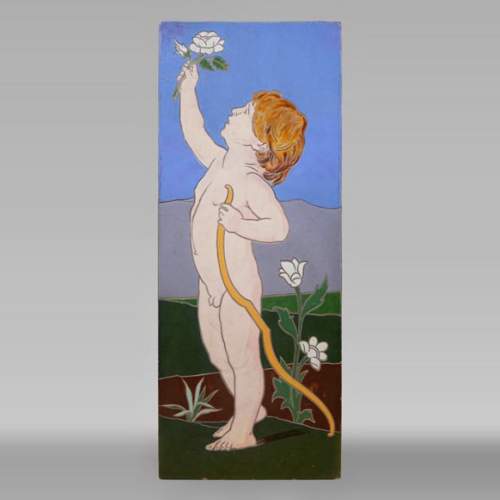
Jules LOEBNITZ (1836 – 1895), Ceramic panel “Child with a flower”

Ref.12841
Jules LOEBNITZ (1836 – 1895), Ceramic panel “Child with a flower”

This rectangular panel made of enameled ceramic made by Jules Loebnitz in the second half of the 19th century depicting a child holding a bow in one hand and a flower in the other one from a painting by Emile Lévy (1826 – 1890). The Pichenot-Loebnitz factory was founded by Mr Pichenot, grand parent of Jules Loebnitz, in 1833. From 1841, Mr Pichenot had started the fabrication of uncrackable earthenware panels for mantel's interiors, showed with success during the Exhibition of 1844. Breaking with the traditional fabrication of white heating system, the Pichenot-Loebnitz factory, was one of the first to start the production of architectural earthenware decorations. In 1857, Jules Loebnitz, artist as much as an industrial, succeeded to his grand father and became director of the factory. He helped renovating the old mantels tiles during the restoration of the Castle of Blois before collaborating with the most important architects of his time Eugène Viollet-le-Duc, Laval, Charles Garnier, Just Lisch et Paul Sédille. Between the architect Paul Sédille and Jules Loebnitz, a true friendship was born that leads them to collaborate very closely from 1867. The architectural polychromy theoretician had met the man that has brought important progresses to French ceramic, allowing the making of important uncrackable earthenware panels. Thus, during the Great Exhibition of 1878, Paul Sédille realized the door of the Palais des Beaux-arts, while Jules Loebnitz was in charge of the ceramic decoration of the facade, in order to advocate the renewed of architectural polychromy. For this purpose, he made a series of three panels taking as a model the paintings of Emile Lévy, kept today in the Musée de la céramique architecturale of Auneuil, depicting the Painting, the Sculpture and the Architecture, transposed to enamel by Lazar Meyer, a student of the painter. The Painting depicts a scene on which we can see a man painting three naked women in the characteristic position of the Three Graces. Cupid, asking for a flower held by one of the woman, has most likely been used too as a model for the one we can see on our panel, as they have the exact same body position. Indeed, the naked child with his red hair is standing by its profile on both panels, the left leg is out straight, the other is bend. He's holding in his left hand a bow and straight out his other hand to the sky, toward where he is looking. The difference is visible with the representation of the flower that the child is holding in our panel. On the contrary of the original painting, the background is abstract, the only décor is the flower behind the child. We also find on one of the plate from La brique et la terre cuite by Pierre Chabt – book that has contributed to the success of the manufactory after it was published in the 1880’s – a panel depicting the same subject with a different background. This model is today kept in the Musée des Arts et Métiers in Paris.

Dimensions:
Width: 39 cm
Height: 98 cm
Depth: 5 cm

Louis XVI style mantel adorned with interlacing flowers in Sienna Brocatelle.

Dimensions:
Width: 149 cm
Height: 102 cm
Depth: 42 cm
Inner width: 110 cm
Inner height: 70 cm