menu
Menu
account_box
Categories
Contact
email Send us a message

Contact us

phone By phone

+33 (0)1 42 25 12 79
Tue.-Sat., from 10am to 6pm
+33 (0)6 60 62 61 90
Everyday from 9am to 7pm.

email by Email

Adress: contact@marcmaison.com

share Let's get social

Languages
And also...
My selection
(30 Objects)
My selection (30 Objects)


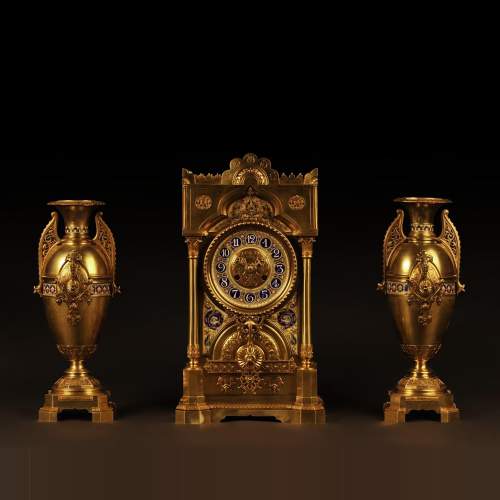
Mantle garniture in the orientalist taste  in gilt-bronze with  polychrome porcelain decoration

Ref.17390
Mantle garniture in the orientalist taste in gilt-bronze with polychrome porcelain decoration

Polished and varnished bronze, polychrome porcelainThis exquisite orientalist mantle garniture was inspired by an eclectic range of decorative source materials and is characteristic of French works of art produced in the 1880s. Fashioned in gilt-bronze and ornamented with porcelain polychrome plaques decorated with vegetal scrolls and cartouches inspired by Iznik enamels, the clock takes the form of a piece of miniature architecture. The clock face is framed by two columns whose capitals support an open foliated pediment directly inspired by Islamic monuments. The clock is accompanied by a pair of vases of Byzantine form, the sides of which are encircled with a porcelain band that echoes the clock’s decoration. The body of the vases is also ornamented with chased bronze of the highest quality. This beautifully chased bronze work comprises palmettos of stylized organic shapes and delicate scrollwork. Certain of the bronze elements are executed in openwork, such as the handles of the vases.    Although not signed, this garniture is inscribed “Paris” under the face of the clock, indicating that this exceptional piece was the work of a French manufacturer. Created around 1880, this set is characteristic of the taste for eclecticism, the divergent sources used and the wide ornamental vocabulary taken from many different periods and continents that created this arresting and original work of art. 

Dimensions:
Width: 22 cm
Height: 43 cm
Depth: 13 cm

Gabriel VIARDOT, Japanese style support unit with bouquet, 1888

Ref.13397
Gabriel VIARDOT, Japanese style support unit with bouquet, 1888

This piece of furniture and display was made by Gabriel Viardot in 1888, at the height of his career. A talented wood sculptor, Gabriel Viardot opened a furniture factory and store in Paris in 1853. In the 1870s, he decided to devote himself to “Chinese-Japanese furniture”. He obtained a silver medal at the Universal Exhibition in Paris in 1878, then the gold medal at the International Exhibition in Antwerp in 1884, and at the Universal Exhibitions in Paris in 1889 and 1900. This piece of furniture, although adapted to European uses, is part of Viardot's Sino-Japanese production. Its base is pierced with geometric scrolls forming a heart in the center. The door is decorated with an exceptional Japanese panel from the Meiji period (1868-1912). It is decorated with a still life combining bas-relief and mother-of-pearl inlay. This representation is characteristic of Japanese art of this period. It has many stylistic and technical similarities with this other panel from the Meiji era. One of the short sides is decorated with a bamboo in bloom accompanied by an inscription made of characters chosen for their aesthetic appearance, probably taken from Japanese prints. The other is carved with mistletoe branches. The crown of the piece of furniture is inspired by Far Eastern architecture and is decorated with a roaring lion. Viardot's signature is on the right side of the piece of furniture, in the lower part. The stamp and the date, rarely indicated, which is indicative of the value of this piece of furniture, are on its left side. Gabriel Viardot created a small Japanese style cabinet known by an old drawing, the upper part of which, more especially the crowning, is very close to that of this piece of furniture.

Dimensions:
Width: 85 cm
Height: 132 cm
Depth: 54 cm

Robert LALLEMANT, "High Jump" Vase, 1930

Ref.15278
Robert LALLEMANT, "High Jump" Vase, 1930

This vase was made in 1930 by Robert Lallemant on the occasion of the Grand Prix of the Stade Français. The ceramicist and decorator Robert Lallemant (Pau, 1902-Davos, 1954) attended the École des Beaux-Arts in Dijon before becoming interested in ceramics between 1921 and 1923. In 1926, his father, Théophile Lallemant, bought him a small ceramics factory in Paris; he managed the business until his death in 1928, which explains the presence of his initial in the signature on our vase, under its base: “T. R. Lallemant”. Robert Lallemant quickly invented a modern and original ceramic style, which he produced in small series. His work was well-received by critics at the Salons des Artistes Décorateurs and the Salons d’Automne in 1926, 1927, and 1928. He was among the founders of the Union des Artistes Modernes (UAM) in 1929. A few years later, he gradually lost interest in ceramics to produce furniture, and then got involved in his father-in-law’s public works business. In 1939, he joined the French Navy, and in 1945 and 1946, he went to Indochina, where he showcased his talents as a photographer. Among other popular themes in the 1920s and 1930s, Lallemant particularly focused on sports, producing several vases on this subject; he was a sportsman himself. Our vase reflects the influence of Art Deco on his work, notably with the stepped shoulders that frame it and its geometric shapes. At the center, an athlete is dynamically depicted in a high jump event. The decoration is characterized by a certain simplification of shapes and colors, aligning with contemporary painting trends. The glaze is brilliant and of high quality. The inscription at the base of the decoration indicates that this vase was commissioned to serve as a trophy for the winner of the high jump event at the 1930 Grand Prix of the Stade Français. Other vases of the same model, without this inscription, were also created by the same artist; the decoration of one of them represents a pole vault event in a style very similar to that of our “High Jump” vase. A photograph from the artist’s archives shows the importance of the sports theme in his work; it depicts a vase of the same shape as ours, decorated with cross-country runners. This photograph also shows that the same decoration could be adapted to different vase shapes.

Dimensions:
Width: 20 cm
Height: 22 cm
Depth: 8 cm