menu
Menu
account_box
Categories
Contact
email Send us a message

Contact us

phone By phone

+33 (0)1 42 25 12 79
Tue.-Sat., from 10am to 6pm
+33 (0)6 60 62 61 90
Everyday from 9am to 7pm.

email by Email

Adress: contact@marcmaison.com

share Let's get social

Languages
And also...
My selection
(5 Objects)
My selection (5 Objects)

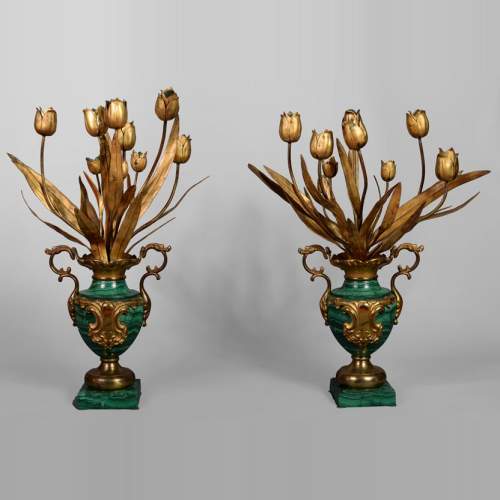
Pair of vases in malachite and gilt bronze, Russia, late 19th century

Ref.13299
Pair of vases in malachite and gilt bronze, Russia, late 19th century

This beautiful pair of vases was made of gilt bronze and malachite. It's very likely a Russian work from the end of the 19th century. The belly of our vases was made of malachite and welcomes a Rococo style decoration of gilt bronze. The whole decoration was made of gilt bronze, like the handles which are also reminding of the Louis XV style as they are shaped of thin acanthus leaves scrolls, or even the neck where are attached the handles and the foot. Finally, from the neck a beautiful gilt bronze tulips bouquet springs while the vase rests on a small malachite square base. The malachite, is an intense green stone because of its high copper composition, which makes it very appreciated in the 19th century. This stone mainly comes from Russia where important deposit are known since the 17th century, we can name the one called Nijni Taguil, discovered in 1835 and exploited by the Count Demidoff (1812 - 1870). Used in bloc to create small objects, the malachite can't be used for big pieces as the ones we can make in marble. That's why the technic called “Rusian mosaïc” was invented during the second half of the 19th century : malachite strips are inlaid to create the illusion of a block , allowing to put this extraordinary color on walls, columns or other interior elements like in the Malachite Room in the Winter Palace in Saint Petersburg. It's the Royal stone manufactory of Peterhof and Ekaterinbourg that develop this art which quickly seduces the aristocracy. This technic is discovered in France when Alexander I of Russia (1777 - 1825) gifted Napoléon Ier (1769 – 1821) a set of malachite element in 1808. Candelabras, big vases and basins are placed in the Emperor Room in Trianon, which became the “Malachite Room”. The new beauty of this sophisticated art creates an important enthusiasm which lasts during the entire 19th century.

Dimensions:
Width: 38 cm
Height: 61 cm
Depth: 23 cm

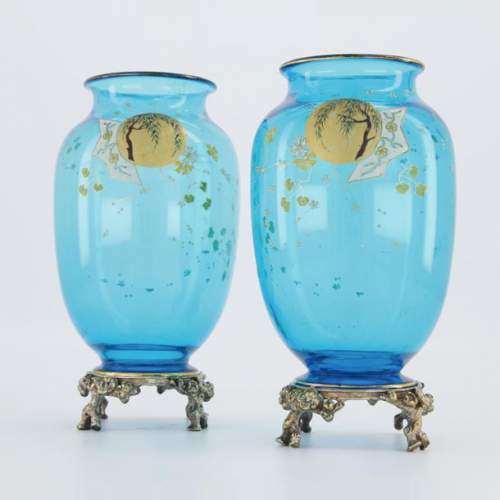
BACCARAT CRISTALLERIE and Eugène ROUSSEAU (model by), Pair of vases « Clair de Lune » in blue crystal and gilt bronze mount, circa 1875-1890

Ref.13481
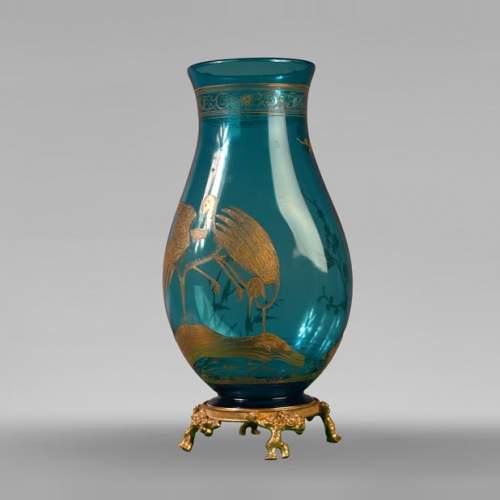
BACCARAT CRISTALLERIE and Eugène ROUSSEAU (model by), Pair of vases « Clair de Lune » in blue crystal and gilt bronze mount, circa 1875-1890

This pair of blue crystal vases with hot-enamelled decoration is mounted in a gilt bronze base representing branches of cherry blossom. These vases were produced by the Baccarat crystal works between 1875 and 1890 after a design by Eugène Rousseau (1827-1890). This is the « Clair de lune » (Moonlight) model, whose Japonisant decoration depicts a weeping willow set within a full moon. The neck and the base are highlighted with a fine gilded line. The two vases are presented on a gilt bronze mount with four feet representing branches of cherry blossom. François-Eugène Rousseau (1827-1890), known as Eugène Rousseau, was a master glassmaker established from 1855 as a dealer specialising in porcelain and faience in Paris. In 1867, having developed an interest in Japonisant motifs, Eugène Rousseau commissioned Félix Bracquemond to produce a porcelain service intended for display at the Universal Exhibition in Paris, where for the first time a European artist directly copied a Japanese artist, reproducing animal figures from Hokusai's Manga. His Japonisant glassware, produced with the probable collaboration of the Appert brothers at Clichy and the Baccarat crystal works, was presented in 1874 in Paris at the fourth Exhibition of the Union centrale des Beaux-arts appliqués à l'industrie. A member of the Union centrale des Arts décoratifs from its foundation in 1862, Eugène Rousseau was awarded the cross of the Légion d'honneur. The Baccarat crystal works owes its international renown to its participation throughout the nineteenth century and up to 1937 in the Universal Exhibitions. It was during the nineteenth century that the manufactory distinguished itself in the eyes of the world through the excellence of its production and its constant pursuit of innovation. Its creations long influenced European glass and crystal manufactories and set the standard in terms of technique of execution and stylistic models. The works of the crystal manufactory were very rarely signed before 1860, the year in which the first labels appeared sporadically, and fifteen years later the stamp bearing the name of the crystal works on certain blown models and bronze parts.

Dimensions:
Width: 13 cm
Height: 23 cm
Depth: 13 cm