Ref.12400
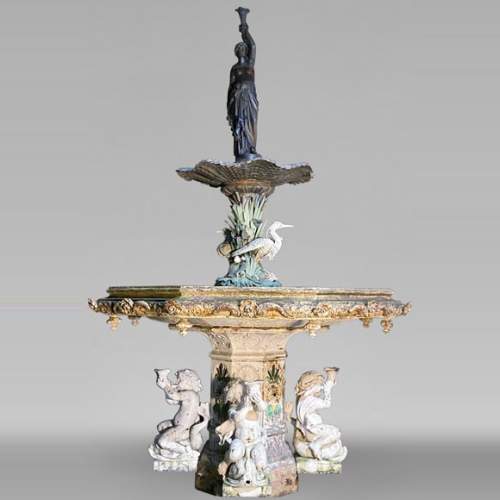
VAL D’OSNE Foundry - Exceptional Renaissance style fountain Model presented in the 1851 World Fair
This exceptional painted cast iron fountain in the Neo-Renaissance style was crafted at the Val d’Osne foundry for the inaugural Universal Exhibition of 1851 in London, where it was prominently displayed.
Hubert Lavigne created the model for our monumental Neo-Renaissance-style fountain for the Val d’Osne foundry. Resting on an octagonal pedestal adorned with shells and reeds in slight relief, the fountain consists of a first broad basin with small lampposts encircling it, punctuated by fleurons with pierced openings from which water can flow and be adorned with arabesques.
In the center of this basin, a beautiful decoration of reeds has been sculpted, where a heron, a turtle, a frog, and a duck flourish in a very realistic manner. It supports a second basin with undulating contours and exterior striations reminiscent of a seashell's characteristics. This last basin features a sculpture in its center representing a woman draped in ancient attire around her waist and brandishing a cup with her left arm.
Children seated on dolphins, blowing into a conch shell, have been placed all around the base to animate it. The sculptor's artistry is particularly evident in their modeling, reminiscent of the children sculpted on the facade of the Louvre.
In the context of the industrial revolution and the flourishing of free trade, industrial exhibitions, initially national in scope, provided a platform for sharing inventions that opened up future horizons. Thus, the first Universal Exhibition took place in London from May 1 to October 15, 1851, at the Crystal Palace. Queen Victoria's reign demonstrated its modernity and adherence to a liberal philosophy, where international trade would be a guarantor of peace and the flourishing of human genius. The Crystal Palace, conceived for the occasion by Joseph Paxton and executed by Owen Jones, was a giant structure of iron and glass covering 8 hectares, erected swiftly through modern prefabrication methods, showcasing the progress of industry. Unfortunately, this architectural masterpiece was permanently destroyed in a fire on November 30, 1936.
Functioning as a demonstrative showcase of Great Britain's supremacy in the global economy and industry, the Exhibition was designed as a presentation of the products of art and industry on a grand scale from each country. The interior was segmented into four sections, later adopted for subsequent Universal Exhibitions: raw materials, machinery, manufactured goods, and works of art. For each section, national pavilions served as showcases for their best productions and innovations. The color illustrations by Dickinson and Matthew Digby Wyatt are valuable testimonies to this event, capturing the beauty of the venue and the precious art objects on display. Infused with pedagogical intent and national affirmation, the 1851 Universal Exhibition inaugurated a highly successful practice, creating an artistic and technical dialogue beyond borders.
The participation of the Val d’Osne foundry in this first Universal Exhibition, notably featuring the presentation of our fountain in the vast glass nave, bestowed upon it international recognition. Its frequent participation in such events, coupled with the accolades it received each time, quickly elevated the foundry to the foremost position in France during the second half of the 19th century.
Established in 1836 at the initiative of Jean-Pierre-Victor André, founder of the "J.-P.-V. André" house and considered the pioneer of ornamental cast iron in place of wrought iron, the foundry offered urban furniture and decorative cast iron. Thriving over the years, the establishment changed hands without compromising its quality until 1986, absorbing several competing establishments including Barbezat and Ducel, thus enriching its catalog with over 40,000 different models. This included balconies, urban furniture, lighting, as well as monumental fountains, animal groups, statues, and large cast iron groups inspired by ancient or classical models. To achieve this, the foundry collaborated with numerous significant artists such as Albert Ernest Carrier-Belleuse, Mathurin Moreau (a shareholder in the company), James Pradier, and Hubert Lavigne, the sculptor of our fountain.
Hubert Lavigne, born in Moselle, specifically in Cons-la-Grandville, in 1818 and deceased in Paris in 1882, studied at the Beaux-Arts in Paris under the guidance of sculptors Ramey and M.A. Dumont. A remarkable sculptor, he won the Third Prize in Rome in 1843 with a plaster bas-relief depicting the Death of Epaminondas, now housed in the Museum of Fine Arts in Nancy. He also won two medals at the Salons of 1861 and 1863, to which he was a dedicated participant between 1849 and 1881. He received commissions for Parisian buildings, including the Palais Royal at the Louvre, where his sculptures adorn the facade of the Turgot wing, as well as the Sorbonne church and the Saint-Michel Fountain. He also created numerous works in cast iron for the Val d’Osne foundry, such as agricultural representations, eagles, tritons, children blowing into a conch shell, and more.
A prolific and talented sculptor, Théodore Véron Hubert, lamented in his 1877 work, Dictionnaire Véron, ou mémorial de l'art et des artistes de mon temps, that our sculptor was not duly recognized for his merits: "And to think that after so much study and conscientiousness, so many superior productions marked by an aesthetic worthy of a Dumont, this eminent artist, and at the same time a noble character whom we have followed since 1841 when we drew together (at the Lapin Academy), and whose superior creations we see every year; to say that this truly distinguished sculptor is not yet decorated or recognized! Truly, it's enough to discourage modesty and conscience!"
Featured in the foundry's catalog, our fountain was commissioned by numerous cities to adorn their squares. Notably, a model can be found in Cirey-sur-Vezouve in eastern France, another in Saint-Pierre de la Réunion, and yet another on the island of Sao-Miguel in Portugal.