menu
Menu
account_box
Categories
Contact
email Send us a message

Contact

phone By phone

+33 (0)1 42 25 12 79
Tue.-Sat., from 10am to 6pm
+33 (0)6 60 62 61 90
Everyday from 9am to 7pm.

email by Email

Adress: contact@marcmaison.com

share Let's get social

Languages
And also...
My selection
(32 Objects)

My selection (32 Objects)


Paul SOYER, Bronze, Gilded Bronze and Enameled Clock, circa 1860

Ref.13949
Paul SOYER, Bronze, Gilded Bronze and Enameled Clock, circa 1860

This mantel clock is made in bronze and highly decorated with enamels painted in “grisaille”. Two patinas of bronze bring life and color to the frame, which - as was regularly the case for mid 19th century mantel clocks - is built like a miniature architectural Renaissance structure. The body has a square base, with columns on every corner that rise to composite order capitals, with a mixture of styles that is characteristic of 19th century art. The columns are linked together by gilded bronze round arches populated by Chimaera, mythological creatures. Above, the gilded bronzes are adorned with dark bronze ram heads, a motif borrowed from Antiquity and very popular in the 19th century, especially for furniture and decorative bronze pieces. Enamel is everywhere, painted in grisaille and enhanced with gold, displaying a lush decor of foliage, grotesques and curlicue. Below the clock face, two tapered putti flank a vase brimming with fruit. The sides are adorned with full length portraits of a gentleman and a lady. The man is dressed in the style of the characters in Rembrandt’s The Night Watch, painted in 1642. The lady plays a mandolin, which was imported to France from Italy in the 15th century. The Musée d’Orsay in Paris has recently acquired from Paul Soyer’s descendants an almost identical mantel clock to the one presented here. (OAO 1787) According to museum sources, this clock was presented at the World’s Fair in Philadelphia in 1876. Born in the Seine-et-Marne region, Paul Soyer began his carreer as a chisel artist, in Paris, in the 1850’s. He progressively learned the art of enameling and opened his own studio in 1861, rue Mauconseil between the Halles and Bonne-Nouvelle neighborhoods. He collaborated with well know artists like Claudius Popelin, Charles Duron and Gustace Baugrand. Working with the latter, he was awarded a bronze medal at the World’s fair in 1867. He then opened a larger workshop Rue Saint Sauveur and specialized in different enamel techniques with a preference for painted enamels. His very varied production, went from small pieces for jewellery, enameled objects for goldsmiths, plates for cabinet makers, to large portraits. A follower of Popelin, he remained faithful to the art of the late Renaissance, with a preference for a polychrome enamel technique, which associated grisaille and gold camaïeu. He participated in all the French and Foreign World’s Fairs, to the Union Centrale de Beaux-Arts appliqués à l’Industrie exhibits. Often rewarded, particularly with a gold medal in 1878, he was considered beyond competition and member of the jury in 1889, when he received the Légion d’Honneur.

Dimensions:
Width: 27 cm
Height: 67 cm
Depth: 23 cm

Ernest LEVEILLE - Exceptional cracked glass vase with polychrome and gilt insert decor on a gilt bronze mount, circa1890

Ref.12691
Ernest LEVEILLE - Exceptional cracked glass vase with polychrome and gilt insert decor on a gilt bronze mount, circa1890

This exceptional cracked glass vase mounted in gilt bronze is a typical work of the late 1890’s production of Eugène Rousseau (1827 -1890) and Ernest-Baptiste Léveillé (1841-1913). Eugène Rousseau (1827 - 1890) merchant editor of porcelain and crystals established since 1855 on the 43 rue de la Coquillière à Paris, was a pioneer by going further that everybody else in the renewal of the glass art. Indeed, at the end of his life he starts to study the glasses coloration and obtains unexpected decorations by superposing colored and shady layers inspired bu the old Venetian techniques from the 16th century and practiced by the Chinese people during the 18th century. In 1884, he’s the first to exhibit cracked glass during the Exposition de l’Union centrale des arts décoratifs. Thus, he creates glasses with the aspect of gemstones. The following year in 1885, he gives his stock to his old student Ernest-Baptiste Léveillé, then also merchant editor of porcelains and crystals who had opened on the 74 boulevard Haussmann in Paris in 1869 la Maison Léveillé. Renamed « Maison Rousseau-Léveillé réunies », the production keeps the developed technical characteristics until the death of the master in 1890. The models then become more bold and the decors follow the trend of the curved line. Named again « Maison E. Léveillé », the store is moved nine years later on the 140 Faubourg Saint-Honoré in Paris. In 1902, Ernest Léveillé merges with the maison Toy, also a crystals and porcelains stores, under the name « Maisons Toy et Léveillé réunies ». The establishment is then located on the 10 rue de la Paix. He participates to many Parisian Salons between 1892 and 1897 and also to the World’s Fairs of 1889 and 1900 in which he wins the gold medal. Our slender shape vase takes all the characteristics of the technique developed by Eugène Rousseau then exploited by Ernest Léveillé. Indeed, the cracked glass is decorated with an inclusion decoration of red, blue and gold powder, forming beautiful marbled mottled effects. Louis Vauxcelles speaks in these words about these characteristic on his book Histoire de l’art français de la Révolution à nos jours, published betweent 1922 and 1925 : « Without overloading the crystal with gold motifs as many others, without daubing it randomly with bright colors, without trying to assign a role for which it is not made for, or making it look like marble, porcelain, lacquer, bronze, he has for ambition to only create effects that are conform to its nature and to let it be enough by itself, and giving elements of its own decoration. Under the localized action of the oxides, he succeeds to mottle it and braids a net of blazing cracks thanks to a projection of cold water between two fires. Léveillé had the art of the unexpected projections, vigorous reliefs and capricious details. » Our vase also shows an impressive Napoleon III style gilt bronze mount with a remarkable quality of carving. The circular base rests on four feet, it is adorned with a round roses frieze and a torus of coiling acanthus leaves surmounted by flutes. A beautiful decor composed of small flowers bouquets and intertwined acanthus leaves comes to lightened up the lower part of the vase. The neck is encircled by a splendid knotted cord in gilt bronze falling on each side. This mount seems to have been made by the sculptor and bronze maker Paul Louchet (1854-1936) old student of Jules Lefebvre and Henri Harpignies. He signs by the mark « Louchet Fondeur Paris » a certain number of his Art Nouveau creations that he makes in his workshop located on the 3, rue Auber in Paris and that he exhibits in the Parisian Salons. The attribution of our mount to the work of this bronze maker was made thanks to a comparison with a similar mount on another vase signed by the artist.

Dimensions:
Width: 18 cm
Height: 73 cm

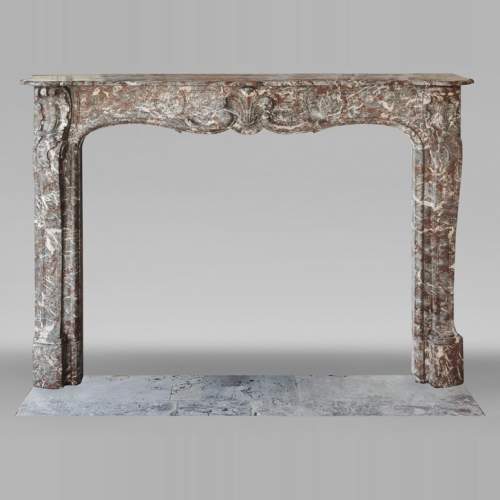
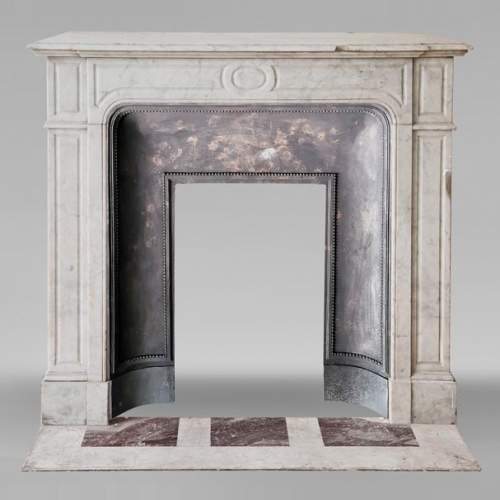
Beautiful Louis XV period mantel in grey Sainte Anne marble

Dimensions:
Width: 188 cm
Height: 125 cm
Depth: 35 cm
Inner width: 143 cm
Inner height: 100 cm

Émile BRACQUEMOND, Octave GUILLONNET, Winner's vase, 1924

Ref.13009
Émile BRACQUEMOND, Octave GUILLONNET, Winner's vase, 1924

This vase was created by the painter Octave Guillonnet and the ceramicist Émile Bracquemond for the Sèvres Manufacture on the occasion of the Paris Olympic Games in 1924. Octave Guillonnet (Paris, 1872-Montgeron, 1967) was an Orientalist painter who could also be considered a sports painter: he notably exhibited a monumental “rugby match” at the 1899 salon. He was also a member of the Society of Sport Painters and Sculptors from its foundation in 1922. The career of Émile Bracquemond (Paris, 1889-Clichy, 1970) is less well-known. However, it seems that besides his collaboration with the Sèvres Manufacture, he was particularly recognized for his feline sculptures. The order for commemorative vases to be awarded to the winners of sporting events was placed by the city of Paris in anticipation of the 1924 Olympic Games to promote the production of the Sèvres Manufacture. Although Pierre de Coubertin was opposed to awarding trophies to winners, the project, once launched, was completed for this edition only. Subsequently, the rules were changed, and winners were awarded only medals. The shape of this vase is very simple: the body flares out in an almost straight line from the base to two-thirds of its height before tapering towards the neck. The neck is adorned with a gray band bordered by a gold stripe, decorated with silhouettes of biplanes left in reserve. The body of the vase, with its subtly shaded blue glaze, features four pâte-sur-pâte scenes, each honoring a different sport. In the case of our vase, polo, Basque pelota (the athlete holds a chistera), and gymnastics apparatus are represented. The sports are depicted very precisely, with each discipline represented by a characteristic gesture. The slight relief of these decorations gives them greater depth and liveliness. While the winner’s vases were usually covered with a gold and brown decoration representing laurel branches, ours has a plain blue background that distinguishes it from the others. Not all the disciplines represented on our vase were Olympic sports in 1924. Indeed, Basque pelota was only presented as a demonstration sport at this edition of the competition. Moreover, polo, which was an Olympic sport in 1924, is no longer part of the Games today. There are four models in total for these commemorative vases, each depicting four different sports. The Sports Museum has a copy of each model, providing a complete overview. The sports represented on the other vases are as follows: rugby, rowing, diving, and football; javelin, wrestling, shot put, and boxing; tennis, cycling, sailing, and shooting. This winner’s vase is therefore both a historical and artistic testament to the 1924 Olympic Games, which will resonate on the centenary of this event and the Paris Olympic Games in 2024, particularly within the framework of the edition by the manufacture of trophy vases created by six artists from the Beaux-Arts de Paris, intended to be awarded to the French gold medalists at the Paris 2024 Games.

Dimensions:
Height: 33 cm

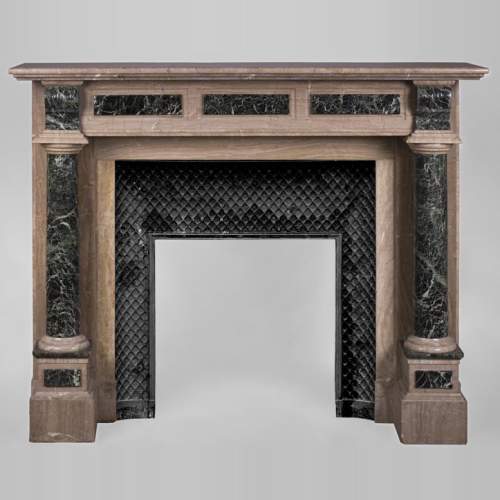
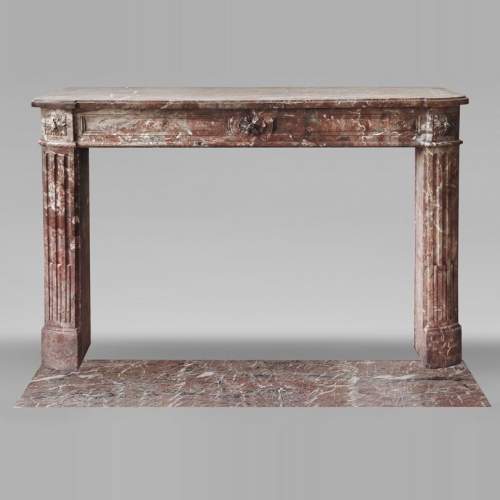
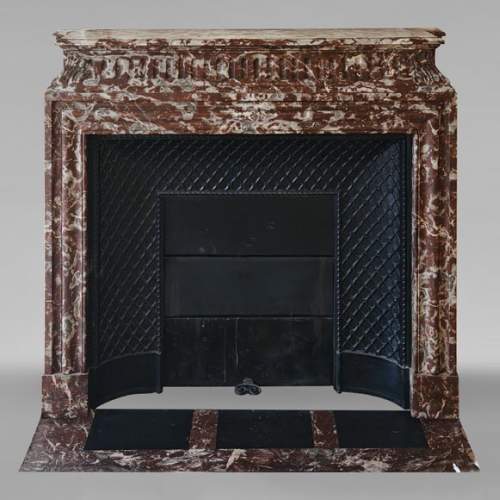
Louis XIV style mantel with acroterion in Rouge du Nord marble

Dimensions:
Width: 145 cm
Height: 126 cm
Inner width: 111 cm
Inner height: 94 cm

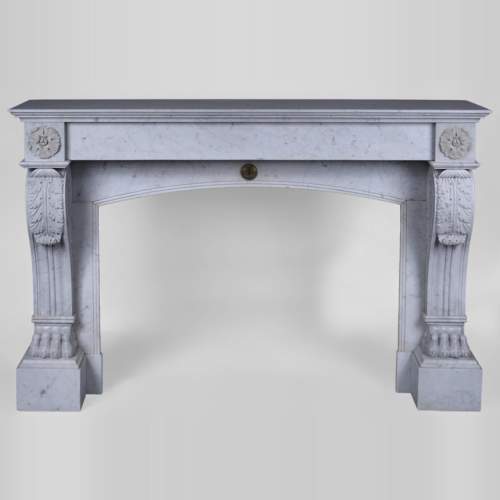
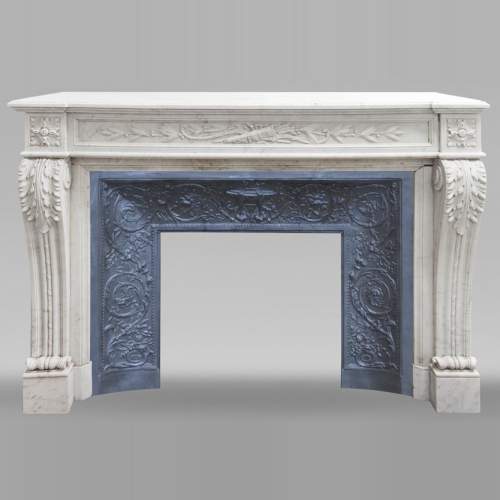
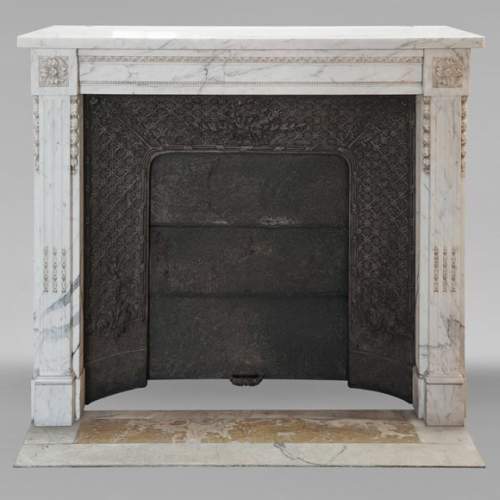
Napoleon III period fireplace with lion's paw feet, in Carrara marble

Dimensions:
Width: 158 cm
Height: 110 cm
Depth: 50 cm
Inner width: 116 cm
Inner height: 81 cm