menu
Menu
account_box
Categories
Contact
email Send us a message

Contact us

phone By phone

+33 (0)1 42 25 12 79
Tue.-Sat., from 10am to 6pm
+33 (0)6 60 62 61 90
Everyday from 9am to 7pm.

email by Email

Adress: contact@marcmaison.com

share Let's get social

Languages
And also...
My selection
(50 Objects)
My selection (50 Objects)

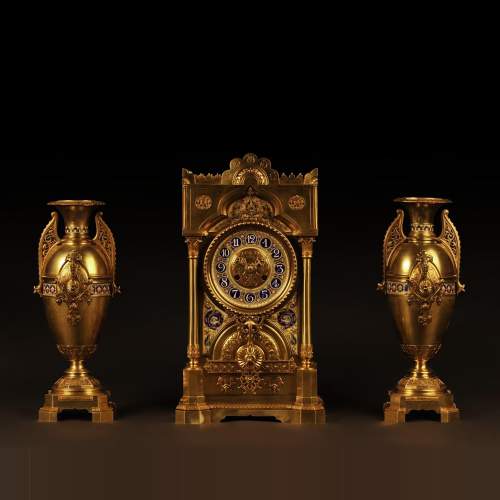
Mantle garniture in the orientalist taste  in gilt-bronze with  polychrome porcelain decoration

Ref.17390
Mantle garniture in the orientalist taste in gilt-bronze with polychrome porcelain decoration

Polished and varnished bronze, polychrome porcelainThis exquisite orientalist mantle garniture was inspired by an eclectic range of decorative source materials and is characteristic of French works of art produced in the 1880s. Fashioned in gilt-bronze and ornamented with porcelain polychrome plaques decorated with vegetal scrolls and cartouches inspired by Iznik enamels, the clock takes the form of a piece of miniature architecture. The clock face is framed by two columns whose capitals support an open foliated pediment directly inspired by Islamic monuments. The clock is accompanied by a pair of vases of Byzantine form, the sides of which are encircled with a porcelain band that echoes the clock’s decoration. The body of the vases is also ornamented with chased bronze of the highest quality. This beautifully chased bronze work comprises palmettos of stylized organic shapes and delicate scrollwork. Certain of the bronze elements are executed in openwork, such as the handles of the vases.    Although not signed, this garniture is inscribed “Paris” under the face of the clock, indicating that this exceptional piece was the work of a French manufacturer. Created around 1880, this set is characteristic of the taste for eclecticism, the divergent sources used and the wide ornamental vocabulary taken from many different periods and continents that created this arresting and original work of art. 

Dimensions:
Width: 22 cm
Height: 43 cm
Depth: 13 cm

Maison SORMANI, Luxurious writing set in mahogany, ebony and ivory marquetry

Ref.11536
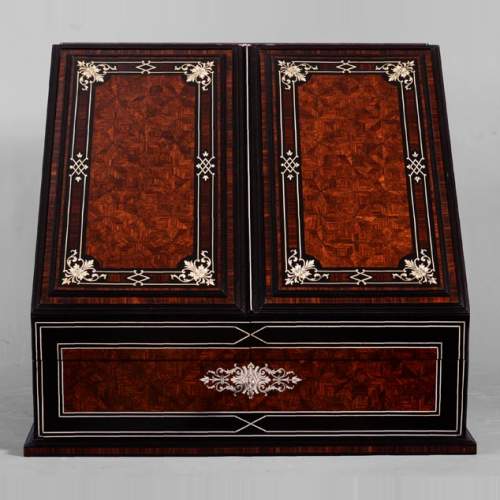
Maison SORMANI, Luxurious writing set in mahogany, ebony and ivory marquetry

This luxurious writing set was made by the great Maison Sormani around 1875, as indicated by the calendar and the signature « Veuve P. Sormani & Fils, 10 r.Charlot PARIS ». Indeed, this signature is used between 1866, the year Paul Sormani died, and 1886, the year Paul-Charles Sormani took over the company on his own. The Maison Sormani is considered one of the greatest luxury manufacture during the Second Empire and until the beginnings of the 20th century. One of the reasons to their success is that the Impress, Eugénie, used to decorate her palaces with the creations of the house. The lattest was founded by Paul Sormani (1817-1866), who was born in Italy, but settled his shop in Paris as soon as 1847. He initially concentrated himself on small, fancy pieces, exploiting the techniques of marquetry and leatherwork, before specialising himself in the reproduction of ancient furniture often due to the greatest cabinetmakers of the 18th century, which could be found in particuler in the royal furniture store. Paul Sormani entered all the World’s Fairs that punctuated the second half of the 19th century, wining twice a silver medal in 1855 and 1867, and once a bronze one in 1862. After his death in 1866,his wife and his son Paul-Charles (1848-1926) took over his activity under the corporate name « Sormani Veuve Paul et Fils » (meaning, « Sormani widow Paul and sons ») until 1886, when Paul-Charles became the only director. The workshops of the 10, rue Charlot used to employ about a hundred of workers, amongst them leather craftsmen, goldsmiths, cabinetmakers, etc. and collaborated with famous artists, like the designer and cabinetmaker Edouard Lièvre (1828-1886) for some pieces of furniture. The house’s success remains constant as testified by the participation to the World’s Fairs of 1878, 1883 and 1889, where it was awarded respectively a gold medal, the Diplôme d’honneur and the Grand Prix. In 1914, Paul-Charles Sormani associated himself with Thiebault Frères, creating the Thiebault-Sormani firm settled at the 134, Boulevard Haussmann, and which production was characterised by high quality pieces in the Louis XV and Louis XVI styles. The firm closed in 1934. Our writing set is characteristic of the luxuous production of marquetry of the Maison Sormani. With a sumptuous mahogany and ebony marquetry adorned with refined ivory patterns, the angled chest opens itself through two frontal doors, discovering plenty of small compartments with serrated edges where one was supposed to put the letters, paper and ink pot. The left door leaf is lined with electric blue velvet, and thought in order to welcome all the small tools with their ivory handles necessary to write a correspondence, such as a seal or a dip pen. Meanwhile, the right door leaf retains a calendar dating back from 1875, and a piece of paper on which some inscriptions are still legible. Underneath is a drawer locked with a key, allowing to keep the correspondences safe.
Dimensions:
Width: 41 cm
Height: 37 cm
Depth: 31 cm

Pair of vases in malachite and gilt bronze, Russia, late 19th century

Ref.13299
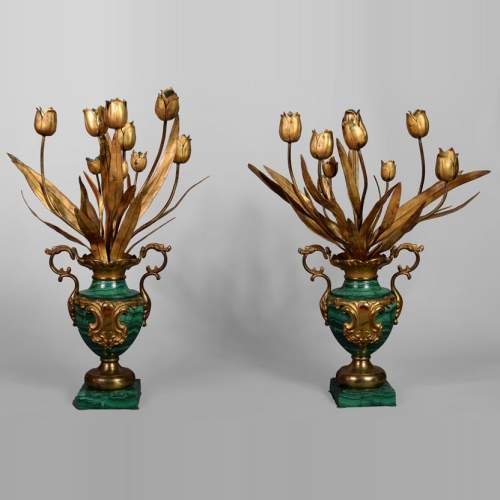
Pair of vases in malachite and gilt bronze, Russia, late 19th century

This beautiful pair of vases was made of gilt bronze and malachite. It's very likely a Russian work from the end of the 19th century. The belly of our vases was made of malachite and welcomes a Rococo style decoration of gilt bronze. The whole decoration was made of gilt bronze, like the handles which are also reminding of the Louis XV style as they are shaped of thin acanthus leaves scrolls, or even the neck where are attached the handles and the foot. Finally, from the neck a beautiful gilt bronze tulips bouquet springs while the vase rests on a small malachite square base. The malachite, is an intense green stone because of its high copper composition, which makes it very appreciated in the 19th century. This stone mainly comes from Russia where important deposit are known since the 17th century, we can name the one called Nijni Taguil, discovered in 1835 and exploited by the Count Demidoff (1812 - 1870). Used in bloc to create small objects, the malachite can't be used for big pieces as the ones we can make in marble. That's why the technic called “Rusian mosaïc” was invented during the second half of the 19th century : malachite strips are inlaid to create the illusion of a block , allowing to put this extraordinary color on walls, columns or other interior elements like in the Malachite Room in the Winter Palace in Saint Petersburg. It's the Royal stone manufactory of Peterhof and Ekaterinbourg that develop this art which quickly seduces the aristocracy. This technic is discovered in France when Alexander I of Russia (1777 - 1825) gifted Napoléon Ier (1769 – 1821) a set of malachite element in 1808. Candelabras, big vases and basins are placed in the Emperor Room in Trianon, which became the “Malachite Room”. The new beauty of this sophisticated art creates an important enthusiasm which lasts during the entire 19th century.

Dimensions:
Width: 38 cm
Height: 61 cm
Depth: 23 cm

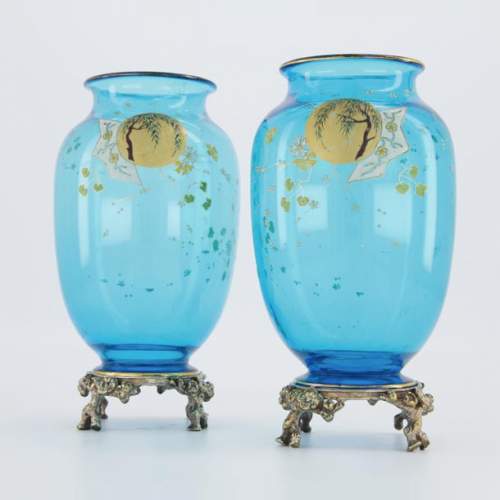
BACCARAT CRISTALLERIE and Eugène ROUSSEAU (model by), Pair of vases « Clair de Lune » in blue crystal and gilt bronze mount, circa 1875-1890

Ref.13481
BACCARAT CRISTALLERIE and Eugène ROUSSEAU (model by), Pair of vases « Clair de Lune » in blue crystal and gilt bronze mount, circa 1875-1890

This pair of blue crystal vases with hot-enamelled decoration is mounted in a gilt bronze base representing branches of cherry blossom. These vases were produced by the Baccarat crystal works between 1875 and 1890 after a design by Eugène Rousseau (1827-1890). This is the « Clair de lune » (Moonlight) model, whose Japonisant decoration depicts a weeping willow set within a full moon. The neck and the base are highlighted with a fine gilded line. The two vases are presented on a gilt bronze mount with four feet representing branches of cherry blossom. François-Eugène Rousseau (1827-1890), known as Eugène Rousseau, was a master glassmaker established from 1855 as a dealer specialising in porcelain and faience in Paris. In 1867, having developed an interest in Japonisant motifs, Eugène Rousseau commissioned Félix Bracquemond to produce a porcelain service intended for display at the Universal Exhibition in Paris, where for the first time a European artist directly copied a Japanese artist, reproducing animal figures from Hokusai's Manga. His Japonisant glassware, produced with the probable collaboration of the Appert brothers at Clichy and the Baccarat crystal works, was presented in 1874 in Paris at the fourth Exhibition of the Union centrale des Beaux-arts appliqués à l'industrie. A member of the Union centrale des Arts décoratifs from its foundation in 1862, Eugène Rousseau was awarded the cross of the Légion d'honneur. The Baccarat crystal works owes its international renown to its participation throughout the nineteenth century and up to 1937 in the Universal Exhibitions. It was during the nineteenth century that the manufactory distinguished itself in the eyes of the world through the excellence of its production and its constant pursuit of innovation. Its creations long influenced European glass and crystal manufactories and set the standard in terms of technique of execution and stylistic models. The works of the crystal manufactory were very rarely signed before 1860, the year in which the first labels appeared sporadically, and fifteen years later the stamp bearing the name of the crystal works on certain blown models and bronze parts.

Dimensions:
Width: 13 cm
Height: 23 cm
Depth: 13 cm

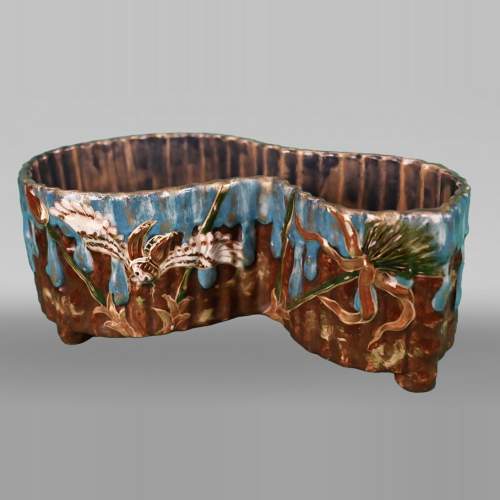
Émile GALLÉ, Jardiniere with a design inspired by the nature of Pharaonic Egypt, circa 1879-1890

Dimensions:
Width: 26 cm
Height: 17 cm
Depth: 15 cm

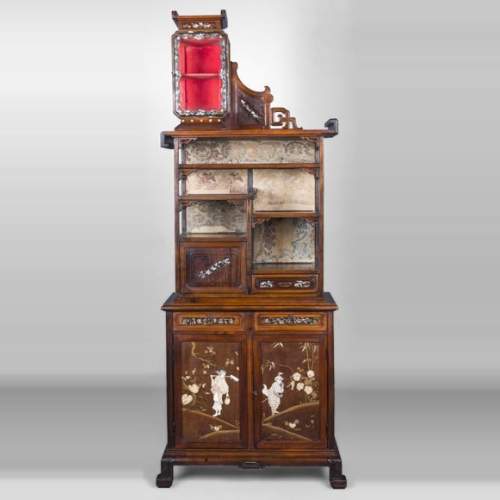
Gabriel VIARDOT, Japanese style support unit with bouquet, 1888

Ref.13397
Gabriel VIARDOT, Japanese style support unit with bouquet, 1888

This piece of furniture and display was made by Gabriel Viardot in 1888, at the height of his career. A talented wood sculptor, Gabriel Viardot opened a furniture factory and store in Paris in 1853. In the 1870s, he decided to devote himself to “Chinese-Japanese furniture”. He obtained a silver medal at the Universal Exhibition in Paris in 1878, then the gold medal at the International Exhibition in Antwerp in 1884, and at the Universal Exhibitions in Paris in 1889 and 1900. This piece of furniture, although adapted to European uses, is part of Viardot's Sino-Japanese production. Its base is pierced with geometric scrolls forming a heart in the center. The door is decorated with an exceptional Japanese panel from the Meiji period (1868-1912). It is decorated with a still life combining bas-relief and mother-of-pearl inlay. This representation is characteristic of Japanese art of this period. It has many stylistic and technical similarities with this other panel from the Meiji era. One of the short sides is decorated with a bamboo in bloom accompanied by an inscription made of characters chosen for their aesthetic appearance, probably taken from Japanese prints. The other is carved with mistletoe branches. The crown of the piece of furniture is inspired by Far Eastern architecture and is decorated with a roaring lion. Viardot's signature is on the right side of the piece of furniture, in the lower part. The stamp and the date, rarely indicated, which is indicative of the value of this piece of furniture, are on its left side. Gabriel Viardot created a small Japanese style cabinet known by an old drawing, the upper part of which, more especially the crowning, is very close to that of this piece of furniture.

Dimensions:
Width: 85 cm
Height: 132 cm
Depth: 54 cm

Robert LALLEMANT, "High Jump" Vase, 1930

Ref.15278
Robert LALLEMANT, "High Jump" Vase, 1930

This vase was made in 1930 by Robert Lallemant on the occasion of the Grand Prix of the Stade Français. The ceramicist and decorator Robert Lallemant (Pau, 1902-Davos, 1954) attended the École des Beaux-Arts in Dijon before becoming interested in ceramics between 1921 and 1923. In 1926, his father, Théophile Lallemant, bought him a small ceramics factory in Paris; he managed the business until his death in 1928, which explains the presence of his initial in the signature on our vase, under its base: “T. R. Lallemant”. Robert Lallemant quickly invented a modern and original ceramic style, which he produced in small series. His work was well-received by critics at the Salons des Artistes Décorateurs and the Salons d’Automne in 1926, 1927, and 1928. He was among the founders of the Union des Artistes Modernes (UAM) in 1929. A few years later, he gradually lost interest in ceramics to produce furniture, and then got involved in his father-in-law’s public works business. In 1939, he joined the French Navy, and in 1945 and 1946, he went to Indochina, where he showcased his talents as a photographer. Among other popular themes in the 1920s and 1930s, Lallemant particularly focused on sports, producing several vases on this subject; he was a sportsman himself. Our vase reflects the influence of Art Deco on his work, notably with the stepped shoulders that frame it and its geometric shapes. At the center, an athlete is dynamically depicted in a high jump event. The decoration is characterized by a certain simplification of shapes and colors, aligning with contemporary painting trends. The glaze is brilliant and of high quality. The inscription at the base of the decoration indicates that this vase was commissioned to serve as a trophy for the winner of the high jump event at the 1930 Grand Prix of the Stade Français. Other vases of the same model, without this inscription, were also created by the same artist; the decoration of one of them represents a pole vault event in a style very similar to that of our “High Jump” vase. A photograph from the artist’s archives shows the importance of the sports theme in his work; it depicts a vase of the same shape as ours, decorated with cross-country runners. This photograph also shows that the same decoration could be adapted to different vase shapes.

Dimensions:
Width: 20 cm
Height: 22 cm
Depth: 8 cm

BOCH Frères, Art Nouveau Vase in Iridescent Faience Decorated with a Toad and Mushrooms, late 19th century

Ref.14914
BOCH Frères, Art Nouveau Vase in Iridescent Faience Decorated with a Toad and Mushrooms, late 19th century

This iridescent faience vase with a toad and mushroom motif was created by the Boch Frères manufactory in the late 19th century. In 1841, Eugène and Victor Boch founded a fine faience manufactory called Kéramis in La Louvière, Belgium. The faience factory quickly flourished and diversified its production, adapting to the stylistic and technical evolutions of the time. This particular vase is emblematic of the Art Nouveau movement, as evidenced by its asymmetrical design directly inspired by nature: the body of the vase takes the form of a tree stump. Wider and rounded at the base due to roots seemingly ready to plunge into the earth, it rises to a certain height before ending with an irregular rim. Several mushrooms, among which an agaric, grow on it, and a toad climbs at the base of the stump. The vase features an iridescent glaze transitioning from pink to violet, lightening to white on the mushrooms and darkening to brown on the toad. This glazing demonstrates the high level of mastery achieved by certain artists and the most important manufactories at the end of the 19th century. The mark under the base indicates that the manufactory had a subsidiary in Thiais, in the Seine department. A vase of the same shape but with a slightly different glaze – where pink blends with yellow-orange, green, and blue (and the toad appears black) – was noted by expert Alain Cical.

Dimensions:
Width: 20 cm
Height: 34 cm
Depth: 13 cm

Auguste LEDRU (sculptor) and Émile COLIN (editor), Large Stoneware Vase with Masks and Gilt Bronze Female Figures, circa 1902

Ref.13929
Auguste LEDRU (sculptor) and Émile COLIN (editor), Large Stoneware Vase with Masks and Gilt Bronze Female Figures, circa 1902

This beautiful stoneware vase with gilt bronze ornaments was designed by the sculptor and ornamental designer Auguste Ledru and edited by the bronze manufacturer Émile Colin in 1902, the year the plaster model was presented at the Salon of the Société des Artistes Français under number 4065. Auguste Ledru (1860-1902) was a student of Dumont, Bonnassieu, Thomas, and Boisseaux. He also worked with his father, also named Auguste Ledru, who was a sculptor and ornamental designer like him. He regularly participated in the Salon of the Société des Artistes Français between 1883 and 1902, the year of his death. In 1892, he won an Honorable Mention, in 1894, a third-class medal, and in 1896, a second-class medal with his brother-in-law René Lalique (1860-1945). Auguste Ledru also collaborated with publishing houses such as Maison Susse, Thiébaut Frères, and Émile Colin, as was the case for our vase. The Colin house, which initially practiced plaster molding, became known as a bronze manufacturer from 1855 onwards. It published works by the greatest masters of French sculpture, such as Albert-Ernest Carrier-Belleuse (Le Zouave), Jean-Baptiste Carpeaux (L’Enfant au Cor), and the Parisian goldsmith Christofle. It is also known for lighting fixtures adorned with bronzes. The house participated in the 1891 Chicago World’s Fair and won a Grand Prix at the 1900 Paris Exposition thanks to style lighting fixtures modeled by Léon Méssagé. From that date, its production seemed to focus on contemporary art bronze, abandoning classical editions. This very original vase with a wide body features a stoneware decoration developing around two masks, whose hair and beard transform into foliage on either side. These vegetal and abstract lines characteristic of Art Nouveau create a play of light relief across the entire vase. At the top, two gilt bronze female figures, with their feet on the body and their hands on the neck, form handles. The vase is signed “Ledru” on the body. The Musée d’Orsay in Paris possesses a large jug with an ornamentation similar to our vase. Indeed, the spout is adorned with a mask and a nude female figure reminiscent of the handles on our vase.

Dimensions:
Width: 55 cm
Height: 70 cm
Depth: 45 cm