menu
Menu
account_box
Categories
Contact
email Send us a message

Contact

phone By phone

+33 (0)1 42 25 12 79
Tue.-Sat., from 10am to 6pm
+33 (0)6 60 62 61 90
Everyday from 9am to 7pm.

email by Email

Adress: contact@marcmaison.com

share Let's get social

Languages
And also...
My selection
(16 Objects)

My selection (16 Objects)


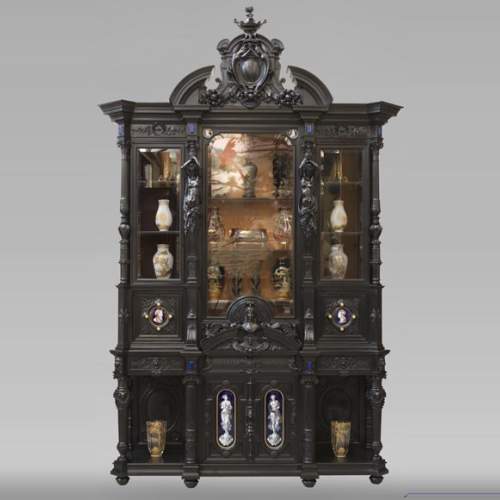
A monumental Display Cabinet coming from an exceptional furniture set realized by Moses Michelangelo Guggenheim for the Palazzo Papadopoli in Venice, Italy

Ref.03172
A monumental Display Cabinet coming from an exceptional furniture set realized by Moses Michelangelo Guggenheim for the Palazzo Papadopoli in Venice, Italy

This monumental display cabinet is composed of three windows, designed to exhibit fine china and other sophisticated crockery, a custom revealed by the period photographs. The high society of the time collects objects of art and priceless tableware, and enjoys to show them to the guests while preserving them in this precious and imposing case. A true ceremonial piece, this opulent dresser was arranged in the reception hall that once was the Salone delle Quattro Porte in Palazzo Papadopoli . The smaller surface of this piece is pretext for an abundance of carvings that confirm the prestigious nature of it. The numerous sculptures are the work of an extremely skilled sculptor. The vertical uprights are decorated with images of old sheathed bearded men. The sheath is the support for a foliage frieze that ends with a scroll. The protruding cornice rests on corbels, representing a vocabulary of ornamental architecture. It supports four vases with lids and an armorial pediment flanked by two griffins and crowned with a cardinal's hat: it is a hat with a flat, wide-brimmed shape and from which hang large silk cords. Between the cornice and the window, a carved frieze of festoons alternates with monsters. Shells are arranged above the festoons. The extreme quality of the sculpture and the much-sought decor is indicative of the work of an exceptional sculptor, whose mastery was unrivaled. The coat of arms on this dresser is the Aldobrandini's, whose most famous member was Pope Clement VIII, between 1592 and 1605. Having his nephews quickly appointed cardinal in order to enlarge the Aldobrandini's power, we owe this very Pope the concept of « nepotism », « nepote » being the Italian for nephew. The Aldobrandini, from Florence, increased their wealth during the Middle Ages and adopted the coat of arms azure per bend embattled or and six stars or. Since 16th century it is framed with the cardinals symbols, just like it is on this amazing dresser : a broad brimmed hat with tassels, the galero. Agostino Caracci, brother of considerable Anibal Caracci, designs this exact coat of arms for the cardinal Cinzio Aldobrandini. The Aldobrandini heraldy is sculped on many Italian buildings, it is for example carved with the galero in the Aldobrandini Chapel of Ravenna's Duomo. Used by Clement VIII, it is often seen with the papal keys, like in Santa Maria Maggiore where his gravestone was designed by the illustrious sculptor Bernino, and on the coins minted with his blazon. An Aldobrandini descent from his mother Maria Maddalena, Nicolo Aldobrandini-Papadopoli wished to preserve the memory of this lineage in the Palazzo Papadopoli decoration.

Dimensions:
Width: 210 cm
Height: 346 cm
Depth: 62 cm

The seats  coming from an exceptional furniture set realized by Moses Michelangelo Guggenheim for the Palazzo Papadopoli in Venice, Italy

Ref.03168
The seats coming from an exceptional furniture set realized by Moses Michelangelo Guggenheim for the Palazzo Papadopoli in Venice, Italy

Two armchairs and four chairs in carved walnut wood. This set is coming from the Palazzo Papadopoli, Venice, Italy, "Salone delle Quattro Porte" which was totally refurnished between 1874 and 1881 by Moses Michelangelo Guggenheim . The armchairs and the chairs of this set are produced in the same way with the difference that the armchairs are fitted with sculpted armrests. The base is made of four legs resting on round feet. The two front feet are tapered and fluted in their middle part, similar to columns. The architectural language here adopts an ornamental theme. The two back legs are from a square section. The feet are connected to each other by a spacer in the shape of an H, decorated in its center with an image of acanthus leaves. The frame of the seat is carved from a frieze of small flowers taking place in flowery containers. The main surface is decorated with a plant motif hanging from this frame. In the center of this motif is a crown of a duke. The uprights of the back are represented in an identical manner on all the chairs. The upper part shows the busts of sheathed women carved in very high relief and ending with an acanthus leaf. They rest on a console which again depicts the crown of the duke.The handles of the two chairs are a beautiful work of sculpture, notably through the back attachment where a winding acanthus leaf is represented. The grips protrude from the arms and show the heads women with extravagantly made up hair.

Dimensions:
Width: 63 cm
Height: 107 cm
Depth: 61 cm

TAHAN Manufactory, Julien-Nicolas RIVART (1802-1867) and Pierre-Joseph GUEROU - Exceptional Louis XV style violin-shaped Desk Decorated with porcelain marquetry And gilt bronze espagnolettes

Ref.10711
TAHAN Manufactory, Julien-Nicolas RIVART (1802-1867) and Pierre-Joseph GUEROU - Exceptional Louis XV style violin-shaped Desk Decorated with porcelain marquetry And gilt bronze espagnolettes

Of exceptional manufacture, this Louis XV style desk is a "bureau plat de milieu", designed to be arranged in the center of a room. It is the fruit of a collaboration between the cabinetmaker Tahan and the audacious Julien-Nicolas Rivart , supported by the painter Pierre-Joseph Guérou . Lavishly decorated on all sides and mounted in a sumptuous decor of gilt bronze, four espagnolettes decorate its curved legs, and four beaded shells, enliven by foliage, adorn the four "violin" shaped crosspieces. The presence of the three signatures allows us without hesitation to determine the part of each one in the elaboration of this work of exception. We know that Julien-Nicolas Rivart registered a patent for a porcelain inlay technique in September 1849, and that he joined in 1850 with Paul-Joseph Andrieux, a native of Limoges, under the name "Rivart et Andrieux", being then the only ones to fully master this meticulous and eminently delicate technique of marquetry. Rivart achieved here a synthesis between the Florentine hard stone marquetry and the decoration of porcelain slabs from 18th century. Rivart's invention enables sophisticated hues to contrast directly with the wood, and prevents to hide the veins and the cabinetmaker's beautiful work. For that reason, at the World's Fairs of 1851, 1855 and 1867, this technique is described as "a delicious process", "yet more beautiful than beautiful", and receives the Emperor Napoleon III's congratulations. He can hence combine the lightness of marquetry and its sophisticated contrasts effects, with the charm of painting on porcelain. The flower crown adorning the shelf was thus painted with a great range of hues and the freshness of porcelain painting. Pierre-Joseph Guérou , painter of flowers and former painter of the Sèvres Manufactory in the years 1847-1848, realizes here a gorgeous painted decoration of naturalistic flowers, that he signs and dates of 1853. He unfolds here a complete palette of complementary tints, with purple campanulas and a yellow tulip for example, that create a remarkable luminosity. Presently, very rare furniture pieces bearing Guérou's signature are known, which makes our desk all the more rare. Guérou signed as well in 1852 a table preserved in the Museum of Murska Sobota (Slovenia) and originating from the Beltinci residence, which decoration is slightly different, being composed of four flower bouquets. The table itself proposes a more simple decoration, the four sides displaying a wood marquetry and the gilt bronze being notably reduced. Once the shelf of our desk was realized, one of the privileged collaborators of Rivart entered on stage, the renowned Tahan . Signing and dating 1856 on the drawer's lock, the "Patented Cabinetmaker of the Emperor" used his exceptional mastering for the realization of this desk and probably for its gilt bronze decoration. The desk presented here is hence a fine witness of Tahan's favorable disposition towards the "Rivart process". Pierre Lambert Tahan , a Belgian cabinetmaker, settled in Paris shortly before 1806, in the district of the Temple. In 1844, he ceased all activity and left the direction of his shop to his son, Jean-Pierre Tahan . The latter will then completely revolutionize the organization of the company by separating manufactory and store, installed at 32 rue de la Paix. A year later, he is already reported as "Supplier of the King and Princes". In 1855, he bears the title of "Supplier of the Emperor", a reference of the highest importance which he takes care to recall on our table the following year. At that time, the Court commissioned him a large range of furniture pieces, libraries, tables, pedestals and toiletry cases. Then, Tahan will participate in the great World's Fairs of his time. On the occasion of the World's Fair of 1855 in Paris, he presents an extraordinary aviary in walnut carved with foliage and flying birds. Executed by Tahan , our desk is a true luxurious work, suitable to the decoration of a princely interior. The comparison can easily be established with the table bought by the Count of Manneville on the occasion of his marriage in 1861 and now preserved in the Sèvres Museum of the Cité de la Céramique. On this table we observe a very similar crown of flowers, knotted with four sky-blue ribbons, although the colors are paler. There is no mention of Guérou for the painting of these flowers, which is hardly surprising given the late date of realization for this table, almost ten years after the realization of our desk.

Dimensions:
Width: 159 cm
Height: 80 cm
Depth: 98 cm

Julien-Nicolas RIVART (1802-1867) and Pierre-Joseph GUEROU - Pair of Side Cabinets decorated of bouquets in porcelain marquetry

Ref.17255
Julien-Nicolas RIVART (1802-1867) and Pierre-Joseph GUEROU - Pair of Side Cabinets decorated of bouquets in porcelain marquetry

Bibliography : Masterpieces of Marquetry in the 19th century. Patents. Rivart, Cremer, Fourdinois, Kayser Sohn et Duvinage, Marc Maison et Emmanuelle Arnauld, Ed. Faton, 2012, p. 39 et 40. Richly decorated in porcelain marquetry and gilt bronze, this pair of side cabinets, made by Julien-Nicolas Rivart , demonstrates the high level of perfection attained by its creator, and may be considered as a master piece of his production. The center of the front panel is decorated with a bouquet of naturalistic flowers contrasting with its delicate colors against the dark background, and raises these furniture pieces to works of great originality. Finding inspiration in the technique of porcelain plaques set into wood panels, and in Florentine mosaics in hard stone, Rivart totally renewed the use of porcelain by inlaying it like real marquetry where each element was independent. As early as 1849, he registered a patent on this process, thus securing the exclusive rights on this type of decoration. At the various World's Fairs of the time, Rivart displayed his creations which were hailed as a success by both the press and the public. His technique was described by contemporary observers as being "one of the most important innovations in furniture decoration" and opinion was unanimous regarding the charm of these naturalistic flowers. Each of the two side cabinets is decorated in a different way, proof of Rivart 's concern for attaining rich ornamental decoration: purple lilacs, tulips, roses and morning glory on one cabinet, while the other contains white lilacs, peonies, St. John's wort and poppies. Each bouquet ornamenting the central panel is of a rare quality of execution and makes a striking contrast against the black color of the wood. Echoing the motifs used on the doors, the side panels are decorated with gilt bronze vases filled with flowers. The style of the bronze, in the taste of the 18th century, becomes part of this play of color: among the ornaments, one's attention is drawn to the frieze made up of neo-classical water leaves that run all along the central panels as well as egg-and-dart molding on the upper cornice and lower base, just above a gilt bronze mount in the form of a shell, that is inspired by 18th century examples. Both these side cabinets are signed by Pierre-Joseph Guérou on the inlaid porcelain and are dated 1854, which allows us to place them accurately within the context of their manufacture. A painter at the Sèvres factory, in 1847 and 1848, Guérou worked with Rivart on several occasions, for the painting of different elements the latter wanted to inlay in his furniture. A specialist in flowers painting on porcelain, he participated several times in the Salon between 1836 and 1865. Although his style is easily recognizable, his signature is however only rarely seen. A very few other works signed by him are known today, most notably the jewel cabinet made for the Empress Eugénie, decorated using Rivart 's technique, which is presently conserved at the Chateau of Compiègne, a table preserved in the Murska Sobota Museum in Slovenia, and at last a sumptuous "violin" style desk that the Marc Maison Gallery holds in its collections as well. This pair of side cabinets is hence one of the only known works bearing Pierre-Joseph Guérou 's signature. Its presence, an extremely rare fact, underscores the exceptional character of these pieces and attests to the virtuoso production that attained "perfection in the execution of cut and inlaid porcelain plaques" (Report of the jury of the Universal Exhibition of 1855).

Dimensions:
Width: 90 cm
Height: 113 cm
Depth: 44 cm

Alphonse GIROUX et cie and Julien-Nicolas RIVART (1802-1867) - Gorgeous writing desk with espagnolettes and decoration of roses in porcelain inlays

Ref.10721
Alphonse GIROUX et cie and Julien-Nicolas RIVART (1802-1867) - Gorgeous writing desk with espagnolettes and decoration of roses in porcelain inlays

A rare example of Rivart 's collaboration with the prestigious Alphonse Giroux et Cie manufactory, this piece of furniture stands out for its sophistication. The hues of brown obtained by various woods give this precious work a great luminosity. The feet are adorned with gilt bronze espagnolettes of very fine manufacture, and the shelf on top of it is framed by an openwork balcony. Founded by François-Simon-Alphonse Giroux in 1799, this shop turned to cabinetmaking as early as 1834 under the name "Alphonse Giroux". He begins under the Restoration to receive commissions of gifts from Kings Louis-Philippe and Charles X to the "Children of France". The sons Alphonse-Gustave and André Giroux took over the business in 1838, which then became "Alphonse Giroux et Cie" until its absorption by Duvinage in 1867. At the World's Fair of 1855 , the Empress Eugénie bought them a "bonheur du jour" desk. In collaboration with Susse Frères, they are the exclusive manufacturers of the first daguerreotype cameras as soon as 1839. Alphonse Giroux and Cie was famous thus under the Restoration and then the Second Empire , at which time they supplied the members of the Imperial court, especially in the trade of writing furniture, as this desk bears witness. Desiring to remain at the forefront of decorative techniques, Giroux collaborated here with Julien-Nicolas Rivart who had patented his porcelain marquetry process in 1849. This piece of furniture demonstrates once more the importance of these porcelain decorations, prized by the most prominent cabinetmakers. This writing desk is all the more interesting for it is the first time that a collaboration between Rivart and Giroux is attested. The dominant brown and gold tone is only broken by the flowers of fresh colors provided by Julien-Nicolas Rivart . This beautiful decoration depicts here a bouquet of roses and buttercups on the chest, and a beautiful frieze of morning glories on the shelf. Opening with a key, the chest of this writing desk offers a large shelf and three drawers with handles in gilt bronze, decorated with wooden marquetry patterns. The writing shelf, of curved forms, is lined with a caramel-colored leather blotter.

Dimensions:
Width: 76 cm
Height: 91 cm
Depth: 45 cm

Eugène-Frédéric PIAT (1827-1903) - Pair of Japanese wall brackets, a similar model of which belonged to Sarah Bernhardt

Ref.10521
Eugène-Frédéric PIAT (1827-1903) - Pair of Japanese wall brackets, a similar model of which belonged to Sarah Bernhardt

Bronze with brown patina, glazed stoneware phoenixes (China, 19th century) H. 83 cm / 32’’ 11/16 ; W. 25cm / 9’’ 13/16 ; D. 25cm. / 9’’ 13/16 This model of wall brackets was created by Frédéric Eugène Piat for the Maison Gagneau in Paris. According to the description proposed by the Museum of Troyes in its "Catalog of Decorative Arts" of 1897, there are arms of light composed of a "Chinese modillon with two brackets, an entablature and a gallery with openwork". Inspired by Chinese art, this pair of wall brackets combines the Far Eastern motifs with French ornamental elements: rinceau scrolls and interlaces characteristic of the Louis XV style, illustrating the vogue for eclecticism that marks the artistic production in the 19th century. The motif of the Asian monster recalls the lions mufles made by the artist in its works of Renaissance inspiration while evoking the imaginary bestiary of Japonism; the monster holds in its jaws a ring that recalls a knocker but devoid of its primary purpose as it is indeed a purely decorative element. The same model belonged to the actress Sarah Bernhardt and is visible on old photographs of her Parisian house. The same pair of wall brackets adorned her studio. Frédéric-Eugène Piat (1827-1903) was one of the leading French sculptors and ornamentalists of the 19th century at the beginning of, with Louis-Constant Sévin in particular, the renewal and development of the French bronze industry. An active member of the Bronzes Manufacturers' Association, he is one of those who have merged art and industry. He later became one of the founders of the Central Union of Fine Arts Applied to Industry in 1864. After training with sculptors and ornamentalists, he started his own business in 1845 and enjoyed a good reputation in the 1850s. During the next decade, he began a collaboration with the founder Louis Léon Marchand (1831-1899). In the 1870s, he collaborated with eminent manufacturers: Georges Édouard Gagneau, Charles de Marnyhac, Emile Colin and the Val d'Osne Foundry. His artistic consecration takes place from the year 1873: while he designs models to be exhibited at the World’s Fair of 1873 in Vienna, he receives the visit of the President of the Republic Adolphe Thiers who makes him knight of the Legion of Honor for his fruitful contribution in the field of the bronze industry in French art. He participated at the Parisian Salons and at nine World’s Fairs in the second half of the century. He is particularly noticed during the World’s Fair of 1878 held in Paris where he exhibited a vast collection of works of art thanks to which he received a gold medal, but especially during the World’s Fair of 1889 when he was decorated with the Grand Prix, higher reward ever given to an industrial artist. Thanks to the quality and style of his productions, which are typical of the taste of the time for historicism and eclecticism, and as shown by this pair of Japanese-style consoles, Piat enjoyed not only a nation-wide reputation but also international.

Dimensions:
Width: 25 cm
Height: 83 cm
Depth: 25 cm

GABRIEL VIARDOT (attr. to) - Bedroom furniture composed of a wardrobe  and a bed in tinted sycamore

Ref.11387
GABRIEL VIARDOT (attr. to) - Bedroom furniture composed of a wardrobe and a bed in tinted sycamore

This Japanese bedroom furniture is composed of a bed and a wardrobe. It was very likely made by the leader of the Japonisme in France, the furniture maker Gabriel Viardot (1830-1904), circa 1870-1880. This attribution is allowed because of the high making quality of the furniture and by stylistic comparison to other signed pieces of drawn in the archives sketchbook. Gabriel Viardot starts his career in the Jeanselme furniture workshop, furnisher of the Napoleon III court, before starting his own as a wood sculptor in 1849. He was then already the head of a small sculptors team even though he was only 19 years old. He opens in 1853, a workshop and a wood furniture and decorative objets shop located on the 36 and 38 rue Rambuteau in Paris. At this time, Gabriel works with his brother, Alexandre-Laurent, under the company name “Viardot Frère & Cie”. Seven years later, in 1860, he creates his own workshop « G. Viardot », on the 5 rue du Grand-Chantier, and takes the direction of the family business until 1872. He decides then to dedicate his production to the Chinese-Japanese furniture that he had observed during the 1867 World Fair. His characteristic furniture production was made with lacquered panel sent directly from China or Japan, often adorned with Tonkin mother of pearl inlays. The furniture were next lightened up with decorative bronzes of which the models were created by himself. Gabriel Viardot participates to many exhibitions that mark the artistic scenes of the second half of the 19th century. Each participation was successful, indeed, he wins in the 1878 World Fair a silver medal, then in 1855 in Antwerp and in Paris in 1889 and 1900 gold medals. He also participated to the exhibitions of the Union Centrale des Arts Décoratifs where he is in a class of his own and jury member from 1884. In the middle of the 1880’s, his company employed between 90 and 100 furniture makers and sculptors trained by himself. He also employs almost 20 subcontractors. From 1890, he creates furniture models for the famous decorative arts and furniture company, l’Escalier de Cristal. Indeed, we can read on Henry Pannier’s notebooks, the Viardot name associated to the description of some furniture. Viardot organizes his succession on the 26thDecembre 1890 by creating the "G. Viardot et Cie", company in which he associates his two children. When he dies in 1906, they take the direction of the workshop. The wardrobe is adorned on its pediment, reminding the roof of the pagoda, with a beautiful projecting sculpture of flowered cherry tree branch that we call « sakura » in Japanese. The center of the wardrobe shows a large rectangular mirror framed by two asymmetric unit shelves above cartouches adorned with branches of bamboo in slight relief. The wardrobe’s whole receive a carved and in relief decoration belonging to the Asian iconography. We find some of these typical elements on different model in the furniture maker drawings archives. Indeed, we can notice the stylized spiral feet, the branches decors on the panels and the open worked decoration on the superior right angle of the mirror. The bed is also adorned with a very rich sculpted and carved decoration with Asian inspiration depicting plants, interlacing, flowers and fantastic animals. The foot board shows a very beautiful medallion sculpted with high relief flowers on the center and statues of Foo dogs on the mounts. The headboard is adorned with a beautiful sculpted dragon and surmounted by a canopy with geometric motifs in frieze. The presence of the canopy is quite habitual in the Viardot’s beds production as shown the archives drawings. On the model here, we can also see the presence of the dragon on the header board.

Dimensions:
Width: 155 cm
Height: 255 cm
Depth: 225 cm

Alphonse GIROUX (in the manner of), Bamboo Decorated Gueridon, first half of the 19th century

Ref.14968
Alphonse GIROUX (in the manner of), Bamboo Decorated Gueridon, first half of the 19th century

This gueridon with bamboo decor was made in the spirit of Alphonse Giroux during the first half of the 19th century. In the late 1790s, Alphonse Giroux (1775/76–1848) established a store selling artistic supplies and small objects at 7 Rue Coq-Saint-Honoré in Paris. He collaborated with artists and had a strong influence on the design of the items he sold. His shop catered to a highly distinguished clientele, including kings Louis XVIII and Charles X. In 1833, his sons, André (1801–1879) and Alphonse-Gustave (1809–1886), joined the business; under Alphonse-Gustave’s influence, the store began to create small furniture pieces like the one in question. André and Alphonse-Gustave took over the business in 1838 and remained at its helm until 1867, when it was taken over by Ferdinand Duvinage (1813–1876) and two associates. This small table rests on four legs crafted to imitate bamboo stalks. Each protrusion marking the height of the legs is accentuated by a gilt bronze element, itself mimicking bamboo, like a mise en abyme. The gueridon has three tiers. Two of these intermediate tiers are arranged around a circle connecting the four legs, bordered by two fine golden bamboo rods. The center is occupied by a stretcher of partially frosted glass, as if surrounded by lace and sprinkled with small flowers. The top tier features decoration that also plays on transparency – and the absence of transparency – though in a more complex manner: the center is marked by a circle adorned with a frieze of garlands; on the outside, the floral motif from the lower levels reappears, itself encircled by a delicate frieze of flowers and leaves; lace transitions to the bamboo, then to two wood veneers linking the four gilded bronze caps crowning the table’s legs. A fine gilt bronze interlacing crowns the piece. The bamboo motif was used in decorative arts from the late 18th century, which explains its presence in this period. It also returned to fashion at the end of the 19th century, aligning both with the taste for revival furniture and the vogue for Japonism. The designer of this piece offers a particularly refined and delicate interpretation of the bamboo motif with this gueridon, following in the tradition of prestigious 18th-century cabinetmakers and anticipating the trend for East Asian-inspired arts to come.

Dimensions:
Height: 82 cm

DAÏ NIPPON, Japanese-style cabinet with mother-of-pearl marquetry

Ref.10532
DAÏ NIPPON, Japanese-style cabinet with mother-of-pearl marquetry

Founded in 1889, Daï Nippon, a Parisian manufacturer of Sino-Japanese style furniture, was located at 3 and 5 Boulevard des Capucines. The company created exquisitely refined pieces using materials directly imported from Asia (bamboo, mother-of-pearl, Chinese lacquer, exotic woods) to suit European tastes. Specializing in works of art and furniture from the Far East, the company had purchasing offices in Shanghai, Canton, Hong Kong, Yokohama, Kobe, and Nagasaki. Resting on a base featuring a lotus flower at its center and lion's paw feet at the ends, this cabinet boasts exceptional mother-of-pearl marquetry decoration, directly imported from Asia. The doors depict highly detailed battle scenes with horsemen and soldiers in a picturesque miniature landscape. The sides of the cabinet feature flowers and butterflies in a striking naturalistic style. The finely chiseled bronze hinges feature elaborate motifs blending vegetal scrolls, Japanese-style dragons, and highly creative chimeric monsters. At the center, an exceptional openwork bronze depicts winged hybrid beings, and at the center, a keyhole cover in the shape of a Foo lion's head (a guardian lion in Chinese tradition). The piece is topped with a griotte red marble slab. Following in the footsteps of interior designers such as Perret & Vibert and Gabriel Viardot, Daï Nippon created superb interpretations of the Japonisme style, adapted to the French market. This piece of furniture can be dated to around 1890.

Dimensions:
Width: 125 cm
Height: 136 cm
Depth: 57 cm

Edmond Chauffrey, Indo-Chinese cabinet with mother-of-pearl marquetry and relief enamelled stained glass

Ref.14906
Edmond Chauffrey, Indo-Chinese cabinet with mother-of-pearl marquetry and relief enamelled stained glass

Combining Far Eastern aesthetics and techniques with French craftsmanship, this 19th-century Indo-Chinese cabinet is a testimony to French taste for the blending of styles. As early as the reign of Louis XV, ornamanists were already creating Rocaille-style bases for antique Chinese porcelain vases. During the second half of the 19th century, the vogue for Japonisme encouraged cabinetmakers and decorators to combine ancient Asian elements with contemporary creations. The undulating cornice of this cabinet echoes the architectural motifs of Asian temples, featuring at its center a dragon mask made from carved wood. The entire piece is richly decorated with mother-of-pearl marquetry, displaying a remarkable diversity of motifs: court scenes, soldiers, landscapes, vegetal elements, wild birds, and butterflies both rendered with great naturalism. The ensemble is of Indo-Chinese origin with the exception of the stained-glass panels signed by Edmond Chauffrey. The Bordeaux-based master glassmaker began his career in 1856 at the famous Vieillard manufactory as a porcelain painter. In 1878, he founded the Chauffrey workshop and specialized in the production of decorative stained glass, catering primarily to the upper bourgeoisie of Bordeaux. Around 1885, when the renowned ceramicist Amédée de Caranza left his position as head of the Vieillard workshop, Edmond Chauffrey was entrusted with promoting Caranza’s relief enamel technique. He thus became the only one to make use of the Caranza process. This technique gives this Japonist stained glass decoration its distinctive presence. Inspired by Japanese prints, the vegetal motifs and butterflies retain their vivid colors, while the relief creates a striking contrast with the mother-of-pearl marquetry. As a testament to the admiration inspired by his creations — such as this extremely refined cabinet — the jury of the Bordeaux Exhibition awarded the master glassmaker a gold medal in 1885. Upon Edmond Chauffrey’s death in 1926, his sons took over the workshop.

Dimensions:
Width: 197 cm
Height: 303 cm
Depth: 68 cm