menu
Menu
account_box
Categories
Contact
email Send us a message

Contact us

phone By phone

+33 (0)1 42 25 12 79
Tue.-Sat., from 10am to 6pm
+33 (0)6 60 62 61 90
Everyday from 9am to 7pm.

email by Email

Adress: contact@marcmaison.com

share Let's get social

Languages
And also...
My selection
(77 Objects)

My selection (77 Objects)


Napoleon III monumental vase in Porcelain of Paris with the Triumph of Venus mounted in gilt bronze with espagnolettes

Ref.10637
Napoleon III monumental vase in Porcelain of Paris with the Triumph of Venus mounted in gilt bronze with espagnolettes

This exceptional monumental vase in porcelain of Paris, conceived in the spirit of the Sèvres Manufactory’s productions, is quite characteristic of the Napoleon III style . The long neck of the shape is extremely rare, as well as the gilt bronzes’ richness of ornamentation. Its dimensions and its important bronze mount indicate a ceremonial piece, of supreme luxury, comparable to those the Manufactory exhibited at the World's Fairs . Evoking the aristocratic art of the Ancien Regime in many ways, this vase pays tribute to the refinements of the 18th century, and could have been commissioned to decorate the mansion of a 19th century personality.Indeed, the “Celestial blue” background, embellished with gold arabesques, is characteristic of the porcelains from the Royal Manufactory of Vincennes as early as 1753, which became the Sèvres Manufactory. It is a famous blue, difficult to obtain, which served to decorate the first service delivered to Louis XV.The lively shapes of the bronze base also evoke the art of the ornamentalists in Louis XV’s time, such as Jean-Claude Duplessis or Gouthiere, who were in charge of drawing gilt bronze mounts for China porcelain. The bronze mount of our vase is hence very close to the Duplessis’ ornementations.The two espagnolettes, with sheathed busts of women holding garlands of flowers, seem to evoke the sculptures that adorn the front of Marie Antoinette ’s Theater at the Petit Trianon of the Versailles Palace. This large vase is decorated with painted medallions, hosting a still life on one side and the miniatures of famous subjects on the other. Indeed, it is an unambiguous composition after François Boucher's The Triumph of Venus (1740) that adorns the large main medallion, while the small medallion on the neck represents a famous portrait of the Princess of Lamballe. The characters of the large medallion are all present in Boucher's original painting, but the porcelain painter has reinterpreted them to propose a more concentrated composition, fitting perfectly to the surface of the vase. One recognizes the large striped veil characteristic of this painting where putti are spinning, as well as the group around Venus, especially the Triton with a seaweed crown, and the Mermaid with the diadem of pearls. The Tritons with the conchs present to the left of the painting were thus brought closer to the main group in this miniature. Let us note  that the composition has been reversed, probably having been made from an engraving of the painting.The medallion on the neck of the vase is a portrait of Madame de Lamballe, an intimate friend of Queen Marie Antoinette , who became Superintendent of the Queen's House. Numerous miniatures have been produced from a famous painting by Louis-Edouard Rioult where she appears wearing a crown of flowers and ribbons. The Princesse de Lamballe is known for her virtue and renowned sweetness, but also for her interest in the Enlightenment.This monumental vase is an important work, characteristic of the grandiose productions presented at the World's Fairs of the time of Napoleon III. But it is also a work of art full of references to the art of the 18th century, heir of the Age of Enlightenment.

Dimensions:
Width: 67 cm
Height: 213 cm
Depth: 55 cm

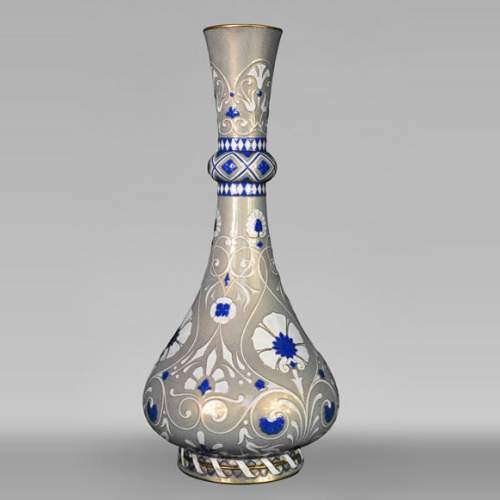
Albert DAMMOUSE and MANUFACTURE DE SEVRES - Important antique exhibition vase, "vase potiche  allongée" model, with ibis on its golden wooden pedestal

Ref.10647
Albert DAMMOUSE and MANUFACTURE DE SEVRES - Important antique exhibition vase, "vase potiche allongée" model, with ibis on its golden wooden pedestal

This important antique vase with an ibis on its golden wooden pedestal was made by the renowned French ceramist Albert Dammouse in 1873. There is the Manufacture de Sèvres’s seal. This vase is both emblematic of the period’s decorative arts and of Albert Dammouse’s works who was known for his dexterity in the material treatment as well as his qualities as decorator. Albert Dammouse, whose father was sculptor at the Manufacture de Sèvres, joins the École nationale des Arts décoratifs in 1863 before study from 1868 Milès Solon’s lessons, also decorator at the Manufacture de Sèvres, at the School of Fine Arts. In 1871, he moved to his own workshop in the city of Sèvres, next to the Manufacture, until his death in 1926. Albert Dammouse is interested in all the ceramics, but his porcelains have made first his reputation. In 1874, at the Union centrale des Arts Décoratifs, he exhibits porcelains and gets the gold medal. He won then a gold medal at the third Paris World’s Fair in 1878 and built ovens and workshops in Sèvres in order to produce more works. Although Dammouse has his own workshop some of his works, such as our vase, are the result of collaboration between Dammouse and the Manufacture de Sèvres. This is the model "elongated ovoid porcelaine vase" invented by Jules Peyre and used by many artists with sometimes some variations such as this Chinese Vase No. 1 entitled "Pécher", made around 1860 and decorated by Marc Emmanuel Louis Solon. Renowned throughout Europe, the Sèvres factory, where this vase was decorated, remains at the end of the century renowed for its technical and artistic savoir-faire even if industrialisation was growing.Notably, thanks to the discovery, in 1768, of the first kaolin field in France by Pierre-Joseph Macquer and Robert Millot, two researchers at the Manufacture de Sèvres, hard-paste porcelain (made up of nearly 75% of kaolin), whose manufacturing secret was kept by Saxony, is finally developed in France. With this discovery, the Manufacture de Sèvres is developing, particularly from the beginning of the 19th century. The productions are characterized by their modernity and the diversity of styles. While the pedestal is representative of the 19th century richness of ornamentation and eclectic revival of historic styles, the vase is characterized by a certain lightness and purity, aesthetic appeared with Japonism. Nature is one of the favorite themes of Japanese art, and the vase is decorated with an ibis and a shrub around wich birds are flying. Indeed, Japonism, which inspires Europeans arts in the second half of the century, is one of the principal inspiration in Dammouse’s works. With the various exchanges that took place between France and Japan from 1858, the year of the signing of a commercial treaty, and the contribution of the World's Fairs, true international encounters, the West discovers the Japanese art that provides to the artists some new patterns and a new and refine aesthetic. In 1873, year of the creation of this vase, takes place the first Japanese exhibition in Paris. The art dealer Siegfried Bing opens the store "Art Nouveau", rue de Provence, around 1872 and where Dammouse will be exposed. Later, Albert Dammouse, who was inspired especially by flora, will be one of the first, concerning ceramic, to create Art Nouveau style works of art . This vase, with its decorative and sophisticated look, belongs to the trends of its time. In the same vein, Ferdinand Mérigot is at the origin of the Japanese decoration that adorns this pair of vases made in 1868 and whose model is also Chinese Vase No. 1, variant of our form. The pedestal in golden wood, inspired by Napoléon III style, is ornated with rococo bows and acanthus leaves. This very elaborate pedestal was specially created to highlight the porcelain. The vase does not have a bottom: the bottom is pierced, and thanks to a system it is possible to fit the vase to the base. Thus deprived of any practical function but destined primarily to the decor, it seems certain that this vase participated in an exhibition. Although Dammouse was one of the artistes of the great trends of his time, Roger Marx, in his Paris World's Fair’s report in 1900, wrote with relevance : « no material that he treated with a sovereign skill, no trend that made him lose the notion of composed decor », qualities by which he was renowed. « Dammouse is a skilled ceramist, but is above all an artist », wrote the critic Georges Vogt in his Paris World's Fair’s report in 1900.

Dimensions:
Width: 43 cm
Height: 158 cm
Depth: 43 cm

Jean-François GECHTER (Att. to) - "Bonaparte crossing the Great Saint Bernard", important patinated bronze sculpture

Ref.10841
Jean-François GECHTER (Att. to) - "Bonaparte crossing the Great Saint Bernard", important patinated bronze sculpture

This important patinated bronze sculpture, representing General Bonaparte crossing the Great-Saint-Bernard, is attributed to the romantic sculptor Théodore Gechter (1796-1844). The general is represented according to tradition, « calme on a fiery horse », although he had crossed the pass on a mule. The prancing animal confers a dynamism to the composition, which is reinforced by the grandiloquent gesture of Bonaparte draped in a loose cloak. The victorious general, with an idealized face, looks at the spectator and shows him the direction to follow, this third political way which he sought to impose between the royalists and the republicans . This beautiful sculpture was executed after the famous painting by Jacques-Louis David (1748-1825). This representation commemorates the victorious passage, in May 1800, of the Great-Saint-Bernard pass by the reserve army under the direction of the First Consul, the first stage of his triumphal reconquest of Italy. With great audacity, Bonaparte played the surprise by crossing a pass, deemed impratical in the spring. He returned to the feat of great captains of the past : Hannibal, passing through the Alps with his elephants in 218 during the Second Punic War, and Charlemagne, in 773, in his fight against Lomabards. Even before the Napoleonic victories, Austerlitz, Jena, Friedland, Wagram, the painting inscribed the name of Bonaparte among those of the greatest conquerors of History. The composition of David, taken up by Théodore Gechter, is an absolute icon, archetype of the representation of the hero of the Revolution, probably the most famous portrait of Napoleon around the world. There are several bronzes edition of this model. The representation of Gechter differs in several points from that of the painter J. L. David. General Bonaparte, realized by Gechter does not look at the spectator but at the ground. This rocky and eventful base underscores the obstacles that General Bonaparte has had to face and thus reinforces his heroic action. It should also be noted that Gechter did not go so far as to inscribe the names of victorious conquerors on the rock, as in the case of David’s painting. We find the fiery movement of the characters in Charles Martel and Abdérame, King of the Saracens, plaster group presented by Gechter at the Salon of 1833. A bronze model, commissionned by the Ministry of Commerce and Industry, melted by Gonon is now preserved in the Louvre. The sculptor represents Charles Martel in armor slaying his enemy. The representation of the rider is a pretext for the study of the movement and contortions of the horse. The expression of the warriors pride and this victorious feeling is the sign of a romanticism peculiar of Gechter. The artist has taken great care with the modeling of theses faces, perfectly catching the light. The precision in rendering the details is obvious (the helmet, the crafted brigantine, the chainmails). In addition, Gechter alternates in his compositions rough surfaces, smooth or chiseled throughout the sculpture, precisely as in the Bonaparte crossing the Great-Saint-Bernard. The extraordinary quality of our sculpture, the composition in movement, the precision in the rendering of the details suggest that it is indeed a model of Gechter, executed around 1840. This bronze sculpture is of high quality, by the delicacy of carving, the quality of the details and ornaments, the fiery movement, which are characteristic of Théodore Gechter, a romantic sculptor who particularly liked the modeling of horses.

Dimensions:
Width: 53 cm
Height: 63 cm
Depth: 25 cm

Mantle garniture in the orientalist taste  in gilt-bronze with  polychrome porcelain decoration

Ref.17390
Mantle garniture in the orientalist taste in gilt-bronze with polychrome porcelain decoration

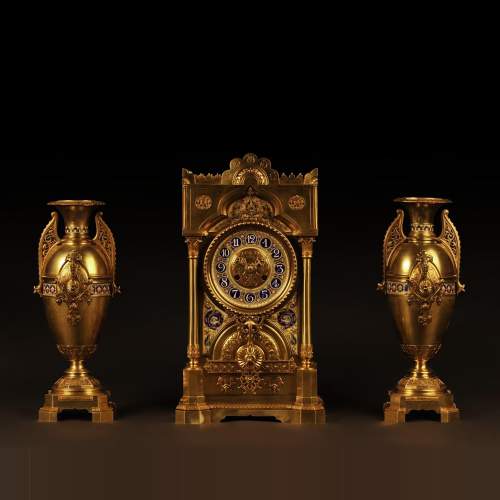
Polished and varnished bronze, polychrome porcelainThis exquisite orientalist mantle garniture was inspired by an eclectic range of decorative source materials and is characteristic of French works of art produced in the 1880s. Fashioned in gilt-bronze and ornamented with porcelain polychrome plaques decorated with vegetal scrolls and cartouches inspired by Iznik enamels, the clock takes the form of a piece of miniature architecture. The clock face is framed by two columns whose capitals support an open foliated pediment directly inspired by Islamic monuments. The clock is accompanied by a pair of vases of Byzantine form, the sides of which are encircled with a porcelain band that echoes the clock’s decoration. The body of the vases is also ornamented with chased bronze of the highest quality. This beautifully chased bronze work comprises palmettos of stylized organic shapes and delicate scrollwork. Certain of the bronze elements are executed in openwork, such as the handles of the vases.    Although not signed, this garniture is inscribed “Paris” under the face of the clock, indicating that this exceptional piece was the work of a French manufacturer. Created around 1880, this set is characteristic of the taste for eclecticism, the divergent sources used and the wide ornamental vocabulary taken from many different periods and continents that created this arresting and original work of art. 

Dimensions:
Width: 22 cm
Height: 43 cm
Depth: 13 cm

Joseph Chéret (1838 - 1894) for the Manufactory of Sèvres "Putto with greek masks" Coin tray made in faience with a blue glaze

Ref.15462
Joseph Chéret (1838 - 1894) for the Manufactory of Sèvres "Putto with greek masks" Coin tray made in faience with a blue glaze

This coin tray was made in blue glazed faience in the 19th century by the manufacture of Sèvres, after an artwork of Joseph Gustave Cheret (1838-1894). This sculpture represents a putto with two Greek comedy masks. The first one, sitting at its foot, is a woman's mask of a courtesan called 'pseudokoré'. The putto is holding the other one in his arms, it is the mask of a bearded man called 'pornoboskos'. The putto is partially covered with a drape. At his feet are severals musical instruments : a flute, some bells and a tambourine, with the signature 'Joseph Cheret Saw'. Another mark 'CH FICQUENET. - Sevres' is on the side. Cheret is an important sculptor of the 19th century. He was trained by the famous Carrier-Belleuse. This very gifted student eventually married one of the daughters of his mentor in 1868. From 1863 he regularly presented works in different Fairs and Exhibitions. We owe him the first salamander design, which he realized in collaboration with the Chaboche Company. This object is inspired by sculptures depicting putti or young satyrs having fun with Greek comedy masks. Very popular in the imperial Rome period, these images are experiencing a revival during the Renaissance and then in the 19th century during eclecticism. It is particularly representative of the 19th century taste, especially by its material: a blue glazed faience. At that time, ceramic techniques were very popular. This blue can be compared to 'Deck blue', used by Théodore Deck at the same time.

Dimensions:
Width: 25 cm
Height: 63 cm
Depth: 27 cm

Maison SORMANI, Luxurious writing set in mahogany, ebony and ivory marquetry

Ref.11536
Maison SORMANI, Luxurious writing set in mahogany, ebony and ivory marquetry

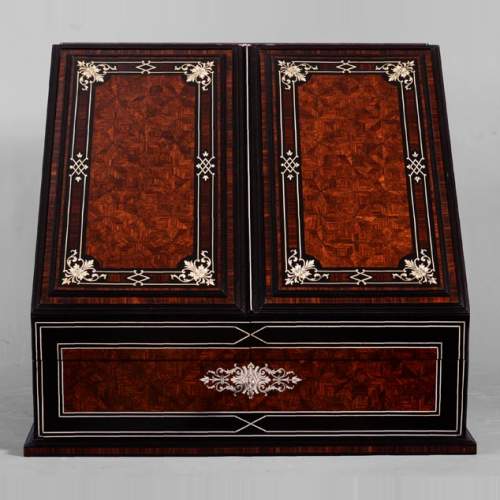
This luxurious writing set was made by the great Maison Sormani around 1875, as indicated by the calendar and the signature « Veuve P. Sormani & Fils, 10 r.Charlot PARIS ». Indeed, this signature is used between 1866, the year Paul Sormani died, and 1886, the year Paul-Charles Sormani took over the company on his own. The Maison Sormani is considered one of the greatest luxury manufacture during the Second Empire and until the beginnings of the 20th century. One of the reasons to their success is that the Impress, Eugénie, used to decorate her palaces with the creations of the house. The lattest was founded by Paul Sormani (1817-1866), who was born in Italy, but settled his shop in Paris as soon as 1847. He initially concentrated himself on small, fancy pieces, exploiting the techniques of marquetry and leatherwork, before specialising himself in the reproduction of ancient furniture often due to the greatest cabinetmakers of the 18th century, which could be found in particuler in the royal furniture store. Paul Sormani entered all the World’s Fairs that punctuated the second half of the 19th century, wining twice a silver medal in 1855 and 1867, and once a bronze one in 1862. After his death in 1866,his wife and his son Paul-Charles (1848-1926) took over his activity under the corporate name « Sormani Veuve Paul et Fils » (meaning, « Sormani widow Paul and sons ») until 1886, when Paul-Charles became the only director. The workshops of the 10, rue Charlot used to employ about a hundred of workers, amongst them leather craftsmen, goldsmiths, cabinetmakers, etc. and collaborated with famous artists, like the designer and cabinetmaker Edouard Lièvre (1828-1886) for some pieces of furniture. The house’s success remains constant as testified by the participation to the World’s Fairs of 1878, 1883 and 1889, where it was awarded respectively a gold medal, the Diplôme d’honneur and the Grand Prix. In 1914, Paul-Charles Sormani associated himself with Thiebault Frères, creating the Thiebault-Sormani firm settled at the 134, Boulevard Haussmann, and which production was characterised by high quality pieces in the Louis XV and Louis XVI styles. The firm closed in 1934. Our writing set is characteristic of the luxuous production of marquetry of the Maison Sormani. With a sumptuous mahogany and ebony marquetry adorned with refined ivory patterns, the angled chest opens itself through two frontal doors, discovering plenty of small compartments with serrated edges where one was supposed to put the letters, paper and ink pot. The left door leaf is lined with electric blue velvet, and thought in order to welcome all the small tools with their ivory handles necessary to write a correspondence, such as a seal or a dip pen. Meanwhile, the right door leaf retains a calendar dating back from 1875, and a piece of paper on which some inscriptions are still legible. Underneath is a drawer locked with a key, allowing to keep the correspondences safe.

Dimensions:
Width: 41 cm
Height: 37 cm
Depth: 31 cm

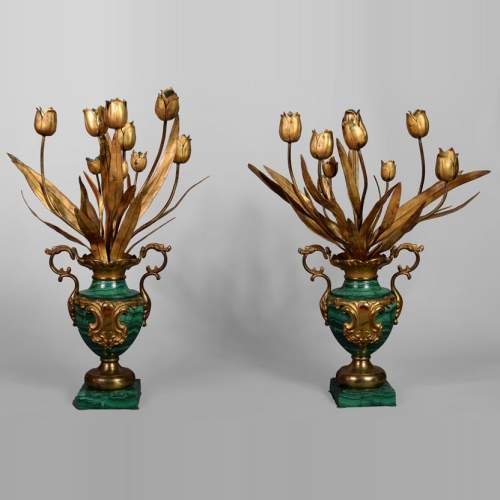
Pair of vases in malachite and gilt bronze, Russia, late 19th century

Ref.13299
Pair of vases in malachite and gilt bronze, Russia, late 19th century

This beautiful pair of vases was made of gilt bronze and malachite. It's very likely a Russian work from the end of the 19th century. The belly of our vases was made of malachite and welcomes a Rococo style decoration of gilt bronze. The whole decoration was made of gilt bronze, like the handles which are also reminding of the Louis XV style as they are shaped of thin acanthus leaves scrolls, or even the neck where are attached the handles and the foot. Finally, from the neck a beautiful gilt bronze tulips bouquet springs while the vase rests on a small malachite square base. The malachite, is an intense green stone because of its high copper composition, which makes it very appreciated in the 19th century. This stone mainly comes from Russia where important deposit are known since the 17th century, we can name the one called Nijni Taguil, discovered in 1835 and exploited by the Count Demidoff (1812 - 1870). Used in bloc to create small objects, the malachite can't be used for big pieces as the ones we can make in marble. That's why the technic called “Rusian mosaïc” was invented during the second half of the 19th century : malachite strips are inlaid to create the illusion of a block , allowing to put this extraordinary color on walls, columns or other interior elements like in the Malachite Room in the Winter Palace in Saint Petersburg. It's the Royal stone manufactory of Peterhof and Ekaterinbourg that develop this art which quickly seduces the aristocracy. This technic is discovered in France when Alexander I of Russia (1777 - 1825) gifted Napoléon Ier (1769 – 1821) a set of malachite element in 1808. Candelabras, big vases and basins are placed in the Emperor Room in Trianon, which became the “Malachite Room”. The new beauty of this sophisticated art creates an important enthusiasm which lasts during the entire 19th century.

Dimensions:
Width: 38 cm
Height: 61 cm
Depth: 23 cm

CRISTALLERIE  DE BACCARAT, Neo-Greek, krater-shaped vase, made out of coated crystal, and etched through hydrofluoric acid, 1867 World’s Fair

Ref.13171
CRISTALLERIE DE BACCARAT, Neo-Greek, krater-shaped vase, made out of coated crystal, and etched through hydrofluoric acid, 1867 World’s Fair

This krater-shaped vase made out of coated crystal is a work from the Baccarat crystal-glass making factory, between 1862 and 1867, year when similar models were displayed at the Parisian World’s Fair. It is the Baccarat manufacture’s second entry, the first being at the first Parisian World’s Fair of 1855. Baccarat does win a gold medal, in particular for two vases made out of ruby red crystal, and a crystal fountain of seven meters high. Created under Louis XV’s reign, the crystal-glass making factory got its international fame through its participations, all along the 19th century, and until 1937, to the World’s Fairs.he works of the manufacture are scarcely signed between 1764 and 1860, year where the first labels did appear punctually. Fifteen years later, a seal with the name of the firm is placed on some blowing models and gilded bronze pieces. It is not until 1936 that the « BACCARAT » brand, with a carafe and two glasses, started appearing systematically on every production. During the 1867 World’s Fair, Baccarat inspired itself from the Bacchus cult for most of its production. We can see in our vase the influence of ancient ceramics through the shape of a krater – a piece of ceramics used by Greeks to dilute wine with water – as well as in the composition and the decoration’s subject. The latest is engraved thanks to hydrofluoric acid, a technical mastered by the German chemist Louis Kessler in 1855, who did improve the chemical formula of the bath to make it less aggressive and thus, less dangerous. Baccarat bought the patent in 1864, allowing the manufacture to diverse its production and to reach a new level of virtuosity. Detaching themselves from an opaque, white background, pink colored figures are represented in the spirit of ancient decorations on ceramics. We can see on one face a maenad wearing a spinning drapery, holding a drinking cup in one hand and a thyrsus in the other – a stick similar to a scepter and crowned with a pine cone, Dionysus’s attribute. On the other side, two figures are placed face to face, a masculine and a feminine one. They might represent the divine couple of Dionysus and Ariadne : she is sat on an ancient seat, richly dressed, and addressing the half-naked young man that is also carrying a thyrsus. In order for this decoration to be perfect, the two figurative scenes are framed with different patterns : palm motif, interlacing, Greek key frieze and laurel leaves.The handles have been realized after : they were shaped in clear crystal, and then adorned with gold painting applied with a brush. Even if, until today, our vase is the only one known showing this krater shape and the color rose, other similar models, with similar decorations, does exist – in particular in blue and yellow. Moreover, this bacchanal scene on an opaque white background have been applied on other pieces produced by the firm, that can be seen in museums’ collections, such as the Corning Museum of Glass, the Chrysler Museum of Norfolk, the Musée d’Orsay or at the Petit Palais.

Dimensions:
Width: 31 cm
Height: 25 cm
Depth: 25 cm

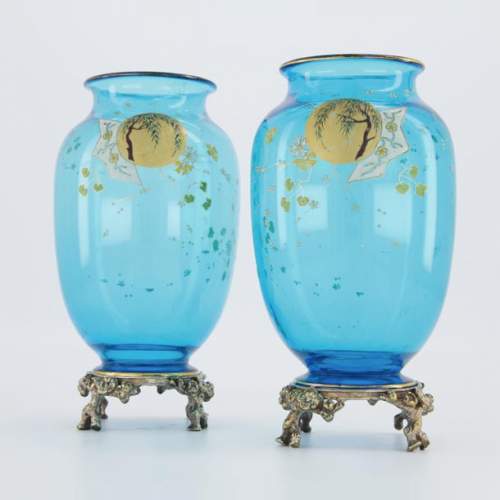
BACCARAT CRISTALLERIE and Eugène ROUSSEAU (model by), Pair of vases « Clair de Lune » in blue crystal and gilt bronze mount, circa 1875-1890

Ref.13481
BACCARAT CRISTALLERIE and Eugène ROUSSEAU (model by), Pair of vases « Clair de Lune » in blue crystal and gilt bronze mount, circa 1875-1890

This pair of blue crystal vases with hot-enamelled decoration is mounted in a gilt bronze base representing branches of cherry blossom. These vases were produced by the Baccarat crystal works between 1875 and 1890 after a design by Eugène Rousseau (1827-1890). This is the « Clair de lune » (Moonlight) model, whose Japonisant decoration depicts a weeping willow set within a full moon. The neck and the base are highlighted with a fine gilded line. The two vases are presented on a gilt bronze mount with four feet representing branches of cherry blossom. François-Eugène Rousseau (1827-1890), known as Eugène Rousseau, was a master glassmaker established from 1855 as a dealer specialising in porcelain and faience in Paris. In 1867, having developed an interest in Japonisant motifs, Eugène Rousseau commissioned Félix Bracquemond to produce a porcelain service intended for display at the Universal Exhibition in Paris, where for the first time a European artist directly copied a Japanese artist, reproducing animal figures from Hokusai's Manga. His Japonisant glassware, produced with the probable collaboration of the Appert brothers at Clichy and the Baccarat crystal works, was presented in 1874 in Paris at the fourth Exhibition of the Union centrale des Beaux-arts appliqués à l'industrie. A member of the Union centrale des Arts décoratifs from its foundation in 1862, Eugène Rousseau was awarded the cross of the Légion d'honneur. The Baccarat crystal works owes its international renown to its participation throughout the nineteenth century and up to 1937 in the Universal Exhibitions. It was during the nineteenth century that the manufactory distinguished itself in the eyes of the world through the excellence of its production and its constant pursuit of innovation. Its creations long influenced European glass and crystal manufactories and set the standard in terms of technique of execution and stylistic models. The works of the crystal manufactory were very rarely signed before 1860, the year in which the first labels appeared sporadically, and fifteen years later the stamp bearing the name of the crystal works on certain blown models and bronze parts.

Dimensions:
Width: 13 cm
Height: 23 cm
Depth: 13 cm

Gallé for l'Escalier de Cristal, Ceramic covered pot adorned with a Foo dog on the lid taking the traditional shape of Chinese perfume burner, circa 1870

Ref.13576
Gallé for l'Escalier de Cristal, Ceramic covered pot adorned with a Foo dog on the lid taking the traditional shape of Chinese perfume burner, circa 1870

This ceramic pot with a lid takes the shape of a traditionnal Chinese perfume burner without having the function as it is not pierced. It was made by Charles Gallé (1818 – 1902) or his son Emile (1846 – 1904) for the maison l'Escalier de Cristal in the second half of the 19th century and more precisely in the 1870's as indicates a torn label under a similar perfume burner on which we can read the names Pannier et Lahoche and the address of the store from 1872. We can think this ceramic imitating a perfume burner Nous pouvons was made by Gallé as a similar model, with an identical shape but a different decor, is indexed in the Emile Gallé collection of the Musée d'Orsay, and bearing his signature. Emile Gallé was making ceramics with his father Charles Gallé for the Saint-Clément earthenware factory from 1864 and was part of the many artists that have made models for the maison l'Escalier de Cristal. Thus, it seems very liekly that his father could have done it too. Our ceramic, by its decor, testifies the taste for the Chinese art and the way they have inspired the creation of European art objects. Indeed, as for many artists, the Chinese esthetic has marked the production of l'Escalier de Cristal. Thus, the Parisian artists have been asked by the store to produce works in the Chinese style by intrepeting the models and adapting them to the European taste. Our perfume burner rests on three feet. The belly is adorned with a frieze, as the birth of the neck on which we can see a Ruyi frieze. The neck is adorned with a Ba gua trigram - fundamental philosophical concept of the Old China - and flanked with two curved handles. The lid takes the shaped of Foo dog.

Dimensions:
Width: 55 cm
Height: 66 cm
Depth: 36 cm

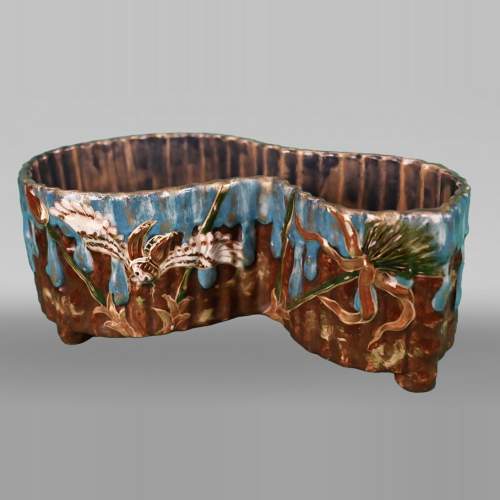
Émile GALLÉ, Jardiniere with a design inspired by the nature of Pharaonic Egypt, circa 1879-1890

Dimensions:
Width: 26 cm
Height: 17 cm
Depth: 15 cm

Gabriel VIARDOT, Japanese style support unit with bouquet, 1888

Ref.13397
Gabriel VIARDOT, Japanese style support unit with bouquet, 1888

This piece of furniture and display was made by Gabriel Viardot in 1888, at the height of his career. A talented wood sculptor, Gabriel Viardot opened a furniture factory and store in Paris in 1853. In the 1870s, he decided to devote himself to “Chinese-Japanese furniture”. He obtained a silver medal at the Universal Exhibition in Paris in 1878, then the gold medal at the International Exhibition in Antwerp in 1884, and at the Universal Exhibitions in Paris in 1889 and 1900. This piece of furniture, although adapted to European uses, is part of Viardot's Sino-Japanese production. Its base is pierced with geometric scrolls forming a heart in the center. The door is decorated with an exceptional Japanese panel from the Meiji period (1868-1912). It is decorated with a still life combining bas-relief and mother-of-pearl inlay. This representation is characteristic of Japanese art of this period. It has many stylistic and technical similarities with this other panel from the Meiji era. One of the short sides is decorated with a bamboo in bloom accompanied by an inscription made of characters chosen for their aesthetic appearance, probably taken from Japanese prints. The other is carved with mistletoe branches. The crown of the piece of furniture is inspired by Far Eastern architecture and is decorated with a roaring lion. Viardot's signature is on the right side of the piece of furniture, in the lower part. The stamp and the date, rarely indicated, which is indicative of the value of this piece of furniture, are on its left side. Gabriel Viardot created a small Japanese style cabinet known by an old drawing, the upper part of which, more especially the crowning, is very close to that of this piece of furniture.
Dimensions:
Width: 85 cm
Height: 132 cm
Depth: 54 cm

Robert LALLEMANT, "High Jump" Vase, 1930

Ref.15278
Robert LALLEMANT, "High Jump" Vase, 1930

This vase was made in 1930 by Robert Lallemant on the occasion of the Grand Prix of the Stade Français. The ceramicist and decorator Robert Lallemant (Pau, 1902-Davos, 1954) attended the École des Beaux-Arts in Dijon before becoming interested in ceramics between 1921 and 1923. In 1926, his father, Théophile Lallemant, bought him a small ceramics factory in Paris; he managed the business until his death in 1928, which explains the presence of his initial in the signature on our vase, under its base: “T. R. Lallemant”. Robert Lallemant quickly invented a modern and original ceramic style, which he produced in small series. His work was well-received by critics at the Salons des Artistes Décorateurs and the Salons d’Automne in 1926, 1927, and 1928. He was among the founders of the Union des Artistes Modernes (UAM) in 1929. A few years later, he gradually lost interest in ceramics to produce furniture, and then got involved in his father-in-law’s public works business. In 1939, he joined the French Navy, and in 1945 and 1946, he went to Indochina, where he showcased his talents as a photographer. Among other popular themes in the 1920s and 1930s, Lallemant particularly focused on sports, producing several vases on this subject; he was a sportsman himself. Our vase reflects the influence of Art Deco on his work, notably with the stepped shoulders that frame it and its geometric shapes. At the center, an athlete is dynamically depicted in a high jump event. The decoration is characterized by a certain simplification of shapes and colors, aligning with contemporary painting trends. The glaze is brilliant and of high quality. The inscription at the base of the decoration indicates that this vase was commissioned to serve as a trophy for the winner of the high jump event at the 1930 Grand Prix of the Stade Français. Other vases of the same model, without this inscription, were also created by the same artist; the decoration of one of them represents a pole vault event in a style very similar to that of our “High Jump” vase. A photograph from the artist’s archives shows the importance of the sports theme in his work; it depicts a vase of the same shape as ours, decorated with cross-country runners. This photograph also shows that the same decoration could be adapted to different vase shapes.

Dimensions:
Width: 20 cm
Height: 22 cm
Depth: 8 cm

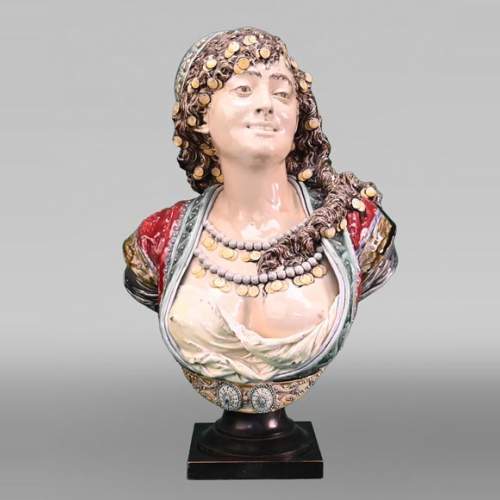
Albert-Ernest CARRIER-BELLEUSE, CHOISY-LE-ROI Manufacture, Bust of an Oriental Woman in glazed earthenware

Ref.14966
Albert-Ernest CARRIER-BELLEUSE, CHOISY-LE-ROI Manufacture, Bust of an Oriental Woman in glazed earthenware

This bust was created by Albert-Ernest Carrier-Belleuse for the Choisy-le-Roi faience factory in the second half of the 19th century. Albert-Ernest Carrier de Belleuse, known as Carrier-Belleuse (1824-1887), was the most prolific sculptor of the Second Empire. He was quickly influenced by the importance of decorative arts and worked with Ferdinand Barbedienne on the creation of decorative objects. He achieved great success at exhibitions and received numerous official commissions. He produced many busts of beautiful and elegant young women, including a Bust of a Woman Wearing a Diadem held at the Orsay Museum. He also provided bust models for the Choisy-le-Roi Faience Factory, where his son later became the artistic director. This bust of an oriental woman, created from an original sculpture signed by Carrier-Belleuse, was made for this manufactory. Titled The Bust of an Algerian Woman, it was auctioned at Sotheby’s in 2017. It is one of his rare orientalist works. The desire to depict a woman in oriental costume aligns with the idealization evident throughout the sculptor's work. The smiling woman shows her teeth. Her long, loose hair, adorned with multiple sequins along the edges, rests on her shoulder and is topped with a hat featuring orientalist motifs. Her bare chest, partially covered by a crumpled fabric and accentuated by the two rows of her necklace, exudes great sensuality. The colorful costume draping her shoulders is highlighted by the vivid colors and brilliance of the faience. At the base of the bust, a gilded belt emphasizes the richness of the costume. The bust is signed on the back and bears the mark of the Choisy-le-Roi manufactory.

Dimensions:
Width: 22 cm
Height: 76 cm
Depth: 22 cm

BOCH Frères, Art Nouveau Vase in Iridescent Faience Decorated with a Toad and Mushrooms, late 19th century

Ref.14914
BOCH Frères, Art Nouveau Vase in Iridescent Faience Decorated with a Toad and Mushrooms, late 19th century

This iridescent faience vase with a toad and mushroom motif was created by the Boch Frères manufactory in the late 19th century. In 1841, Eugène and Victor Boch founded a fine faience manufactory called Kéramis in La Louvière, Belgium. The faience factory quickly flourished and diversified its production, adapting to the stylistic and technical evolutions of the time. This particular vase is emblematic of the Art Nouveau movement, as evidenced by its asymmetrical design directly inspired by nature: the body of the vase takes the form of a tree stump. Wider and rounded at the base due to roots seemingly ready to plunge into the earth, it rises to a certain height before ending with an irregular rim. Several mushrooms, among which an agaric, grow on it, and a toad climbs at the base of the stump. The vase features an iridescent glaze transitioning from pink to violet, lightening to white on the mushrooms and darkening to brown on the toad. This glazing demonstrates the high level of mastery achieved by certain artists and the most important manufactories at the end of the 19th century. The mark under the base indicates that the manufactory had a subsidiary in Thiais, in the Seine department. A vase of the same shape but with a slightly different glaze – where pink blends with yellow-orange, green, and blue (and the toad appears black) – was noted by expert Alain Cical.

Dimensions:
Width: 20 cm
Height: 34 cm
Depth: 13 cm

Auguste LEDRU (sculptor) and Émile COLIN (editor), Large Stoneware Vase with Masks and Gilt Bronze Female Figures, circa 1902

Ref.13929
Auguste LEDRU (sculptor) and Émile COLIN (editor), Large Stoneware Vase with Masks and Gilt Bronze Female Figures, circa 1902

This beautiful stoneware vase with gilt bronze ornaments was designed by the sculptor and ornamental designer Auguste Ledru and edited by the bronze manufacturer Émile Colin in 1902, the year the plaster model was presented at the Salon of the Société des Artistes Français under number 4065. Auguste Ledru (1860-1902) was a student of Dumont, Bonnassieu, Thomas, and Boisseaux. He also worked with his father, also named Auguste Ledru, who was a sculptor and ornamental designer like him. He regularly participated in the Salon of the Société des Artistes Français between 1883 and 1902, the year of his death. In 1892, he won an Honorable Mention, in 1894, a third-class medal, and in 1896, a second-class medal with his brother-in-law René Lalique (1860-1945). Auguste Ledru also collaborated with publishing houses such as Maison Susse, Thiébaut Frères, and Émile Colin, as was the case for our vase. The Colin house, which initially practiced plaster molding, became known as a bronze manufacturer from 1855 onwards. It published works by the greatest masters of French sculpture, such as Albert-Ernest Carrier-Belleuse (Le Zouave), Jean-Baptiste Carpeaux (L’Enfant au Cor), and the Parisian goldsmith Christofle. It is also known for lighting fixtures adorned with bronzes. The house participated in the 1891 Chicago World’s Fair and won a Grand Prix at the 1900 Paris Exposition thanks to style lighting fixtures modeled by Léon Méssagé. From that date, its production seemed to focus on contemporary art bronze, abandoning classical editions. This very original vase with a wide body features a stoneware decoration developing around two masks, whose hair and beard transform into foliage on either side. These vegetal and abstract lines characteristic of Art Nouveau create a play of light relief across the entire vase. At the top, two gilt bronze female figures, with their feet on the body and their hands on the neck, form handles. The vase is signed “Ledru” on the body. The Musée d’Orsay in Paris possesses a large jug with an ornamentation similar to our vase. Indeed, the spout is adorned with a mask and a nude female figure reminiscent of the handles on our vase.

Dimensions:
Width: 55 cm
Height: 70 cm
Depth: 45 cm

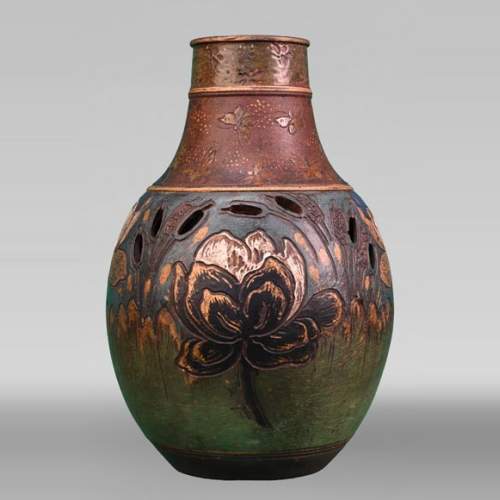
Ernest CHAPLET for the HAVILAND manufacture, Vase with aquatic plant decoration, circa 1880

Ref.15042
Ernest CHAPLET for the HAVILAND manufacture, Vase with aquatic plant decoration, circa 1880

This vase was executed by Ernest Chaplet for the Haviland & Co. manufacture, as evidenced by the mark “H&Co” surrounded by a chaplet incised under the base. Merchant David Haviland (1814-1879) initially created an import business of earthenware and porcelain with his elder brother in 1838 in New York, Haviland Brothers. In 1842, he founded his own porcelain manufacture in Limoges. He was awarded a gold medal in 1853 in New York and received a silver medal at the World Fair in Paris in 1855. The greatest artists, including Ernest Chaplet, worked for his company, which was taken over by his descendants. Ernest Chaplet (1835-1909) first learned stoneware work in Normandy. Then, employed by Haviland & Co. in Limoges, he opened a workshop in Paris. He became independent in 1885, then sold his workshop to Auguste Delaherche in 1887. In 1888, he settled in Choisy-le-Roi and dedicated himself to researching copper reds and flamed porcelain. Around 1900, he focused his production on thick flamed porcelain. In the 1880s, Chaplet primarily produced brown stonewares decorated with colored clays and incised motifs, like our vase. The incisions reveal the underlying stoneware color, while the colored and gilded clay decorations provide great luminosity to the design. The decoration evokes aquatic flora: two large lotus flowers surrounded by reeds stand out against a green and blue background reminiscent of the water’s edge. Above, a swarm of butterflies hovers over the scene. The color variations add to the relief effects created by the artist through the addition or incision of material. The vase bears the number 83, next to the inscription BR 2/2. A very similar vase, with its simple form and technique, decorated with flowers and arrowhead leaves, is in the Musée d’Orsay in Paris.

Dimensions:
Height: 26 cm

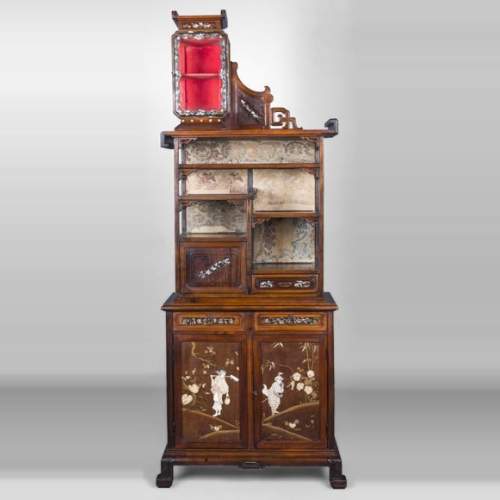
Gabriel VIARDOT, Japanese-Style Shelf Cabinet, late 19th Century

Ref.15090
Gabriel VIARDOT, Japanese-Style Shelf Cabinet, late 19th Century

This shelf cabinet was crafted by Gabriel Viardot in the late 19th century. A talented wood sculptor, Gabriel Viardot opened a furniture workshop and store in Paris in 1853. In the 1870s, he decided to focus on “Chinese-Japanese style furniture”. He received prestigious awards at the Universal Exhibitions in Paris in 1878, 1889, and 1900, as well as a gold medal at the International Exhibition in Antwerp in 1884. This piece, serving as both a cabinet and a display stand, belongs to Viardot’s Sino-Japanese style production. Its four legs, shaped as stylized scrolls, support an asymmetrical structure. The lower left section features shelves inspired by Japanese “cha’dansu” (tea cabinets). It is adorned with a dragon seemingly weaving through a panel at the bottom, a recurring motif in Viardot’s work. At the top, the last shelf is supported by a delicate sculpture of a crane perched on a turtle. The right section consists of a cabinet on a stand, decorated with a panel showcasing rich low-relief carvings. Stylized flames and smoke swirls intertwine with highly realistic flowers. A Japanese panel from the Meiji era (1868-1912), depicting a basket of flowers, was included after a delicate cutting process. The small left side is adorned with Japanese maple leaves, while the right side features a flower. Gabriel Viardot’s signature can be found just below, on the lower crosspiece. A very similar version of this cabinet is depicted in an old sketchbook by the artist. Notably, the crane supporting the shelf and the tiered supports above the dragon on the left are present, although their orientation is reversed.

Dimensions:
Width: 102 cm
Height: 180 cm
Depth: 41 cm

Gabriel VIARDOT, Japonist bed with a canopy and accompanying nightstand, second half of the 19th century

Ref.15445
Gabriel VIARDOT, Japonist bed with a canopy and accompanying nightstand, second half of the 19th century

Nightstand : H. 81 cm / 31’’ 7/8 ; L. 59 cm / 23” 1/4 ; P. 38 cm / 14” 15/16 This set of a Japonist bed and nightstand was crafted by Gabriel Viardot in the second half of the 19th century. A talented wood sculptor, Gabriel Viardot opened a furniture workshop and store in Paris in 1853. In the 1870s, he decided to dedicate himself to “Chinese-Japanese style furniture”. He received prestigious awards at the Universal Exhibitions in Paris in 1878, 1889, and 1900, and won a gold medal at the International Exhibition in Antwerp in 1884. The foot of the bed features carved ornamentation in low and very low relief, inspired by Far Eastern art: on the left, a dragon moves across a geometric structure that extends beyond the frame in which it is inscribed, while on the right, a second frame houses a delicate mother-of-pearl marquetry depicting a sakura (cherry blossom) branch, accompanied by a bas-relief sculpture of a flowering branch mirroring the dragon. The contours display ornamentation characteristic of the artist: the feet are adorned with geometric scrolls, while the top mimics the shape of a cloud. The headboard is topped with two birds fluttering near a sakura branch, surmounted by cloud or smoke scrolls. On either side, there are panels inlaid with mother-of-pearl from the Far East. Four columns rise from the headboard, connected in pairs by an openwork design typical of Viardot’s style. On the left, a sakura branch seems to sprout from one of the two columns, first spreading between them, then into the central space, giving the piece a beautiful asymmetry. The canopy is also adorned with openwork motifs. The two top beams curve upwards at each end to evoke the roof of pagodas. At the front, another blossoming cherry branch harmoniously integrates into the central openwork design. The nightstand rests on four lion paws. It features asymmetrical open shelves reminiscent of Japanese “cha’dansu” (tea cabinets). One of these, covered with white marble on the inside, is closed by a lacquer panel, imported during that period to Europe. At the top, the small drawer, equipped with a decorative handle, displays an engraved bamboo leaf motif, while the sculpted tabletop is raised on one side and lowered on the other, a layout characteristic of the artist’s creations. The nightstand is also signed, a rare occurrence in Viardot’s work, indicating the exceptional care he took in crafting this piece. With this set, Gabriel Viardot follows one of the conventions of Japonism that developed in Europe from the 1870s: he adapts ornamentation inspired by Far Eastern art to an eminently European structure, as both the bed (especially when equipped with a canopy) and the nightstand are furniture pieces that do not exist in Far Eastern culture. One of the drawings found in Viardot’s archives depicts a canopy bed very similar to this one; the posts of the canopy and their ornamentation are quite similar, as is the overall shape of the bed, and much of the ornamentation shows numerous similarities.

Dimensions:
Width: 159 cm
Height: 251 cm
Depth: 213 cm