Cailar, Bayard et Cie – Table Centerpiece with Native American Figures
After the model of the one made for Count Grigori Koucheleff-Besborodko — Antwerp Exhibition of 1885, Paris Universal Exhibition of 1889
This table centerpiece with Native American figures was made by the silversmith firm Cailar, Bayard et Cie before 1885. It was shown at the International Exhibition of Antwerp in 1885, where the firm was awarded a gold medal, and at the Paris Universal Exhibition of 1889, where it received a silver medal.
The firm of Cailar, Bayard et Cie was founded in 1848 by Noël Cailar, a metals merchant who bought out the assets of the Association des ouvriers cuilleristes (spoon-makers' association) and went into partnership with the silversmith Bayard. By 1889 the factory employed 200 workers and produced nickel-based silver-plated flatware; it exported its output mainly to Argentina, Spain, Egypt and Turkey1. The firm took part in the Universal Exhibitions of 1867, 1878, 1885, 1888, 1889 and 1900, at which it received numerous awards.
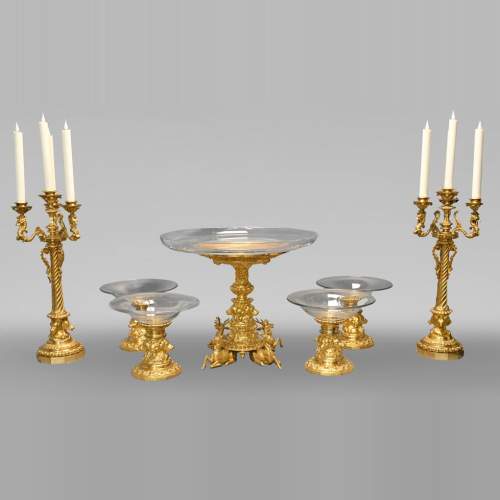
The centerpiece comprises a table centre, two candelabra and two comports.
The table centre rests on a base of complex form organised around an oval, alternating curves with straight-lined projections. The four extremities rest on supple, intertwining branches whose interlacing forms the ornamentation of the lower level. At the ends of the two long sides are two escutcheons, probably intended to receive the arms of the patron or owner of the set. On either side, at four points around the oval, tree leaves emerge and settle onto the platform of the base, whose surface is worked to suggest natural rocky ground. The pierced centre is likewise ornamented with naturalistic foliate interlacing, artfully arranged. The base carries four figures of Native Americans bearing a large turtle shell amid a growth of ferns and branches. Their features clearly derive from the kind of ethnographic study of native peoples that could be undertaken in the 19th century, yet each is deeply individualised and strongly expressive.
The first figure, with a sullen air, supports the shell with one hand and folds the other arm behind his back; he is bare-chested, though an animal skin partly covers his back, and he wears a pair of high boots reaching to the knees; a knife hangs at the front of his loincloth. A second, his features and musculature tensed with effort, holds the load with both hands. He wears his hair long, where the first wore a headdress resembling a turban. This second figure's musculature is set off by his nudity, covered only by a loincloth at the hips. A powder horn of the kind carried by Native Americans hangs from the end of a cord slung across his shoulder. A third figure, naked but for his loincloth, wears a headdress of three feathers. Back bent and knees flexed beneath his burden, he steadies the shell with one hand and rests the other on his hip. Finally, the last bearer, dressed in a loincloth with an animal skin across his back, supports the shell with both hands. Youthful in appearance, he wears four feathers in his hair and an axe at his side.
The feathers are no idle ornament: they attested to an act of courage on the part of the wearer, the way they were cut indicating which feat of bravery was meant. The more feathers, the more the warrior was respected by his peers. War chiefs were naturally chosen from among the men wearing the most imposing headdresses. Feathers also played a large part in native ceremonies. With the Wild West Show — a spectacle staging some hundred Native American warriors (including, for a time, the famous Sioux chief Sitting Bull) — Buffalo Bill helped spread the motif of the great feathered headdress as a Native American "cliché" in Europe.

The four figures described here carry a large turtle shell. Large turtles are a species found chiefly on islands. Yet the presence of this one, which may at first seem to defy all geographical logic, evokes a founding legend believed by certain Native American peoples — some Iroquois, but also the Lenape, the Sioux and the Huron — according to which the whole world rests on the back of a turtle. The turtle thus became linked to Native Americans in European iconography, as attested by a ship's stern figure preserved at the Musée de la Marine in Brest.

The centerpiece also includes two candelabra. Their base takes up the motif of the table centre's in circular form. Upon it stand two Native American warriors, again serving as bearers. One wears a simple loincloth, from the belt of which hang various accessories: a shield with several feathers attached, a gourd, an axe and a dagger. He wears a necklace of claws and, on his head, a headdress resembling a turban. According to Jean-Jacques Arnoux in L'Art contemporain, he represents the "primitive" Native American2. The other is clothed and represents the "contemporary" Native American of the second half of the 19th century. With an animal skin across his back and his legs covered by trousers, he wears moccasins and, at his side, a knife and what appears to be a quiver. With raised arms, the two men hold a basket set upon their heads, from which unfold intricate motifs of branches and clustered flowers forming the light-arms intended to hold the lights.
The base of the comports is similar to that of the candelabra. The figures represented are this time young Native American women, crouching with one leg drawn forward. Though clothed in various fabrics, their silhouette remains sensual, particularly at the breast and the bared leg; they wear a three-strand necklace. Their loosened hair frames a face with, once again, strongly marked features. The two women carry an openwork basket on their heads, serving as the bowl of the comport.
This rich ensemble is in fact a reproduction (with two fewer comports) of a solid-silver centerpiece with coloured-gold ornaments that Alexandre-Gabriel Lemonnier (1808–1884), jeweller to Emperor Napoleon III, to Empress Eugénie and to the Crown of Spain, executed after the models of the sculptor Émile Carlier (1827–1880) for Count Grigori Koucheleff-Besborodko (1832–1870), a Russian writer and patron. That centerpiece — comprising a table centre, two candelabra and four comports — was published in L'Art contemporain in 1862, with two engravings depicting one of the comports and one of the candelabra3. The work enjoyed a significant legacy: according to the Musée rétrospectif de la classe 94, it inspired Tiffany for the Native American pieces the company presented at the 1878 Universal Exhibition — such as "a mantelpiece garniture representing a Native American in a canoe"4, for example — as well as Cailar, Bayard et Cie for their centerpiece5.


This centerpiece, of which the firm seemed particularly proud, was first shown at the Antwerp Universal Exhibition in 1885: "The firm of Cailar and Bayard, of Paris, rivals the house of Christofle in the manufacture of flatware. It exhibits a complete range of table silver and articles […] in white metal, perfect in every respect. […] In its display we especially noticed a magnificent table centerpiece with Native American subjects, as well as a wide choice of tea services, cruet stands, salt cellars, etc., for which it obtained the gold medal."6
It was also published, accompanied by an engraving of it, in the firm's 1888 catalogue7.

It was shown once more at the 1889 Universal Exhibition in Paris. In an article in the Moniteur de l'Exposition de 1889, Charles Lenoir noted the firm's participation: "Silverware is represented by the firm of Cailar and Bayard, whose founding dates back to 1848 and which has since taken on considerable expansion through the manufacture of fine products […]. Here, at this Exhibition, are works of art that set one dreaming, and I am convinced that more than one visitor will have been tempted by the magnificent services and table centres displayed in the window of Messrs. Cailar and Bayard."8 The firm is also cited among the silver medallists of the "silverware" section: "We recall Messrs. Cailar and Bayard's display in 1878, and we find […] marked progress9; […] finer still was the great Native American centerpiece, to which Buffalo Bill's presence in Paris [Bufallo-Bills, sic] lent renewed topicality."10
Thus, although the centerpiece had already been shown to the public at least once before the 1889 Universal Exhibition, the presence of the famous Buffalo Bill on that occasion gave it a particular resonance — all the more so as it is entirely plausible that the American hero may have admired it in person. William Frederick Cody, known as Buffalo Bill (1846–1917), is a mythical figure of the conquest of the American West. He took part in the wars against the Native Americans and was a legendary bison hunter. The writer Ned Buntline recounted his adventures, and between 1882 and 1912 his travelling show, the Buffalo Bill's Wild West, which took him as far as Europe, further increased his fame. His presence did not go unnoticed at the 1889 Universal Exhibition, of which he was a leading figure.

This Native American centerpiece was thus one of the fine pieces exhibited by Cailar, Bayard et Cie on the occasion of two of its appearances at the great international exhibitions of the second half of the 19th century. Added to the popularity of Buffalo Bill and the success of his shows in Europe, it bears witness to the political interest — and aesthetic inspiration — that Europeans took in the American events of the earlier part of the 19th century.
- ↑ Alfred Picard, Exposition Universelle internationale de 1889 à Paris. Rapports du jury international. Groupe III – Mobilier et accessoires, Paris, Imprimerie nationale, 1889, p. 496.
- ↑ Jean-Jacques Arnoux (ed.), L'Art contemporain. Annales illustrées de la production d'élite des Beaux-Arts et de l'industrie artiste, 1st issue, Paris, 1862, pp. 23–24.
- ↑ Ibid., pp. 23–25.
- ↑ L. Bachelet, Exposition Universelle internationale de 1878. Groupe III – Classe 24. Rapports sur l'orfèvrerie, Paris, Imprimerie nationale, 1880, p. 16.
- ↑ Henri Bouilhet, Musée rétrospectif de la classe 94. L'orfèvrerie française à l'Exposition internationale de 1900 à Paris, vol. III, p. 171.
- ↑ Exposition Universelle d'Anvers 1885. Rapports des membres du jury international des récompenses, vol. II, Brussels, Typographie Alfred Vromant, 1886.
- ↑ Orfèvrerie & couverts de N. Cailar, Bayard et Cie à Paris. Tarif général, Paris, 1888, p. 106.
- ↑ Le Moniteur de l'Exposition de 1889, 2nd year, no. 82, Sunday 25 July 1886, p. 247.
- ↑ The firm had already won a bronze medal at the 1878 Universal Exhibition: see L. Bachelet, Exposition Universelle internationale de 1878. Groupe III – Classe 24. Rapports sur l'orfèvrerie, Paris, Imprimerie nationale, 1880, p. 13.
- ↑ Alfred Picard, Exposition Universelle internationale de 1889 à Paris. Rapports du jury international. Groupe III – Mobilier et accessoires, Paris, Imprimerie nationale, 1889, p. 496.